
The sight of an Orthodox Christian monk clothed entirely in black immediately raises questions for many people.
- Some see sorrow.
- Others imagine rejection of life.
- A few think it is a cultural custom without meaning.
None of these explanations are sufficient. In Orthodox Christianity, nothing within the monastic life is accidental. Every gesture, silence, prayer, and garment carries theological meaning.
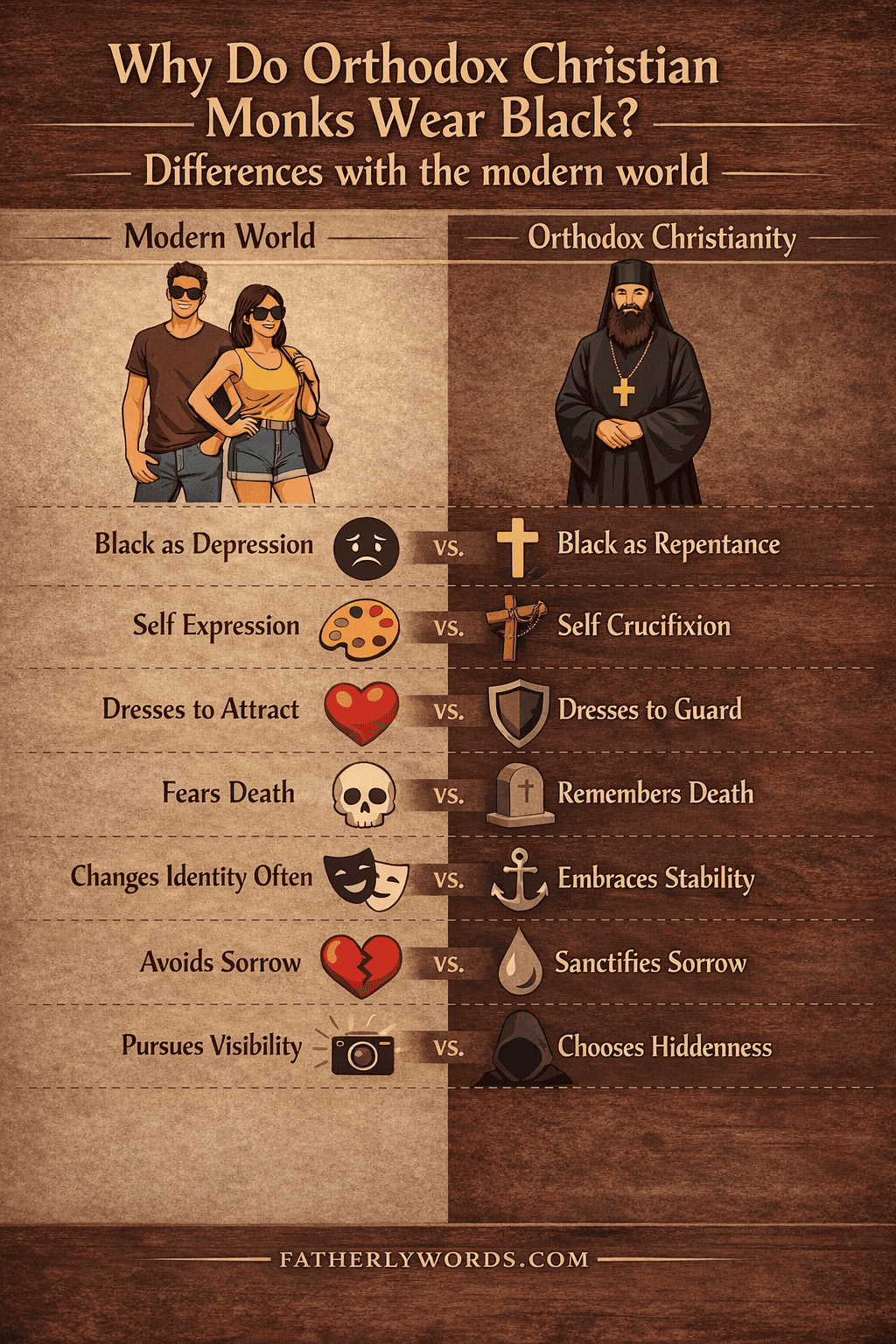
The black robe of the monk is not an aesthetic decision, nor a sign of despair. It is a confession. It is theology worn upon the body. It speaks of repentance, truth, resurrection, vigilance, humility, and hope.
To understand why monks wear black, one must understand how Orthodox Christianity views the world, death, sin, and eternal life.
Monastic clothing is not designed to impress the eyes. It is meant to remind the soul. It does not communicate individuality but crucifixion of individuality for Christ.
Black is not chosen to hide light, but to await it.

The Meaning of Clothing in Orthodox Christianity
Orthodox Christianity never treats the body as meaningless. The body participates in salvation. What the body wears shapes the soul and reveals the heart. From the very beginning, Scripture connects clothing with spiritual reality. The Book of Genesis teaches:
Unto Adam also and to his wife did the Lord God make coats of skins and clothed them.
Genesis 3:21
These garments appear after the fall. Clothing becomes a sign of mortality and mercy at the same time. God covers human shame while reminding humanity of its fallen state.
The monk accepts this truth consciously. He does not pretend innocence. He wears repentance. The Psalms of David declare:
I am clothed with humility.
Psalm 108:29 (LXX)
Here clothing becomes spiritual language. The monk’s black robe is humility made visible.
Black as the Color of Repentance
In Orthodox Christianity, repentance is not an emotion. It is a way of existence. The monk enters a lifelong state of repentance, not because he is worse than others, but because he chooses to see himself truthfully before God. The Psalmist cries:
My sin is ever before me.
Psalm 50:3 (LXX)
Black reflects this awareness. It does not accuse the world. It accuses the self.
Saint Isaac the Syrian teaches:
This life has been given to you for repentance. Do not waste it in vain pursuits.
Black clothing continually reminds the monk of this calling. It keeps the mind sober. It restrains vanity. It quiets distraction.
Black and the Memory of Death
Orthodox Christianity teaches remembrance of death as a source of wisdom, not fear. The monk lives daily with the truth that earthly life is temporary and judgment is real. The Psalms say:
Teach us to number our days that we may apply our hearts unto wisdom.
Psalm 89:12 (LXX)
Black is the color of burial. The monk dresses as one already buried. This is not morbid. It is liberating. When death is remembered, sin loses power.
Saint John Climacus writes:
He who has the remembrance of death as his daily companion will never sin willingly.
The black robe becomes a silent sermon to the monk himself.
Death to the World and Life in Christ
Monastic life in Orthodox Christianity is described as death to the world. This does not mean hatred of creation. It means freedom from passions. The Apostle Paul writes:
I am crucified with Christ.
Galatians 2:20
The monk makes this crucifixion visible. Black is the color of mourning, but here it is mourning for the old self. Christ says:
If any of you wants to be my follower, you must give up your own way, take up your cross, and follow me.Matthew 16:24
The black robe is denial made visible.
Black and Inner Watchfulness
Orthodox Christianity emphasizes nepsis, inner vigilance. Bright colors attract attention outward. Black draws attention inward. The Psalmist prays:
Create in me a clean heart O God.
Psalm 50:10 (LXX)
The monk wears black to guard the heart. He avoids stimulation that excites vanity or curiosity.
Humility Expressed Through Appearance
Monastic clothing is deliberately uniform. Black erases distinction. No monk stands above another through appearance. The Apostle Paul instructs:
In lowliness of mind let each esteem other better than themselves.
Philippians 2:3
Black refuses personal display. It removes competition.
Saint Basil the Great taught that humility must be visible in life, not hidden behind words. Clothing becomes part of this witness.
Black as a Color of Hope
Paradoxically, black also points toward resurrection. In Orthodox Christianity, burial precedes glory. Darkness precedes light. The Psalms proclaim:
Weeping may endure for a night but joy cometh in the morning.
Psalm 29:5 (LXX)
The monk lives in night awaiting dawn.
Christ Himself lay in the tomb wrapped in burial garments. The monk imitates this burial, trusting resurrection.
Black and Stability of Life Purpose
Orthodox Christianity understands monasticism as unwavering commitment. Black does not change with seasons or moods. It reflects permanence. The Apostle James writes:
A double minded man is unstable in all his ways.
James 1:8
The monk’s clothing preaches stability.
Saint Theodore the Studite emphasized that consistency of outward life supports faithfulness inwardly.
Why Monks Do Not Wear White
White symbolizes resurrection and baptism. Monks do not claim resurrection yet. They struggle daily. The Psalms say:
Wash me and I shall be whiter than snow.
Psalm 50:7 (LXX)
This whitening is hoped for, not assumed. White belongs to saints in glory. Black belongs to those still fighting.
Misunderstandings About Black Clothing
Some think monks wear black because life is joyless. Orthodox Christianity rejects this. Christ says:
That My joy might remain in you.
John 15:11
Monastic joy is interior. It does not depend on color.
Others think black rejects beauty. In truth, it rejects vanity, not beauty.
Black and the Angelic Life
Monks are called angels on earth. Angels do not seek attention. They serve silently.
Christ says:
At the resurrection people will neither marry nor be given in marriage; they will be like the angels in heaven.
Matthew 22:30
How Black Protects the Monk Spiritually
The robe reminds the monk of vows. It restrains impulses. It preaches without words. The Psalmist says:
Set a watch O Lord before my mouth.Psalm 140:3 (LXX)
Clothing participates in watchfulness.
Black and Spiritual Equality
No monk is elevated by fashion. All stand equal. The Apostle Paul writes:
There is neither rich nor poor.
Galatians 3:28
Black equalizes.
Explaining This to Little Children
Parents can say that monks wear black to remember God all the time. They can explain that black helps monks stay focused and kind. Children can learn that monks dress simply to love Jesus more. They can understand that monks wear black because they are waiting for heaven.
