
The Holy Monastery of Panagia Makellaria is one of the most historically significant monasteries in Greece, standing as a sacred monument of Orthodox Christianity and a living witness of Greek history.
Perched upon a steep rock above the Selinountas River, near the mountain village of Lapanagoi in the region of Kalavryta, this monastery blends the holiness of the Byzantine past with the unbroken Greek spirit of faith and endurance.
Through fifteen centuries, it has survived wars, destruction, and rebirth, remaining a luminous symbol of Greece’s Christian identity and devotion to the Virgin Mary.
The Founding of the Monastery
The Monastery of Panagia Makellaria traces its origins to the 6th century AD, during the glorious era of the Byzantine Empire—an inseparable part of Greek history.
It was founded in 532 AD by the legendary general Belisarius, under the reign of Emperor Justinian the Great.
According to a marble inscription still preserved in the monastery’s narthex, Belisarius built this monastery as an act of repentance after the tragic “Nika Revolt” in Constantinople, where thousands were killed. Deeply remorseful for his part in the bloodshed, he turned to the Theotokos, the Mother of God, and erected this sanctuary in her honor in the mountains of Achaia, Greece.
The monastery was originally constructed below the great rock on which it stands today.
For the early Byzantine monks who came here, it was a place of stillness and prayer, where heaven seemed to touch the rugged Greek earth. From that moment, Makellaria became part of the sacred geography of Greece, uniting the natural beauty of the Peloponnese with the spiritual beauty of the Orthodox faith.
The Meaning of the Name “Makellaria”
The monastery’s name—Makellaria—is deeply connected to the dramatic and painful events of Greek history under Ottoman rule. After the fall of Constantinople in 1453, Sultan Mehmed II invaded mainland Greece, bringing destruction to monasteries and villages alike.
In May 1458, his forces reached the area of Kalavryta and attacked the monastery, which had become a refuge for Greek Christians escaping persecution. The monks and local defenders resisted heroically, but the Ottomans eventually overpowered them, slaughtering everyone within the walls.
The cells of the monks were filled with blood, and from this came the name “Makellaria,” derived either from the Greek “aima-kellia” (blood in the monastic cells) or from the Italian “macellio,” meaning massacre.
Thus, the monastery’s name bears the memory of the blood of the Greek martyrs who fell for their faith and homeland. In this way, Panagia Makellaria is not merely a religious site—it is a sacred chapter in the long history of Greece’s struggle to preserve its Christian identity.
The Miraculous Rebuilding and the Discovery of the Holy Icon
After its destruction in 1458, the surviving Greek monks attempted to rebuild their monastery.
Around 1700, they chose a more sheltered site in a cave to protect it from the elements and future attacks. But night after night, the walls they raised collapsed.
Soon they discovered their tools had mysteriously moved to the top of the rock above. Recognizing this as a sign from the Theotokos, they climbed the steep cliff and there found a small hollow in the rock containing a clay vessel full of oil—and beside it, a sacred icon of the Virgin Mary.
The monks understood that the Panagia herself desired her monastery to be built on this high place.
When they obeyed, all obstacles ceased. The injured master builder who had opposed the decision was healed after being anointed with oil from the miraculous jar.
This was the beginning of the rebirth of the Monastery of Panagia Makellaria—a moment that entered the living memory of Orthodox Greece as a clear manifestation of divine grace.
The Miraculous Icon of the Panagia Makellaritissa
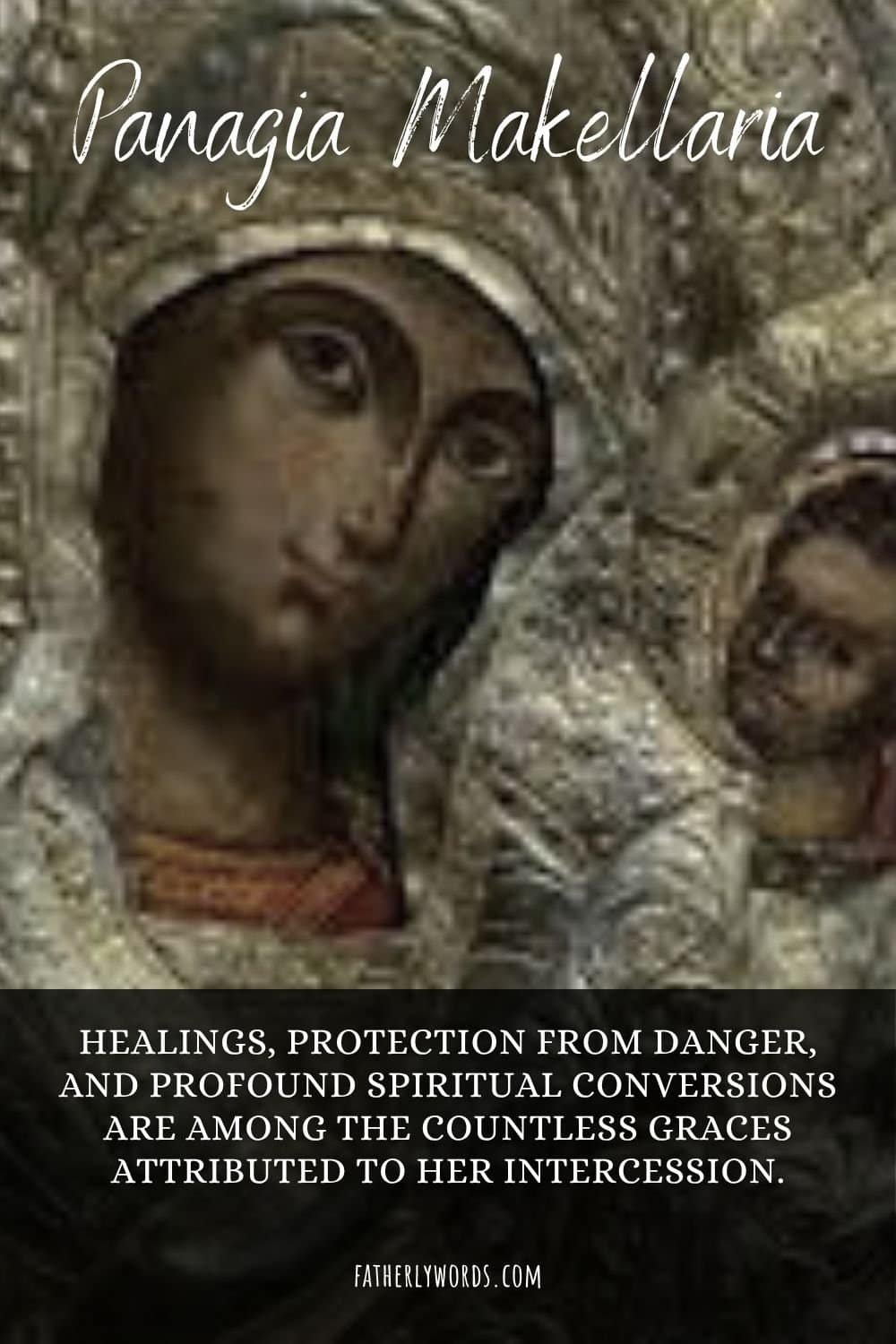
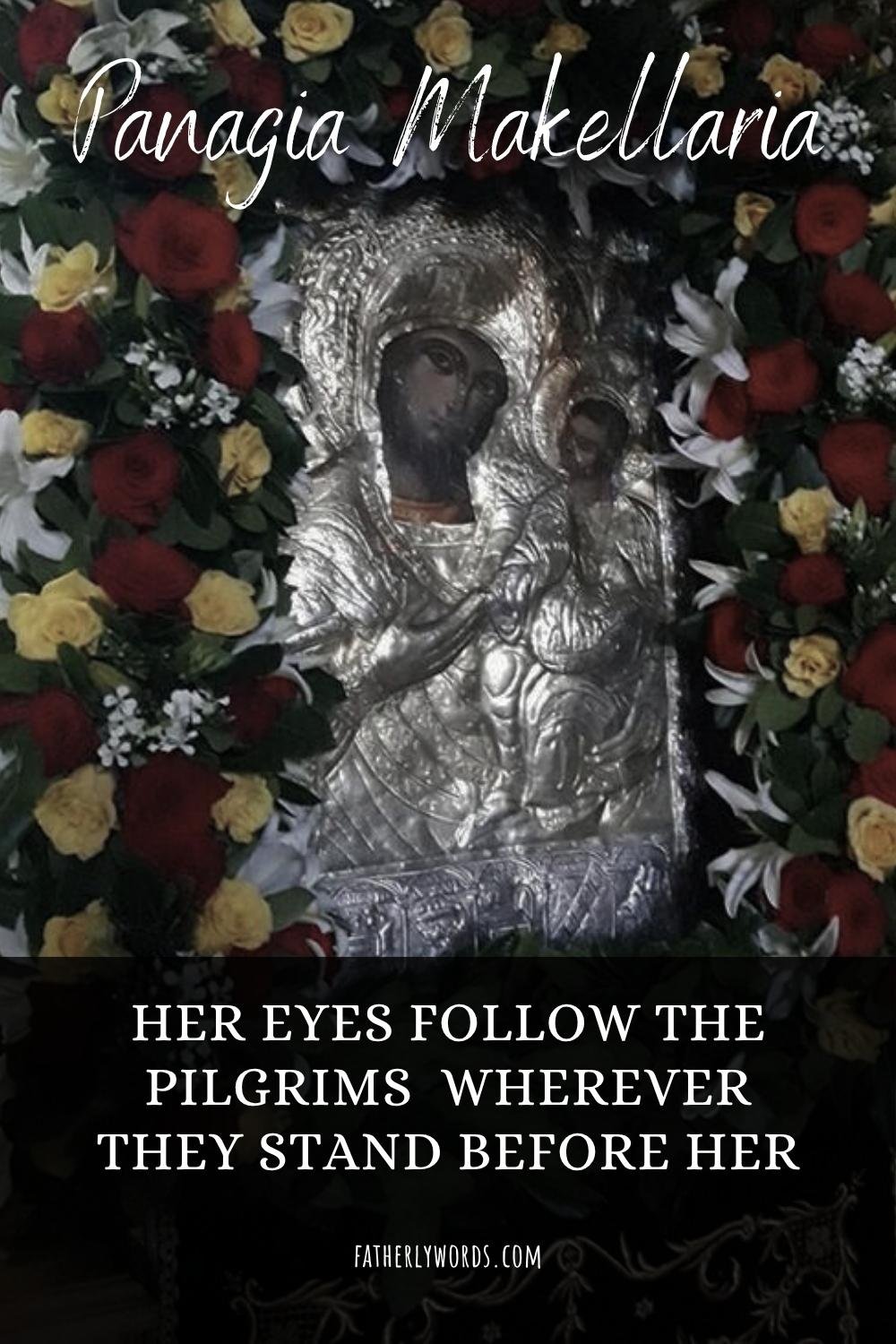
At the heart of the monastery lies its most treasured relic—the wonderworking icon of the Panagia Makellaritissa. This post-Byzantine image depicts the Virgin Mary holding the Christ Child, who blesses with His right hand.
The icon, covered with a silver riza, bears the inscription “Panagia Eleousa”—the Merciful.
For centuries, this icon has been the source of miracles witnessed by the faithful from all over Greece and abroad. Healings, protection from danger, and profound spiritual conversions are among the countless graces attributed to her intercession.
Pilgrims say that her eyes follow them wherever they stand before her, as if the Mother of God personally welcomes each visitor.
The Rebuilding and Flourishing of the Monastery in Greek History
Following its re-establishment, the monastery was renovated multiple times as part of the enduring religious life of Greece.
In 1784, Hieromonk Neophytos, assisted by the villagers of Lapanagoi and a nun named Bartholomaia, led a reconstruction effort.
In 1805, a second renovation was carried out by Georgios Lapanagitis, who built the narthex that still stands today. The marble plaque he commissioned records his offering “for eternal remembrance.”
During this period, faithful Christians from the region of Kalavryta and other parts of Greece donated sacred vessels, silver lamps, icons, vineyards, and olive groves, ensuring that the monastery would continue to shine as a beacon of Greek Orthodox piety.
The Miracle of the Unbroken Lamp
One of the most beautiful miracles associated with the monastery occurred during another Ottoman attempt to destroy it.
The abbot implored the invaders to spare the sacred place, declaring that the Virgin would reveal her power. He threw the lit vigil lamp of the icon from the cliff, promising that if it remained unbroken and still burning, the monastery must not be destroyed.
The lamp was later found hanging unbroken from a tree branch, its flame untouched.
Astonished, the Turkish commander forbade further harm.
A later internal dispute among the Turks led to a deadly battle between them—a divine sign that the Mother of God would always protect this holy site in Greece.
Decline and Revival in the Modern Era
By 1915, after the last five monks died, the monastery entered a period of decline. Yet, it was destined to rise again.
In 1949, Metropolitan Agathonikos of Kalavryta revived it, appointing Hieromonk Agathangelos Mitsioulis from Mount Athos as abbot. Through public fundraising in Aigialeia, the monastery was restored once more.
Later, in the 1970s, Archimandrite Anthimos Dritsas from the Great Cave Monastery led it into a period of renewed glory.
The monastery flourished again, drawing Greek pilgrims from every corner of the country. Many witnessed miracles, and once again, Panagia Makellaria became a light of hope in Greece’s modern spiritual landscape.
In 2011, under Metropolitan Ambrosios, a new chapter began: the monastery became a women’s convent. Today, the sisterhood, under the guidance of Metropolitan Ieronymos, continues the holy work—restoring buildings, preserving icons, and praying for the Greek people and the entire world.
Why Every Visitor Should Come to Panagia Makellaria in Greece
Panagia Makellaria is not only a historical monument; it is a living sanctuary where Orthodox Christianity breathes within the natural beauty of Greece.
Pilgrims who climb the steep road are rewarded with breathtaking views and an atmosphere filled with divine peace. Here, prayer becomes effortless, and the Virgin’s presence is deeply felt.
Inside, visitors can venerate the miraculous icon and the ancient jar of oil found during reconstruction, both symbols of faith and divine mercy. Weapons from the Greek War of Independence are also preserved here, reminding visitors that faith and freedom in Greece have always been intertwined.
Feasts and Celebrations
The monastery celebrates with deep devotion and joy on the following feast days:
• August 15 – The Dormition of the Theotokos
• August 23 – The Apodosis of the Dormition
• September 14 – The Exaltation of the Holy Cross
• August 6 – The Transfiguration of Christ
• Pentecost Sunday
During these days, the monastery fills with Greek pilgrims and visitors from abroad who gather to pray, sing hymns, and celebrate the Theotokos with heartfelt faith.
Access, Directions, and Important Tips
Situated at 640 meters above sea level, the monastery is often called the “Meteora of the Peloponnese” because of its dramatic rock-top position.
It can be reached through the magnificent oak forest of Kaniskas—a 12,860-acre forest that is one of the largest in Achaia, Greece. The journey to the monastery offers stunning views, opportunities for hiking, and moments of silence amidst nature.
However, visitors should not rely on GPS directions, as it may guide them through dangerous paths. Instead, follow the official monastery instructions available here.
The final 10 kilometers are a dirt road, so it is best to check the road conditions in advance by contacting the monastery directly. For visiting hours and details, see here.
Guest rooms are available for pilgrims who wish to stay, pray, and experience the monastery’s daily rhythm of worship. The panoramic view from its courtyard—over the valleys and mountains of Greece—is one of the most inspiring in the Peloponnese.
The Monastery Today: A Living Symbol of Faith and Orthodox Christianity
Today, Panagia Makellaria stands as both a Greek historical monument and a spiritual lighthouse of Orthodox Christianity. The sisterhood continues the sacred tradition of prayer and service.
Visitors from Greece and abroad come to find healing, peace, and inspiration in this holy place.
Other historical Orthodox Monasteries: