
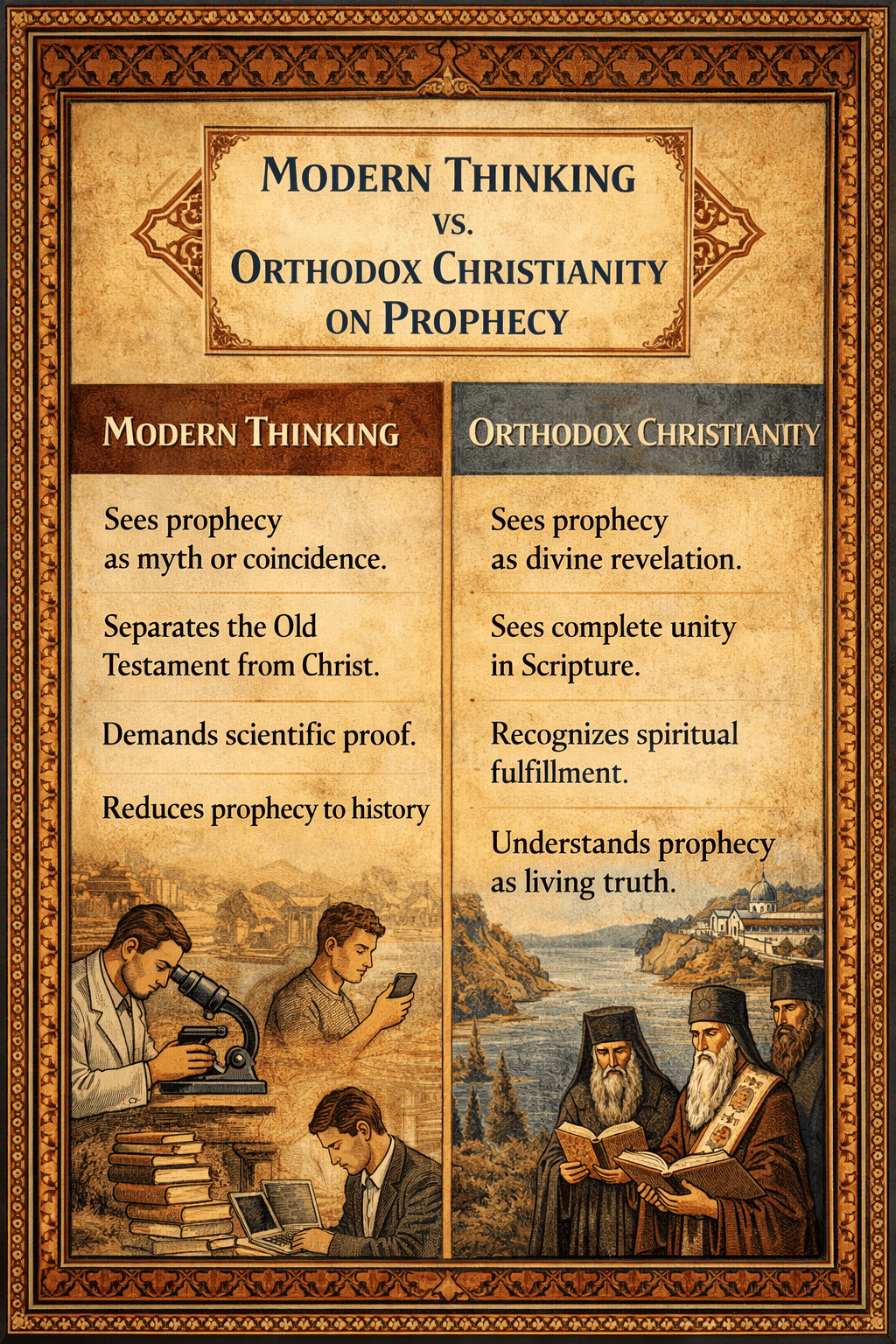
One of the most powerful testimonies of Orthodox Christianity is the unity between the Old and the New Testament. The birth of Christ was not an isolated event. It was prepared, announced, and revealed long before it took place.
The prophets did not speak in vague symbols without meaning. They pointed clearly, precisely, and consistently to the coming of the Messiah.
Many people today wonder whether these prophecies truly refer to Christ or whether they are later interpretations. Orthodox Christianity answers with clarity. The Church has always read the Old Testament as a living preparation for the Incarnation. The same Holy Spirit who inspired the prophets revealed their fulfillment in Christ.
The Nativity is not simply a historical birth. It is the fulfillment of divine promises given across centuries.
The Unity Of Divine Revelation
Orthodox Christianity teaches that God speaks with one voice throughout Scripture. The Old Testament is not separate from the New. It is the foundation upon which the Gospel stands.
Christ Himself confirms this truth:
“Search the Scriptures, for in them you think you have eternal life; and these are they which testify of Me.”
John 5:39
The Scriptures Christ refers to are the Old Testament writings. This means that every prophecy, every symbol, and every sacred event ultimately leads to Him.
Saint Augustine expresses this beautifully:
“The New Testament is hidden in the Old, and the Old is revealed in the New.”
This unity is essential. Without it, the birth of Christ would appear disconnected from history. With it, the Nativity becomes the fulfillment of a long-awaited promise.
The First Promise After The Fall
Immediately after the fall of humanity, God gives the first prophecy concerning Christ. This is not a distant prediction but a direct promise of victory.
“I will put enmity between you and the woman, and between your seed and her Seed; He shall bruise your head.”
Genesis 3:15
This passage reveals that salvation will come through a woman and her Seed. Orthodox Christianity sees here the first announcement of the Virgin Mary and Christ.
Saint Irenaeus teaches:
“The knot of Eve’s disobedience was loosed by the obedience of Mary.”
From the beginning, the path toward the Nativity is already set.
The Prophecy Of The Virgin Birth
One of the clearest prophecies is given by Isaiah. It leaves no room for confusion about the miraculous nature of Christ’s birth.
“Behold, a virgin shall conceive and bear a son, and shall call His name Emmanuel.”
Isaiah 7:14
This prophecy does not speak of an ordinary birth. It speaks of a virgin conceiving, which is humanly impossible. Orthodox Christianity insists on this truth because it reveals that Christ is not merely a man. He is God with us.
The Gospel confirms the fulfillment:
“So all this was done that it might be fulfilled which was spoken by the Lord through the prophet.”
Matthew 1:22
The Church does not reinterpret Isaiah. It recognizes the direct and precise fulfillment in the birth of Christ.
The Prophecy Of The Place Of Birth
The location of Christ’s birth was also foretold with precision. The prophet Micah identifies Bethlehem as the place where the Messiah would be born.
“But you, Bethlehem Ephrathah, though you are little among the thousands of Judah, yet out of you shall come forth to Me the One to be Ruler in Israel.”
Micah 5:2
This prophecy is remarkable. Bethlehem was not a major city. It had no political significance. Yet it was chosen by God centuries before the Nativity.
The Gospel confirms this detail:
“Jesus was born in Bethlehem of Judea in the days of Herod the king.”
Matthew 2:1
Orthodox Christianity sees in this not coincidence but divine precision.
The Prophecy of the Time of Christ’s Coming
The prophet Daniel provides one of the most profound prophecies concerning the timing of the Messiah.
“Seventy weeks are determined for your people… to bring in everlasting righteousness.”
Daniel 9:24
This prophecy outlines a specific period leading to the coming of Christ. The “seventy weeks” are understood by the Fathers as a defined historical timeframe culminating in the Incarnation.
The word “weeks” here does not refer to ordinary weeks of seven days. The Fathers of the Church understand these as symbolic “weeks of years.” In other words, one “week” equals seven years.
So seventy weeks means:
70 × 7 = 490 years
This creates a prophetic period of 490 years.
The prophecy continues by saying that this period begins from a decree to restore and rebuild Jerusalem:
“Know therefore and understand, that from the going forth of the command to restore and build Jerusalem…”
Daniel 9:25
Historically, such decrees were given during the Persian period, after the Babylonian captivity. Orthodox interpreters, following ancient tradition, see this as the starting point of the prophetic timeline.
The prophecy then speaks about the coming of the Anointed One, the Messiah:
“…until Messiah the Prince, there shall be seven weeks and sixty-two weeks.”
Daniel 9:25
This means that after a specific number of these symbolic weeks, the Messiah will appear.
When the timeline is calculated, it leads to the period in which Christ was born and began His saving work. This is why the Church connects this prophecy with the “fullness of time” mentioned by Saint Paul.
“When the fullness of time had come, God sent forth His Son.”
Galatians 4:4
The Prophecy Of The Star And The Nations
The coming of Christ is not only for one nation. It is for all humanity. Even the heavens participate in announcing His birth.
The prophecy of Balaam reveals this:
“A Star shall come out of Jacob; a Scepter shall rise out of Israel.”
Numbers 24:17
This prophecy is fulfilled in the appearance of the star that guides the Magi.
The Gospel records:
“We have seen His star in the East and have come to worship Him.”
Matthew 2:2
Orthodox Christianity sees in this event the calling of the nations. The Magi represent all peoples being drawn to Christ.
The Prophecy Of The Humble King
The Old Testament does not describe the Messiah as a worldly ruler. Instead, it reveals His humility.
“Behold, your King is coming to you; He is just and having salvation, lowly.”
Zechariah 9:9
This humility begins at His birth. Christ is not born in a palace but in a cave, not surrounded by power but by simplicity.
The Psalms echo this humility:
“I am a worm, and no man; a reproach of men, and despised by the people.”
Psalm 21:7 (LXX)
Orthodox Christianity emphasizes that this humility is not weakness. It is divine love revealed.
The Prophecy Of Light In Darkness
The coming of Christ is described as light entering darkness.
“The people who walked in darkness have seen a great light.”
Isaiah 9:2
This light is not physical. It is spiritual illumination. Humanity, lost in ignorance and sin, receives true knowledge of God.
Christ Himself declares:
“I am the light of the world.”
John 8:12
Orthodox Christianity teaches that the Nativity is the beginning of this illumination.
The Role Of The Psalms In Revealing Christ
The Psalms of David contain deep prophetic insights into the life and mission of Christ. They speak not only of His suffering but also of His coming into the world.
“The Lord said to Me, You are My Son, today I have begotten You.”
Psalm 2:7 (LXX)
This verse reveals the divine sonship of Christ, which becomes manifest in His birth.
Another Psalm proclaims:
“Blessed is He who comes in the name of the Lord.”
Psalm 117:26 (LXX)
This blessing is fulfilled in the coming of Christ into the world.
The Psalms are not only prayers. They are prophetic voices pointing toward the Incarnation.
Why These Prophecies Matter In Orthodox Christianity
Orthodox Christianity does not treat prophecy as intellectual proof alone. Prophecy is a revelation of God’s faithfulness. It shows that salvation is not accidental.
Saint John Chrysostom teaches:
“The prophets spoke not from themselves but from the grace of the Spirit.”
This means that the same Spirit who spoke through the prophets reveals Christ to the Church.
These prophecies strengthen faith. They show that God’s promises are true and that His plan unfolds with perfect precision.
The Personal Meaning Of Prophecy
These prophecies are not only about the past. They speak to every believer. Just as the prophets prepared the world, the heart must be prepared to receive Christ.
The Psalmist prays:
“Create in me a clean heart, O God, and renew a right spirit within me.”
Psalm 50:12 (LXX)
When a person reads Scripture with humility, Christ is revealed. The Nativity becomes a present reality, not only a past event.
Saint Seraphim of Sarov teaches:
“Acquire the Spirit of peace, and thousands around you will be saved.”
This inner transformation is the continuation of prophecy within the life of the Church.
Conclusion
The Old Testament prophecies do not vaguely hint at Christ. They point clearly and precisely to His birth. From the first promise after the fall to the detailed revelations of the prophets, everything leads to the Nativity.
Orthodox Christianity preserves this truth with faithfulness and reverence. The same God who spoke through the prophets fulfilled His word in Christ. This unity reveals the certainty of salvation and the depth of divine love.
Dive Deeper: