
Saint Arsenios of Cappadocia, one of the most revered figures in Orthodox Christianity, lived a life that exemplified deep humility, unshakable faith, and divine compassion.
Known in his lifetime as “Hatzefendis,” he became a source of healing, spiritual renewal, and miraculous grace for countless souls—both Christian and Muslim—throughout Asia Minor.
His life was marked by holiness, asceticism, miracles, and total devotion to Christ.
The Orthodox Church commemorates Saint Arsenios on November 10.
His holy relics rest in the Monastery of Saint John the Theologian in Souroti, near Thessaloniki, Greece, where he continues to perform miracles through the grace of God.
The Early Life of Saint Arsenios
Saint Arsenios (in the world, Theodore Anitsalichos or Artzidis) was born around 1840 in Farasa, Cappadocia, one of six Christian villages in the region.
His parents, Eleftherios and Barbara, were virtuous but modest people. When both parents died young, Theodore and his brother Vlasios were cared for by their aunt.
From his earliest years, divine providence marked his life. When he was a child, he nearly drowned in a river, but Saint George appeared and miraculously saved him—an event that foretold his spiritual destiny.
The experience left a deep mark on the young Theodore. His brother Vlasios later became a teacher of Byzantine music, while Theodore devoted his life to monasticism.
He received his early education in Nigde and continued in Smyrna, where he distinguished himself in piety and knowledge.
At about the age of twenty-six, he entered the Monastery of Saint John the Forerunner in Zindzi-Dere and received the monastic name Arsenios.
His Ordination and Secret Teaching Work
Saint Arsenios’s ascetic peace did not last long. The local Orthodox community suffered from oppression and illiteracy under Ottoman rule.
The Metropolitan of Caesarea, Paisios II, ordained him deacon and sent him secretly to Farasa to teach the children of Christians. He taught them to read and write in Greek and instructed them in the Orthodox faith—often under the threat of severe punishment if discovered by the Turks.
At age thirty, he was ordained priest and received the title of Archimandrite and the blessing to serve as spiritual father.
His ministry soon expanded far beyond Farasa. He became a living pillar of Orthodox faith, healing the sick, comforting the sorrowful, and strengthening those under persecution.
A Shepherd of Souls and a Worker of Miracles
Saint Arsenios’s spiritual gifts were countless. With divine grace, he healed both body and soul.
His heart overflowed with love for God and for every human being as an image of the Creator. For him, there was no distinction between Greek or Turk, Christian or Muslim—only the suffering soul before the mercy of Christ.
Women who were barren conceived after he prayed for them. The blind regained sight, the paralyzed walked, the demon-possessed were liberated.
Often, when no special prayers existed for particular needs, he would open the Book of Psalms and assign a psalm for each situation. He had deep faith in the words of Scripture as a living source of grace.
For example, he would recommend Psalms 56, 69, 80, 97, and 128 to those struggling with anxiety, despair, or affliction, teaching that these psalms open the heavens for peace and healing.
Many miracles occurred through simple faith. They were healed not by superstition but by faith in Christ working through His servant.
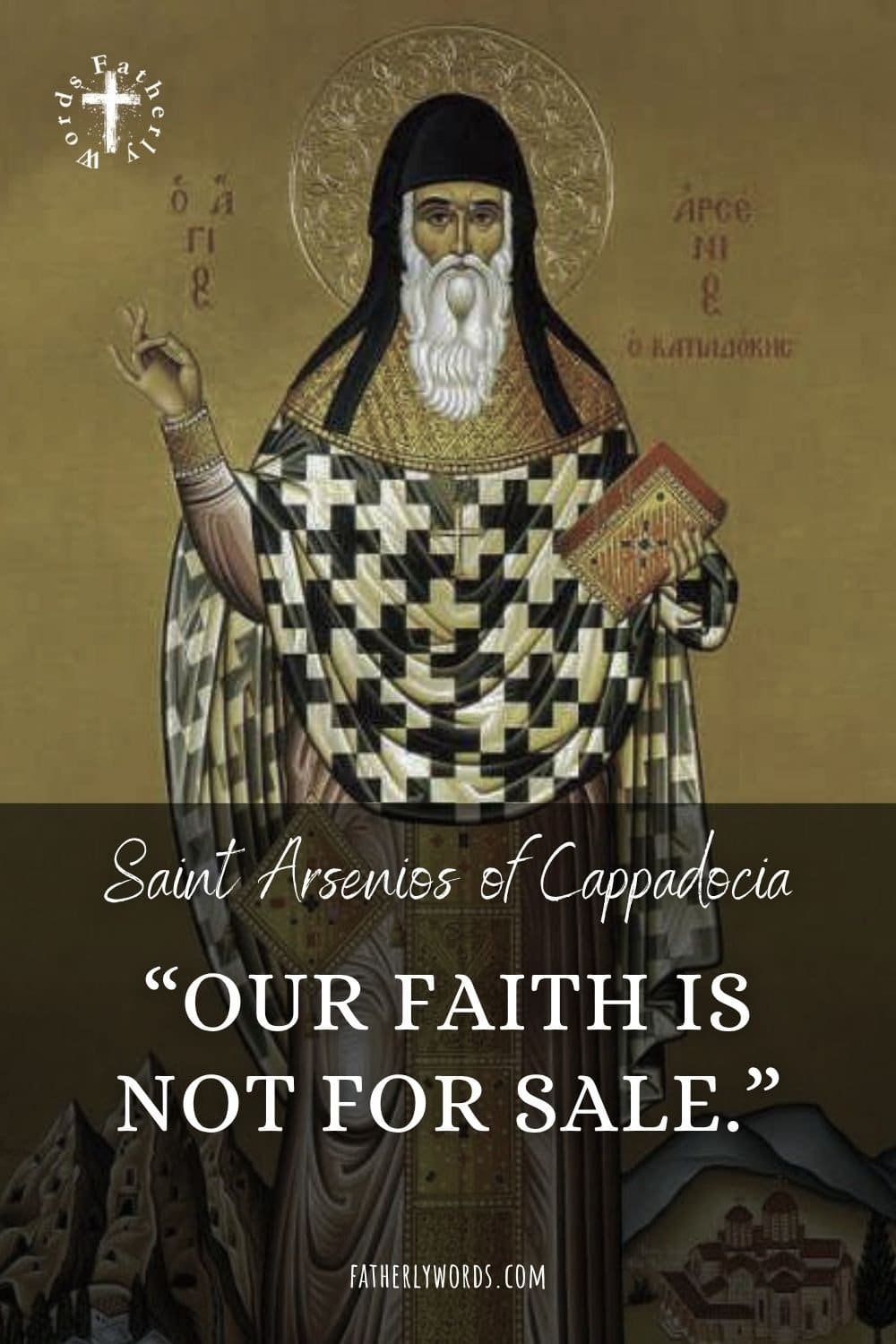
Saint Arsenios would never accept money for his prayers, declaring firmly, “Our faith is not for sale.”
The Humility and Hidden Virtue of the Saint
Despite his sanctity, Saint Arsenios sought to hide his virtues. He often feigned harshness or irritability to avoid human praise.
When women tried to bring him food out of love and gratitude, he would scold them and say, “If I wanted women to serve me, I would have married and become a parish priest. A monk served by women is not a true monk.”
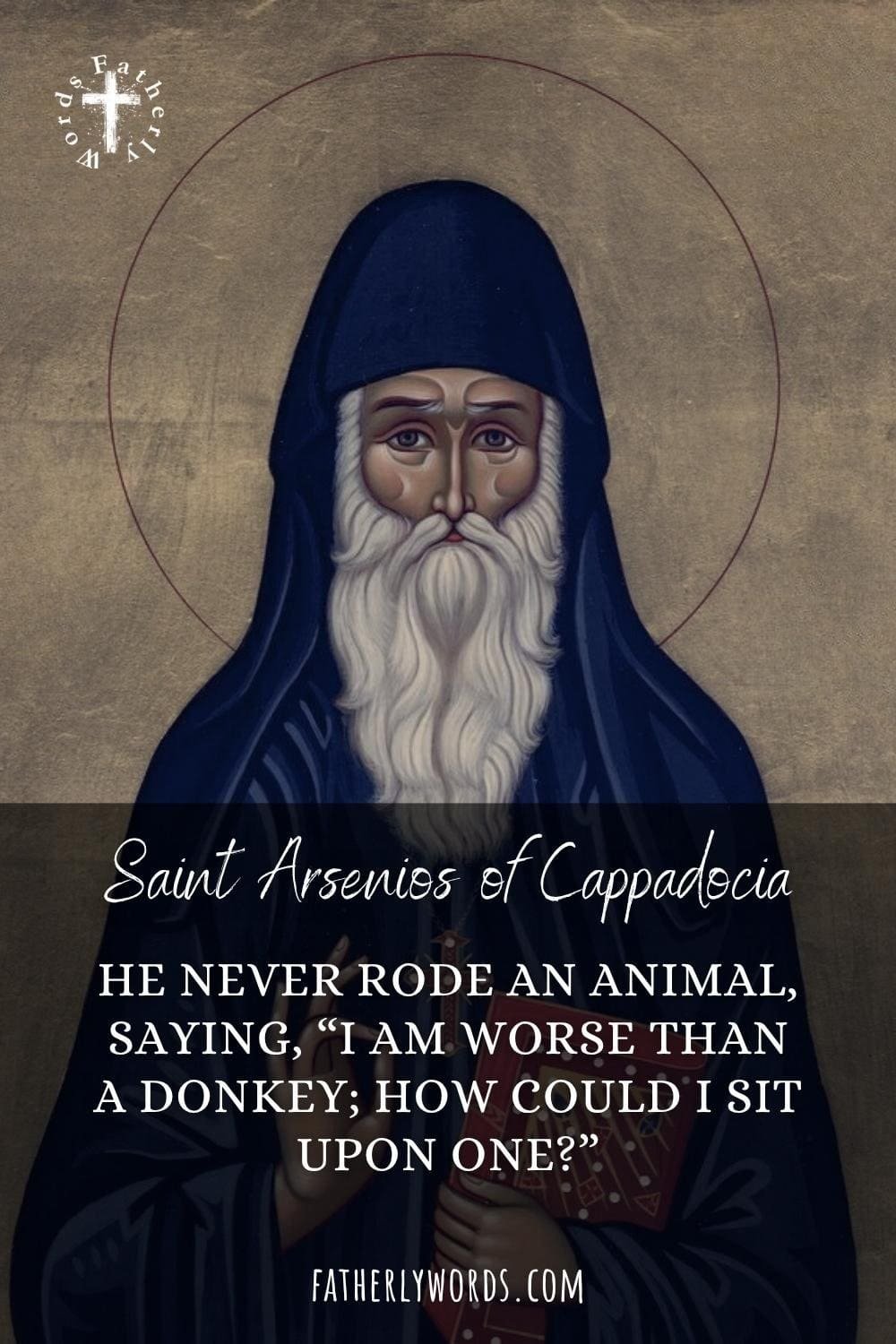
His asceticism was extreme. He went barefoot, even in the cold, refusing to ride an animal, saying, “How could I, who am worse than a donkey, ride upon one?”
Twice a week—on Wednesdays and Fridays—he shut himself in his cell, praying for hours for his flock. Those two days of solitude, he said, sanctified the work of the rest of the week. People knew not to disturb him, yet they would often collect soil from outside his cell to use as a blessing.
He ate little, lived in total simplicity, and gave everything to the poor. Yet he was always radiant with peace, his face shining with the inner light of the Holy Spirit. Those who saw him testified that his countenance resembled that of an angel.
His Love for Creation
The Saint’s compassion extended to all living things. He refused to harm animals and never sat on one to rest himself.
His life reflected a harmony between creation and Creator, showing that holiness transforms even the smallest acts into communion with God. His prayers and tears were for the whole world.
Miracles During His Life
The miracles of Saint Arsenios were countless. People of all backgrounds—Christians and Muslims alike—testified to his healing power and prophetic insight.
A paralytic Turkish woman was brought to him wrapped in a blanket. After he read prayers over her, she immediately stood up healed.
Another time, a leprous woman was cured completely, her skin becoming soft and youthful.
A blind Muslim woman named Meriyama received her sight after his prayer, and she glorified the God of the Christians.
He blessed the garment of a barren priest’s wife, prophesying, “She will bear a daughter, and her name shall be Eva.” The child was born exactly as he said.
On another occasion, a mute Turkish man began to speak for the first time while Saint Arsenios read the Gospel over him.
In another case, he predicted to his villagers that they would one day leave Cappadocia for Greece—and so it happened during the population exchange of 1924.
Perhaps one of the most astonishing miracles occurred when the Saint fell from a great height at a chapel of the Panagia built into a cliff. A peasant ran to gather his body, thinking he was dead, but Saint Arsenios stood up unharmed. He revealed that as he fell, the Mother of God herself had caught him in her arms and gently set him down.
Even nature obeyed his prayers. When the holy spring near the church of Saint Chrysostom dried up, he knelt and read from the Gospel, and immediately the water returned, flowing abundantly.
Defending the Faith and Confronting Evil
Saint Arsenios faced many challenges. Under Ottoman oppression, he struggled to preserve the Orthodox faith among his people, protecting them from both forced Islamization and Protestant proselytism. He fought “bloodless battles,” sustaining the faithful through teaching, example, and divine grace.
His spiritual authority was so evident that even the Turks feared to harm him. Once, when bandits came to rob him, he merely looked at them, and one of them was paralyzed instantly with one leg inside his cell and the other outside. Trembling, the others begged forgiveness, and the saint released them with a sign of the cross.
On another occasion, a Turkish commander drew his sword to strike him, but Saint Arsenios commanded, “Put your hand down, lifeless!” and the man’s arm instantly froze. When the terrified officer repented, Saint Arsenios healed him, saying, “Never again raise your hand against a servant of God.”
Even the Turks proclaimed, “Do not touch Hatzefendis, for his power is from God.”
His Gift of Prophecy
Saint Arsenios was given the gift of foresight. He foretold his people’s departure from Asia Minor and even the time of his death. “I will live only forty days in Greece,” he said, and so it came to pass.
He also revealed that he would die on an island. Indeed, after leading his flock to Greece in 1924, he reposed on the island of Corfu, just as he had prophesied.
The Saint’s Final Days
Three days before his repose, the Mother of God appeared to him, showing him the monasteries of Mount Athos that he had long desired to visit. She told him that in three days he would stand before the Lord he had loved all his life.
On November 10, 1924, Saint Arsenios of Cappadocia fell asleep in peace in Corfu, his face shining with the light of divine grace. His body was fragrant, a sign of sanctity recognized by all who witnessed it.
His Holy Relics and Continuing Miracles
In 1958, his precious relics were transferred from Corfu to Konitsa by Elder Paisios of Mount Athos, who had been baptized by Saint Arsenios and regarded him as his heavenly protector.
In 1970, the relics were enshrined in the women’s Monastery of Saint John the Theologian in Souroti, near Thessaloniki, where countless miracles continue to occur.
Pilgrims from around the world visit the monastery to venerate the relics and receive spiritual comfort.
In 1986, the Ecumenical Patriarchate officially canonized him as a saint of the Orthodox Church.
His life, recorded by Elder Paisios, stands as a living testimony of how faith in Christ conquers all fear and sorrow.

The Teachings of Saint Arsenios
Saint Arsenios’s words reflected profound Orthodox theology expressed in simple, living faith.
He used the Psalms of David as a spiritual medicine, assigning specific psalms for every human need—healing, sorrow, anxiety, or thanksgiving. He often said that prayer and faith open the heavens for the suffering soul.
His most famous saying, “Our faith is not for sale,” summarizes his character.
He stood firm against materialism, compromise, and false teaching. He lived as a true ascetic, showing that spiritual authority flows not from power or wealth but from holiness and humility.
The People’s Love and Veneration
The people of Farasa revered him as a living saint. They turned to him not only for healing but also for wisdom, guidance, and protection.
“In our homeland,” they said, “we did not know what a doctor was. We ran to Hatzefendis.”
Their faith in God through him was rewarded with countless blessings. Even after his death, their devotion continued; his memory became a link between the suffering of Cappadocia and the rebirth of Orthodoxy in Greece.
The Apolytikion of Saint Arsenios
Tone 1
Having imitated the life of the venerable fathers, O Father Arsenios, in these last times you were filled with the gifts of the Holy Spirit, and becoming a wonderworker, you grant divine grace to all who ask through your intercessions to the Lord.
Tone 3
Having lived a godly life, you became a precious vessel of the Comforter, O God-bearing Arsenios; and receiving the grace of miracles, you grant swift help to all. Intercede with Christ our God to grant us great mercy.
Why We Pray His Apolytikion
The Apolytikion reminds us that prayer to a saint is a request for their intercession before God, not worship of them.
By calling upon Saint Arsenios, we ask for his prayers that we may receive mercy and spiritual healing.
His apolytikion expresses the Orthodox understanding of sanctity: that through union with the Holy Spirit, a person becomes a living channel of divine grace.
Veneration and Patronage
Saint Arsenios is venerated throughout the Orthodox world, especially in Greece and among the descendants of Cappadocian refugees. Pilgrims visit his shrine in Souroti, where his relics are a source of peace, healing, and faith renewal.
His intercession is sought by those struggling to preserve faith in difficult times.
The Spiritual Relationship with Saint Paisios
One of the most touching aspects of his legacy is his spiritual connection to Saint Paisios the Athonite. Saint Arsenios baptized the future Elder Paisios, giving him his name and blessing.
He was the spiritual father of Paisios’s parents and the guardian of their faith.
Elder Paisios later wrote the definitive account of Saint Arsenios’s life, describing him as a man “who lived like an angel on earth” and “taught us faith not by words but by divine power.”
How the Devil Tried to Accuse the Saint
The Evil One often sought to disturb Saint Arsenios through slander and trials.
Some accused him of pride or strange behavior because of his deliberate roughness and silence. But his humility and patience revealed the truth: he used such “oddities” only to hide his virtue and to protect himself from praise.
The devil could not harm him, for his heart was completely united with Christ.

The Meaning of His Life for Orthodox Christianity
Saint Arsenios’s life stands as a radiant example of how faith transforms suffering into holiness. In an age of persecution and fear, he embodied the spiritual strength of Orthodox Christianity—rooted in prayer, sacrifice, and love.
His compassion for all, his service to the poor, his miracles, and his unwavering confession of Christ reveal the depth of divine grace that flows through the saints.
A Simple Explanation for Children
Saint Arsenios loved God with all his heart and helped everyone—poor people, sick people, and even those who were not Christians. He prayed all the time, healed people, and taught children about Jesus, even when it was dangerous.
He never thought of himself but only of others.
When he grew old, the Mother of God came to take him to Heaven.
Today, we can still ask him to pray for us when we are sad or sick, and he will help us because he loves everyone who trusts in God.