
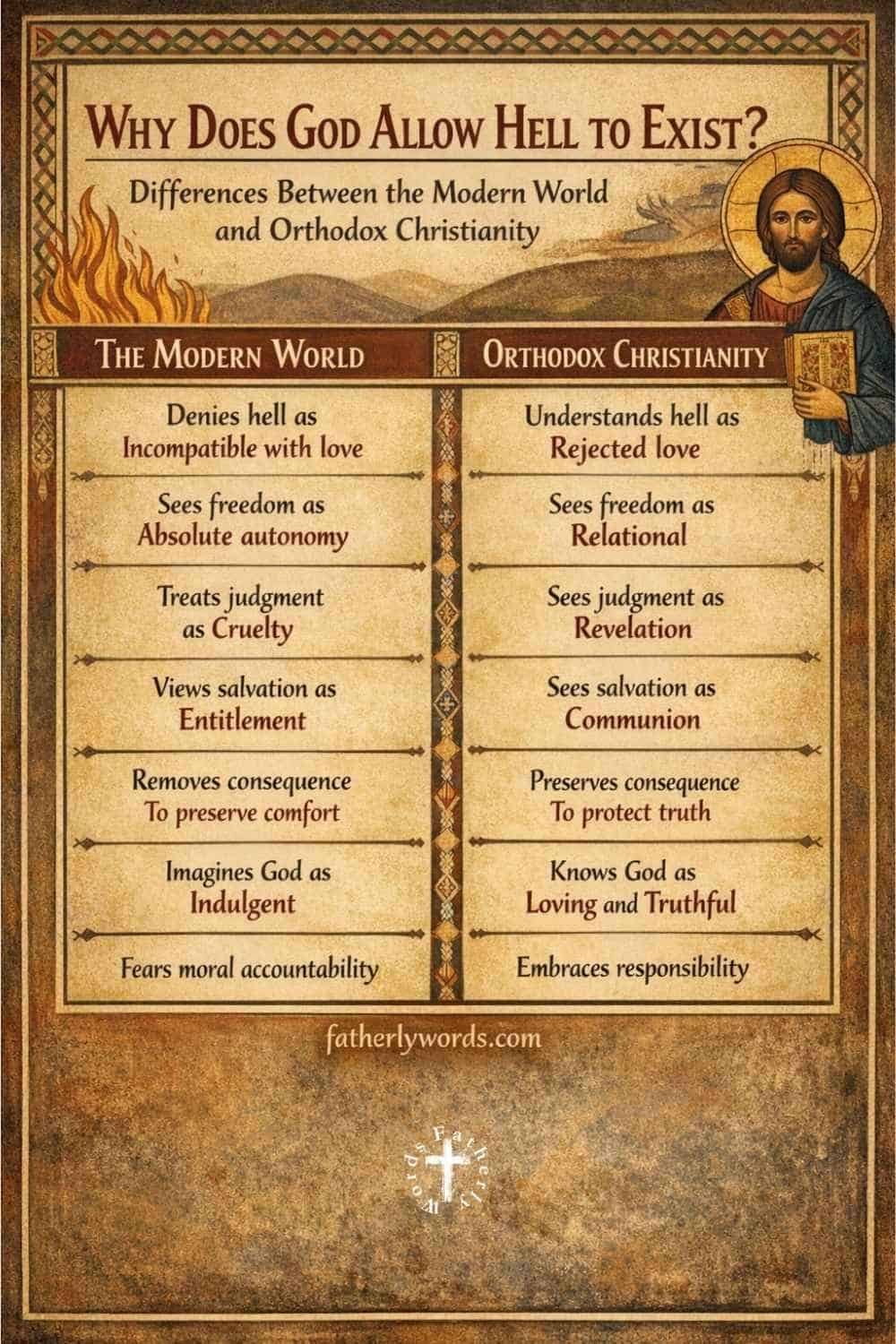
This question touches the deepest wounds and fears of the human heart. Many struggle to reconcile the love of God with the existence of hell. Some reject hell entirely. Others imagine God as harsh and punitive. Orthodox Christianity rejects both distortions.
The Church neither softens divine truth to comfort emotions nor presents God as a tyrant who delights in punishment.
Orthodox Christianity proclaims with absolute clarity that God desires the salvation of every human person.
At the same time, it affirms the real existence of hell. These two truths do not contradict each other. They reveal the mystery of love, freedom, and truth.
To understand why hell exists, one must first understand who God is, what salvation means, and how human freedom operates within divine love.
God Truly Desires the Salvation of All
Orthodox Christianity begins with the clear testimony of Holy Scripture regarding God’s will. The Apostle Paul writes:
God our Savior will have all men to be saved and to come unto the knowledge of the truth.
1 Timothy 2:4
This desire is not symbolic. It is real. God does not create anyone for destruction. He creates every person for communion. The Prophet Ezekiel speaks in God’s name:
I have no pleasure in the death of the wicked but that the wicked turn from his way and live.
Ezekiel 33:11
The Psalms of David echo the same truth:
The Lord is gracious and merciful long suffering and of great mercy.
Psalm 102:8 (LXX)
Orthodox Christianity holds this as foundational. Any explanation of hell that contradicts God’s love is false.
God Is Love Not an Executioner
The Apostle John reveals:
God is love.
1 John 4:8
This is not a metaphor. It is an ontological statement. God does not sometimes love. He is love always.
Orthodox Christianity never teaches that God created hell to torture souls. Hell is not a place where God stops loving. It is the condition of rejecting that love.
God’s love remains unchanged. What changes is the human heart.
What Salvation Means in Orthodox Christianity
Salvation in Orthodox Christianity is not legal acquittal. It is healing and union. To be saved is to be restored to communion with God.
This is life eternal that they might know Thee the only true God.
John 17:3
Knowing God is not intellectual awareness. It is participation. The Psalms declare:
Taste and see that the Lord is good.
Psalm 33:8 (LXX)
Salvation is experiential. It requires openness, repentance, humility, and cooperation.
Why Human Freedom Cannot Be Abolished
Love without freedom is impossible. Orthodox Christianity teaches that God never violates human freedom, even when that freedom is misused.
From the beginning, humanity was created with choice.
I have set before you life and death blessing and cursing therefore choose life.
Deuteronomy 30:19
God invites. He does not coerce.
Saint John of Damascus teaches that God foreknows but does not predetermine human choices. Freedom remains real.
If God were to abolish freedom to prevent hell, He would abolish love itself.
Hell as the Result of Rejected Communion
Hell is not created by God as revenge. It emerges from the refusal of communion. Christ says:
This is the condemnation that light is come into the world and men loved darkness rather than light.
John 3:19
Light does not punish darkness. Darkness flees light. The Psalms say:
The wicked shall not stand in the judgment.
Psalm 1:5 (LXX)
Standing implies relationship. Hell is the inability to stand before love.
The Same Fire Experienced Differently
Orthodox Christianity teaches that heaven and hell are not two different divine energies. They are two experiences of the same uncreated presence of God.
For the purified, this fire illumines. For the hardened, it burns.
Saint Gregory Palamas teaches that the divine light that deifies the saints is the same light that torments those who reject it.
God does not change. The heart changes.
Why Hell Must Exist If Love Is Real
If love is real, rejection must be possible. Without the possibility of refusal, salvation would be forced. The Apostle Paul warns:
Grieve not the Holy Spirit of God.
Ephesians 4:30
One cannot grieve what one cannot resist. The Psalms lament:
They refused to walk in His law.
Psalm 77:10 (LXX)
Refusal has consequences.
Hell Is Not Arbitrary Punishment
Orthodox Christianity rejects the idea of God assigning penalties like a judge balancing scales. Christ says:
Out of thine own mouth will I judge thee.
Luke 19:22
Judgment reveals truth. It does not invent it.
Saint Maximus the Confessor teaches that judgment manifests what a person has become.
Hell is the exposure of a soul that has closed itself to love.
Why God Does Not Simply Annihilate the Wicked
Some ask why God does not simply erase those who reject Him. Orthodox Christianity answers that annihilation would deny the dignity of personhood.
God creates persons eternally. He does not revoke existence. Existence itself is sustained by love.
Hell and the Justice of God
Divine justice in Orthodox Christianity is restorative, not retributive. Yet restoration requires consent. Christ weeps over Jerusalem saying:
O Jerusalem, Jerusalem, you who kill the prophets and stone those who are sent to you! How often I have longed to gather your children together as a hen gathers her chicks under her wings, but you would have none of it!
Matthew 23:37
The refusal belongs to humanity.
Why Preaching Hell Is an Act of Love
Orthodox Christianity does not hide hell to frighten, but to awaken. The Apostle Paul says:
Since, then, we know what it is to fear the Lord, we try to persuade others. What we are is plain to God, and I hope it is also plain to your conscience.
2 Corinthians 5:11
Warning is mercy. The Psalms cry:
Save me O God for the waters are come in unto my soul.
Psalm 68:1 (LXX)
Hell is not preached to dominate but to save.
The Role of Repentance
Repentance remains open until the final breath. The Psalms declare:
A broken and contrite heart O God Thou wilt not despise.
Psalm 50:17 (LXX)
Hell is not imposed upon the repentant.
Saint John Chrysostom teaches that there is no sin greater than God’s mercy, but there is pride greater than repentance.
Why Love Cannot Override Truth
God cannot lie about reality. Christ says:
Everyone who does evil hates the light, and will not come into the light for fear that their deeds will be exposed.
John 3:20
Love respects truth even when truth is painful.
Hell and the Hope of God
Orthodox Christianity never claims knowledge of who is in hell. It prays for all. The Psalms say:
Let my prayer be set forth before Thee as incense.
Psalm 140:2 (LXX)
Hope remains without denial of truth.
Why This Teaching Matters for Daily Life
Understanding hell clarifies choices. It reveals the seriousness of love. The Apostle Paul urges:
Work out your salvation with fear and trembling.
Philippians 2:12
Fear here is reverence.
Explaining This to Little Children
Parents can say that God loves everyone and wants everyone close to Him. They can explain that hell happens when someone refuses God’s love.
Children can understand that God never stops loving, but He never forces friendship. They can learn that choosing kindness and repentance brings joy.
Dive Deeper: