
A short Orthodox commentary on the Gospel reading of the Sixth Sunday of Luke
A man lives among the tombs, breaks every chain, and terrifies a whole region. One word from Christ, and he is sitting quietly at His feet, clothed and in his right mind. Then comes the part almost nobody expects: the people who saw the miracle beg Jesus to leave.
This short commentary on Luke 8:26–39, the Gospel reading about the Gerasene demoniac, answers the questions readers search for most:
- who Legion is,
- why the demons asked to enter the pigs,
- what the Orthodox Church teaches about demons, and
- why a whole town would send away the Healer of souls.
It also explains why the Church reads this Gospel on the Sixth Sunday of Luke, and what it asks of us in daily life.
Keep an eye on verse 39. One small detail there, set beside verse 27, changes how the whole story reads.
Luke 8:26–39: The Gospel Reading on the Healing of the Gerasene Demoniac
Jesus and His disciples have just calmed the storm on the lake (Luke 8:22–25). They land in the country of the Gerasenes, opposite Galilee (verse 26), and the Gospel reading continues:
[27] And when he was come forth to the land, there met him a certain man who had a devil now a very long time, and he wore no clothes, neither did he abide in a house, but in the sepulchres.
[28] And when he saw Jesus, he fell down before him; and crying out with a loud voice, he said: What have I to do with thee, Jesus, Son of the most high God? I beseech thee, do not torment me.
[29] For he commanded the unclean spirit to go out of the man. For many times it seized him, and he was bound with chains, and kept in fetters; and breaking the bonds, he was driven by the devil into the deserts.
[30] And Jesus asked him, saying: What is thy name? But he said: Legion; because many devils were entered into him.
[31] And they besought him that he would not command them to go into the abyss.
[32] And there was there a herd of many swine feeding on the mountain; and they besought him that he would suffer them to enter into them. And he suffered them.
[33] The devils therefore went out of the man, and entered into the swine; and the herd ran violently down a steep place into the lake, and were stifled.
[34] Which when they that fed them saw done, they fled away, and told it in the city and in the villages.
[35] And they went out to see what was done; and they came to Jesus, and found the man, out of whom the devils were departed, sitting at his feet, clothed, and in his right mind; and they were afraid. [36] And they also that had seen, told them how he had been healed from the legion.
[37] And all the multitude of the country of the Gerasens besought him to depart from them; for they were taken with great fear. And he, going up into the ship, returned back again.
[38] Now the man, out of whom the devils were departed, besought him that he might be with him. But Jesus sent him away, saying:
[39] Return to thy house, and tell how great things God hath done to thee. And he went through the whole city, publishing how great things Jesus had done to him.
Read it slowly once. Notice three things:
- a man with no home, no clothes and no peace;
- demons who recognize Christ at once; and
- a town that sends Him away.
Why the Church Reads the Gerasene Demoniac on the Sixth Sunday of Luke
The Church appoints Luke 8:26–39 for the Sixth Sunday of Luke. Three things make this reading fit its place.
First, it belongs to a chain of miracles in Luke 8. Christ commands the storm (Luke 8:22–25), then the demons, and on the following Sunday the Church reads how He heals the woman with the flow of blood and raises the daughter of Jairus (Luke 8:41–56).
Sea, spirits, sickness and death: nothing in creation stands outside His command.
Second, the Epistle gives the key. St. Paul writes that God, “who is rich in mercy,” made us alive together with Christ “even when we were dead in sins” (Ephesians 2:4–5). The man living among the tombs is a living picture of that deadness. The man seated at Christ’s feet is a picture of the new life.
Third, the season speaks. This reading comes in the autumn, as the Church moves toward the Nativity Fast, the time when we prepare to welcome Christ. The Gerasenes show what it looks like to send Him away instead.
Gerasenes, Gadarenes or Gergesenes? Where the Healing of the Demoniac Took Place
Readers often ask why this miracle seems to happen in three different places. The Gospels and their manuscripts use three names: Gerasenes, Gadarenes and Gergesenes. All of them point to the same region on the eastern shore of the Sea of Galilee, across from Galilee itself.
Gadara and Gerasa were cities of the Decapolis, the ten Gentile cities of that area, and Gergesa is the name tied to the lakeshore. Christians have long honored the shore near Kursi, where the ruins of a Byzantine monastery still stand, as the place of the miracle.
You will also notice that Matthew speaks of two possessed men (Matthew 8:28), while Luke and Mark speak of one. There is no conflict. Luke and Mark follow the man whose story stood out, and they do not deny that another was healed with him.
The location matters more than the spelling. This is Gentile land, as the herd of swine shows, since the Law of Moses forbade the Jews to keep or eat them (Leviticus 11:7).
Christ crosses the lake, straight after a storm, to reach one man whom everyone else had given up on.
The Man Among the Tombs: What His Nakedness, Chains and Loneliness Mean
Luke paints the man’s condition in a few strokes: he wears no clothes, he has no house, he lives among the tombs, and no chain can hold him (verses 27 and 29). Each stroke shows what sin and the demonic do to a person.
- He has lost his clothes, which means he has lost his dignity.
- He has lost his house, which means he has lost his family and his place among people.
- He lives among the dead and is driven into the deserts, which means he is completely alone. Even his name is gone, as we will see.
St. Theophylact of Ochrid gives the scene a deeper meaning. The man who wears no garment and lives outside the house, he says, is anyone who does evil and demonic deeds: he has stripped himself of his baptismal robe and lives outside the Church.
The tombs are the dead and rotting works of sin.
St. Cyril of Alexandria adds that going naked among the graves is a mark of the wildness the demons produce.
The chains tell their own story. The townspeople tried everything they knew, and the man broke every bond (verse 29). Human force can restrain a body for a while, but it cannot heal a soul.
Only Christ can, which is why the Church sends the wounded to Him through repentance, prayer and the Holy Mysteries, and not to willpower alone.
Who Is Legion in the Bible? The Demons Who Confess Christ
When the man sees Jesus, he falls down before Him, and the demons speak through him: “What have I to do with thee, Jesus, Son of the most high God? I beseech thee, do not torment me” (verse 28). The demons are not guessing. They know exactly who stands in front of them.
Then Christ asks a question: “What is thy name?” The answer is “Legion; because many devils were entered into him” (verse 30). A Roman legion was a large body of soldiers, thousands strong, so the name tells us the man was held not by one spirit but by a multitude.
St. Theophylact notes that Christ does not ask out of ignorance. He asks so that the man himself would confess the plague that tormented him, and the power of the Healer would shine more brightly in the telling.
Look closer and you see more. The man answers with the name of his tormentors and not with his own, a sign of how completely they had taken over his life.
The name also carries a warning: sin left unchecked rarely stays single. One passion opens the door to another, until a person is ruled by a crowd.
The demons confess Christ as the Son of the most high God, yet this confession saves no one. St. James says the same: “the devils also believe, and tremble” (James 2:19). They believe and they hate.
Faith that is only knowledge, without love and repentance, is the demons’ kind of faith. In Matthew’s account they add, “art thou come hither to torment us before the time?” (Matthew 8:29), and in Luke they beg not to be sent into the abyss (verse 31). They know their end, and they know who will bring it.
This is why Orthodox homes keep an icon of Christ as Ruler of All near the place of prayer. The demons knew His authority on sight, and we are given His face to keep before our eyes.
Why Did Jesus Send the Demons Into the Pigs?
The demons make one last request: let us enter the herd of swine (verse 32). Christ grants it, and the herd rushes down the steep place into the lake (verse 33). People have asked for centuries why the Lord allowed it. The Church answers in several ways.
First, it shows how limited the demons are.
As St. John of Damascus teaches in his Exact Exposition of the Orthodox Faith, demons possess no innate authority or power over any creature except what God expressly permits. To illustrate this absolute divine restriction, he highlights two clear biblical examples: the righteous Job in the Old Testament and the herd of swine in the Gospels.
St. Athanasius records that St. Anthony the Great reasoned the same way. If the demons have no power even over swine without permission, he said, they have far less over human beings made in the image of God. This is a great comfort. The devil is a creature, not an equal rival of God.
Second, St. Cyril of Alexandria notes that unclean spirits seek out unclean animals, creatures like themselves. He adds that the Lord permitted it for our benefit and for the confidence of our safety: we see that the demons are on a leash.
Third, the stampede is a picture of what the demons intended. The herd rushes to its death in a moment. That is what they had been doing to the man for years, driving him toward ruin, and what they would do to anyone if given the freedom.
Finally, the miracle weighs one soul against a herd and shows which is worth more. Christ asks, “For what is a man profited, if he shall gain the whole world, and lose his own soul?” (Matthew 16:26), and elsewhere, “How much then is a man better than a sheep?” (Matthew 12:12).
A man whom no chain could hold is free, and the price was a herd of animals.
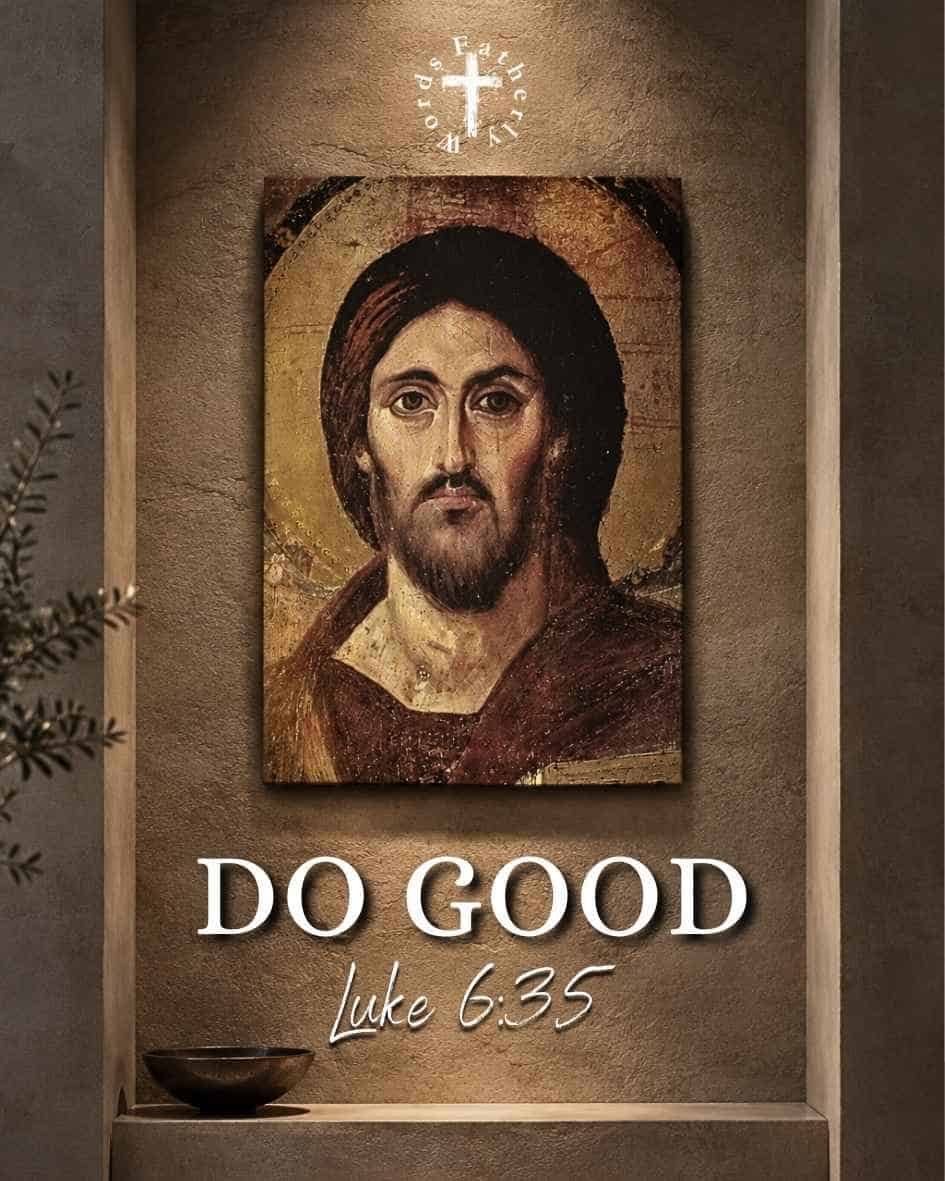
The Christ Pantocrator of Saint Catherine’s Monastery, one of the oldest Byzantine religious icons, dating from the 6th century AD, has been preserved through the centuries in the desert of Sinai, and its gaze, both merciful and commanding, is the gaze of the Lord whom Legion could not resist.
Our canvas print of this icon is the perfect, original religious gift for faithful Christians, one that makes a real difference in a home, and with the code WELCOME-10 you receive 10% off.

What the Orthodox Church Teaches About Demons and Demon Possession
The Church takes this Gospel at its word. Demons are real, personal beings, and Christ Himself speaks to them and commands them. Yet the Church avoids two mistakes: denying the demons, and fearing them.
Demons were not created evil. St. John of Damascus teaches that the devil was made good, a high angelic power, and fell by his own free choice. Evil is not a rival god. It is a turning away from the good. So there is no dualism in the Orthodox faith: the devil is a fallen creature under the authority of the Creator.
Why, then, does Scripture show us possession so plainly?
St. Gregory Palamas explains: “Because most people cannot grasp the devil’s fury against us, in his attacks on the soul and his cooperation in sin, God allowed some to be possessed in the body as well, so that we might learn from them how terrible is the state of a soul that has made him its dweller through evil works.”
Christ came to end this tyranny: “For this purpose the Son of God was manifested, that he might destroy the works of the devil” (1 John 3:8).
He gave His Apostles authority over unclean spirits, and at Pentecost the Holy Spirit came to dwell in the Church. St. Peter still warns that the adversary “as a roaring lion, walketh about, seeking whom he may devour” (1 Peter 5:8).
So the Church arms us: Baptism, with its prayers renouncing Satan and uniting us to Christ; Confession and Holy Communion; prayer, fasting and the Sign of the Cross; the intercessions of the Mother of God and the saints; and the protection of the holy angels.
Be careful not to see demons behind every trouble. The Gospels distinguish between the sick and the possessed (Matthew 4:24), and the Church honors the physician: “Honour a physician with the honour due unto him” (Wisdom of Sirach 38:1).
St. Luke, who wrote this Gospel, was himself a physician (Colossians 4:14).
If someone you love struggles with illness of body or mind, seek a doctor’s care together with the prayers of the Church. Any discernment beyond that belongs to a priest and spiritual father, not to guesswork.
Why Did the Gerasenes Ask Jesus to Leave?
This is the most startling moment in the story, and the one that speaks most directly to us. The herdsmen run to the city and the villages with the news (verse 34). The people come out and find the man “sitting at his feet, clothed, and in his right mind,” and “they were afraid” (verse 35). Then “all the multitude” begs Jesus “to depart from them” (verse 37).
Where is the thanksgiving? Where are the sick brought to be healed? There is none.
Think about it: the whole region had lived for years with a naked, chained, screaming man among their tombs, and they put up with it. What they could not put up with was the healing. The cure frightened them more than the sickness.
Why? Luke says only that they were afraid, but he shows us what kind of fear it was. They had seen the power of God up close, and a power that can cast out Legion can also search a heart.
To receive Christ means humility and repentance: giving up the comforts, habits, profits and pride we cling to. The people had just watched a large herd, a source of income, go over a cliff.
Many preachers hear in this the question Christ still asks us: what does it profit a man to gain the whole world and lose his soul?
St. John of Damascus puts it plainly in the Funeral Service: “All human things are vanity, which do not remain after death. Wealth does not stay, glory does not accompany us; for when death comes, all these things are swept away.”
Notice what Christ does. He does not force His way in. He goes back up into the ship and leaves (verse 37).
In the Book of Revelation the Lord says, “Behold, I stand at the door, and knock: if any man hear my voice, and open the door, I will come in to him” (Revelation 3:20). He knocks. He does not break the door down. God respects the freedom He gave us.
And yet He does not abandon the Gerasenes. Verse 39 shows how He returns to them.
Clothed and in His Right Mind: The Healing of the Gerasene Demoniac
In verse 35 Luke gives us three pictures of the healed man: sitting at the feet of Jesus, clothed, and in his right mind. Each one is the opposite of what we saw in verse 27.
He is clothed. His dignity returns.
St. Theophylact’s reading, that the man without a garment stands for anyone who has lost his baptismal robe, completes the picture: Christ restores what sin stripped away. “As many of you as have been baptized into Christ have put on Christ” (Galatians 3:27).
He is sitting at the feet of Jesus. The man who ran among the tombs now sits still, in the place of a disciple, like Mary of Bethany at the feet of the Lord (Luke 10:39). Peace is not the absence of noise. It is the presence of Christ.
He is in his right mind. This is sound, sober, steady thinking, the opposite of a mind torn by many voices. No chain held him before, and none holds him now. Christ’s presence does.
Many of us carry a crowd of worries and long for that same peace of mind, and the Church has always offered help: certain Psalms of David and the prayers of St. Arsenios the Cappadocian. Which Psalms to read and how to pray them are waiting in our free PDF, so enter your email in the form on this page and it will arrive in your inbox.
“Return to Thy House”: Why Jesus Sent the Healed Man Home
The healed man begs to stay with Jesus (verse 38). It is a beautiful request, and Christ refuses it for a beautiful reason: “Return to thy house, and tell how great things God hath done to thee” (verse 39).
Here is the detail promised at the start. In verse 27 the man did not “abide in a house.” In verse 39 Christ gives him a house. The first thing healing restores is belonging: a home, a family, a place among people. The man who had nothing is sent back to those who know him.
Notice also the wording. Jesus says, “how great things God hath done.” The man goes out “publishing how great things Jesus had done.” He heard “God” and proclaimed “Jesus.”
Christians have always heard in this a quiet confession that Jesus is God. Mark adds that he began to preach in the Decapolis, the ten cities of the region, and that all marveled (Mark 5:20).
This is also how Christ goes back to the Gerasenes. They asked Him to leave, and He answered by sending someone they already knew: the man everyone had called mad. No argument could match his testimony, because the whole town could compare the man they remembered with the man standing in front of them.
This is re-evangelization: reminding people who have drifted from the Gospel of what God has done for them. The Lord still knocks at our door through those who have lived a miracle.
And consider who is chosen. The man the town despised as insane becomes a witness of God. That is why the Church teaches us never to look down on anyone. Every person is made in the image of God, and no one is beyond His reach.
When we pray for the hardest person in our life and help them with love, we meet Christ Himself (Matthew 25:40).
How to Apply Luke 8:26–39 to Your Daily Life
- Ask what you are asking Christ to leave. Every one of us guards a corner: a grudge, a habit, a source of money, a pleasure. Name it honestly and bring it to Confession. Christ does not take from us what is good. He takes what is killing us.
- Run to the Church, not away from it. The Mysteries of the Church are where the Lord’s healing reaches us: Confession, Holy Communion, and the prayers of the priest. Do not fight alone what Christ wants to heal with you.
- Turn the demons’ words into your own prayer. They said, “What have I to do with thee, Jesus, Son of the most high God?” We say, “Lord Jesus Christ, Son of God, have mercy on me, a sinner.” The recognition is the same. The heart is completely different.
- Close every door to the occult. Horoscopes, tarot, séances and spirit boards are forbidden by Scripture (Deuteronomy 18:10–12). A Christian does not play with what Christ commands.
- Never write anyone off. The town called the man mad. Christ made him a witness. Pray for the person you have given up on.
- Tell your story at home. You do not have to preach to a crowd. Let your family and neighbors see what Christ has changed in you, and tell them when they ask. “Return to thy house” is a calling for the ordinary Christian.
Frequently Asked Questions About Luke 8:26–39
What is the meaning of Luke 8:26–39? In Luke 8:26–39, Jesus crosses into Gentile territory and frees a man held by a multitude of demons. The demons confess Him, are permitted to enter a herd of swine, and the herd is destroyed. The town, afraid, asks Him to leave, while the healed man is sent home to proclaim what God has done. The passage shows Christ’s authority over evil, the limits of the demons’ power, and our freedom to welcome Him or turn Him away.
Who is Legion in the Bible? Legion is the name the demons give when Jesus asks the possessed man his name (Luke 8:30). It means a great multitude, and Luke explains it himself: many demons had entered the man.
Why did Jesus allow the demons to enter the pigs? The demons begged for it, and Christ permitted it. The Church sees in this the limits of their power, since they cannot act without God’s permission, along with their destructive hatred and the far greater worth of a human soul.
Are the Gerasenes and the Gadarenes the same people? Both names describe the same region east of the Sea of Galilee. Different Gospels and manuscripts use Gerasenes, Gadarenes or Gergesenes, and Christians have long honored the shore near Kursi as the place of the miracle.
Why did the Gerasenes ask Jesus to leave? They were seized by great fear (Luke 8:37). They had seen God’s power at close range, and they were unwilling to accept the change, repentance and loss that welcoming Christ would bring.
Is demon possession the same as mental illness? No. The Gospels speak of the possessed and the sick as different cases (Matthew 4:24), and the Church honors doctors and medicine. Anyone who is struggling should seek medical care together with prayer and the guidance of a priest.
What is the main lesson of the Gerasene demoniac? Never send Christ away, and never give up on anyone. The Lord who heals a man of Legion can heal any heart that opens to Him, and He sends the healed to tell others what God has done.
