
An Orthodox reflection on the Gospel reading of the Sixth Sunday of Luke
Of everything that happens in Luke 8:26–39, one verse stops readers cold: “And all the multitude of the country of the Gerasens besought him to depart from them” (verse 37).
Christ has just freed a man from a legion of demons, and the town answers by asking Him to go away.
This reflection on the Gospel reading of the Sixth Sunday of Luke asks why the Gerasenes did it, how the Church understands their fear, and how we do the same thing in quieter ways. It also follows what Christ does next, because He does not leave the Gerasenes the way they expect.
For who Legion is, why the demons asked for the pigs, and what the Orthodox Church teaches about demons, read our full commentary on Luke 8:26–39.
Luke 8:26–39: The Gospel Reading Behind the Question
After calming the storm on the lake (Luke 8:22–25), Jesus lands with His disciples in the country of the Gerasenes, opposite Galilee (verse 26). The Gospel reading continues:
[27] And when he was come forth to the land, there met him a certain man who had a devil now a very long time, and he wore no clothes, neither did he abide in a house, but in the sepulchres.
[28] And when he saw Jesus, he fell down before him; and crying out with a loud voice, he said: What have I to do with thee, Jesus, Son of the most high God? I beseech thee, do not torment me.
[29] For he commanded the unclean spirit to go out of the man. For many times it seized him, and he was bound with chains, and kept in fetters; and breaking the bonds, he was driven by the devil into the deserts. [30] And Jesus asked him, saying: What is thy name? But he said: Legion; because many devils were entered into him.
[31] And they besought him that he would not command them to go into the abyss.
[32] And there was there a herd of many swine feeding on the mountain; and they besought him that he would suffer them to enter into them. And he suffered them.
[33] The devils therefore went out of the man, and entered into the swine; and the herd ran violently down a steep place into the lake, and were stifled.
[34] Which when they that fed them saw done, they fled away, and told it in the city and in the villages.
[35] And they went out to see what was done; and they came to Jesus, and found the man, out of whom the devils were departed, sitting at his feet, clothed, and in his right mind; and they were afraid.
[36] And they also that had seen, told them how he had been healed from the legion.
[37] And all the multitude of the country of the Gerasens besought him to depart from them; for they were taken with great fear. And he, going up into the ship, returned back again.
[38] Now the man, out of whom the devils were departed, besought him that he might be with him. But Jesus sent him away, saying:
[39] Return to thy house, and tell how great things God hath done to thee. And he went through the whole city, publishing how great things Jesus had done to him.
Keep verses 35 to 37 in view as you read on:
- the man at Christ’s feet,
- the crowd’s fear, and
- the request to depart.
Why Did the Gerasenes Ask Jesus to Leave? The Answer in Luke 8:37
The Gerasenes asked Jesus to leave because they were “taken with great fear” (verse 37).
They had seen divine power at close range, they had lost a large herd of swine, and they were not ready for the change that welcoming Christ would bring. Fear of loss spoke louder than gratitude.
What makes the scene so unsettling is that nobody disputes the miracle. The people find the man “sitting at his feet, clothed, and in his right mind” (verse 35). Eyewitnesses tell them “how he had been healed from the legion” (verse 36). They believe it, and that is exactly the problem.
It is possible to believe that Christ can act and still not want Him to act in our own lives.
Luke records no word of thanks and no request for healing. A whole region heard of a miracle and asked for no share in it.
What Were the Gerasenes Afraid Of? Power, Change and Loss
St. Theophylact of Ochrid gives the simplest answer: they feared they would suffer some further loss, as they had in the drowning of the swine. Mark tells us the herd numbered about two thousand (Mark 5:13), a fortune for a country village, and the herdsmen ran to the city to report it (verse 34).
Whatever the Gerasenes made of the miracle, the first thing they counted was the cost. For why the Lord allowed that loss at all, see our explanation of why Jesus allowed the demons to enter the pigs.
Titus of Bostra, a fourth-century bishop, observes that God sometimes strikes people in their possessions and, by doing so, blesses their souls. The loss of the herd drew the Gerasenes out of their houses and brought them to Jesus (verse 35). It was a summons, and they heard it as an injury.
Then Titus makes a sharp point. The Gerasenes, he says, should have begged the Lord to stay and guard their land, so that no evil spirit could come near it. Through fear they lost their own salvation by asking the Savior to depart. They sent away the only One who could protect them.
That is the warning at the heart of this Gospel. We rarely push Christ away because we hate Him. We push Him away because we are afraid of what He will ask of us and of what we will lose. Yet the Lord who frees a man from Legion is the only safeguard any home, town or heart will ever have.
How We Ask Jesus to Leave Today: Six Quiet Ways
Few of us would say it aloud. We do it with our calendars, our habits and our silence.
- We keep Him at the edge of our life. An hour in church on Sunday, then work, screens and noise for the rest of the week. We never say “depart from us.” We simply leave no room.
- We postpone Confession. “After the holidays.” “When things calm down.” Every delay tells Him to wait outside.
- We guard our herd. Everyone has something they cannot imagine losing: income that is not entirely honest, a pleasure, a grudge, a habit. The Gerasenes counted their swine before they counted a neighbor’s soul.
- We want comfort without change. We ask Him to heal our trouble, but not to touch our anger, our pride or our spending.
- We fear what others will say. A healed man makes a whole town uncomfortable, because his new life judges the old one. Many of us quietly dim our faith so as not to unsettle family, friends or coworkers.
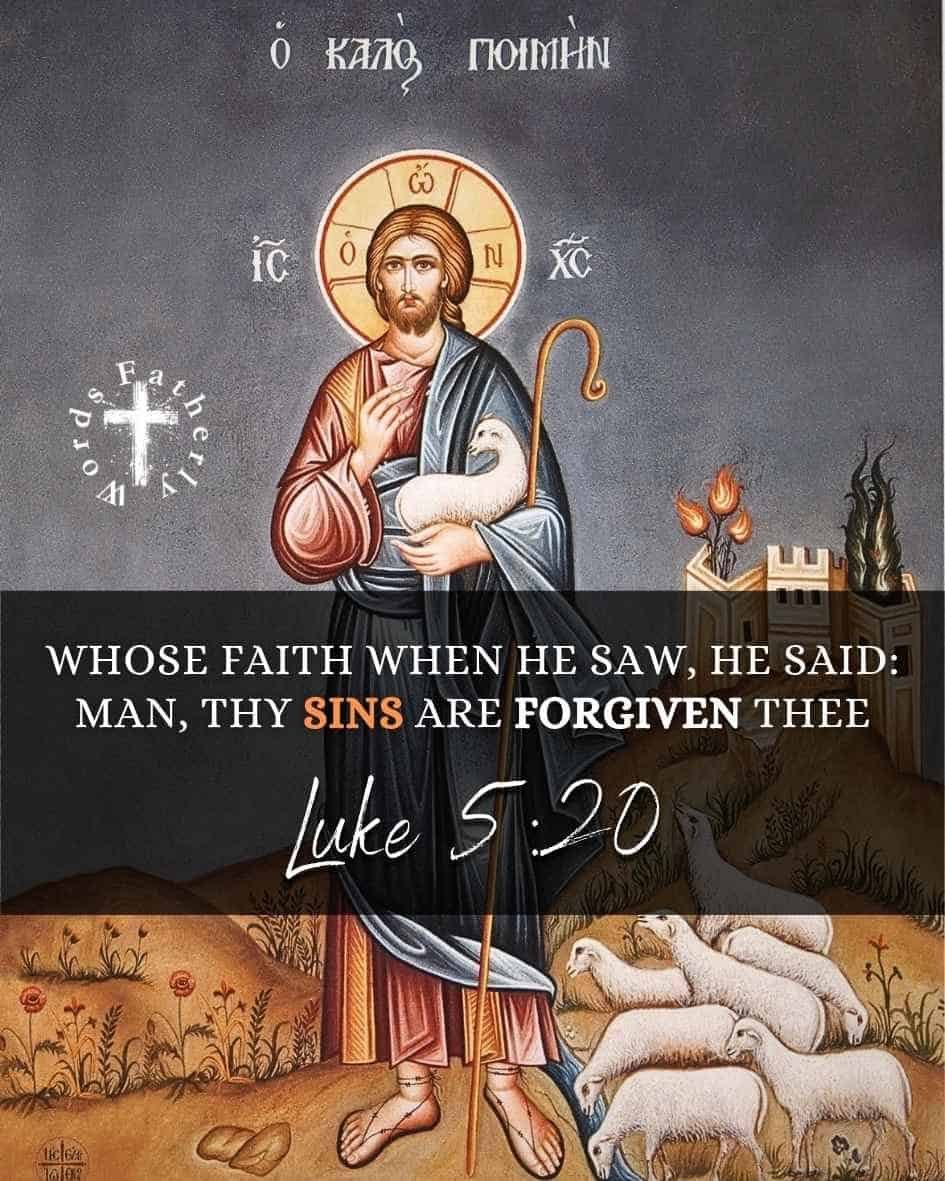
- We never open the door to the Gospel at all. No prayer, no reading, no icon in the home. Orthodox families have kept an icon of Christ in the place where they live and pray for this very reason: it is hard to pretend He is absent when His face looks back at you.
If you recognized yourself in even one of these, you are not alone. The Gerasenes were ordinary people. The difference is that we still have time to answer differently.
We push Him away because we are afraid of what He will ask of us and of what we will lose.
Why Jesus Left Without a Fight: Christ’s Humility and Our Freedom
St. John Chrysostom points to the humility of Christ in verse 37. After conferring such great benefits, Christ is sent away, and He puts up no obstacle. He boards the ship and leaves those who had declared themselves unworthy of His teaching.
This is how God treats human freedom. He made us free, and He will not break down a door to save us against our will.
Later in Luke, when a Samaritan village refuses Him and James and John want to call down fire, Christ rebukes them: “the Son of man is not come to destroy men’s lives, but to save them” (Luke 9:56).
Looking at Jerusalem, He says, “how often would I have gathered thy children together, even as a hen gathereth her chickens under her wings, and ye would not!” (Matthew 23:37). The ache in that sentence belongs to a Lord who wants to save and will not force.
But the Church never reads a closed door as the end of the story. A refused Christ is not an abandoned sinner. He leaves the shore, and He leaves a witness behind, as verse 39 shows.
The Christ Pantocrator of Saint Catherine’s Monastery, one of the oldest Byzantine religious icons, dating from the 6th century AD, has looked out from the desert of Sinai for centuries with a gaze that is gentle and searching at once, the gaze of the Lord who never forces a door and never stops calling.
Our canvas print of this icon is the perfect, original religious gift for faithful Christians, a quiet presence in the home that makes a real difference, and with the code WELCOME-10 you receive 10% off.

Sitting at His Feet: What the Gerasenes Missed and the Healed Man Found
Set the two groups side by side. The crowd stands at a distance, afraid, asking Him to go. The healed man is sitting at the feet of Jesus, clothed and in his right mind (verse 35).
Titus of Bostra notes that he never left those feet, because that was where he had found safety. The cure was not only an event in the past. It was a place to stay: near Christ.
The man understood this himself. When the ship was ready to leave, he begged to go along (verse 38).
St. Theophylact explains the request: having learned by experience, he feared that far from Jesus he might fall prey again to evil spirits. Christ does not scold that fear. He answers it by sending the man home, showing that His grace can protect even where He is not bodily present.
And He has promised the same to us: “lo, I am with you alway, even unto the end of the world” (Matthew 28:20).
The Lord stays with us in the Church, in the Holy Mysteries, in prayer and in His Word.
Many of us know that same fear of being left alone with our worries, and the Church has always offered help for anxious hearts: certain Psalms of David and the prayers of St. Arsenios the Cappadocian. Which Psalms to turn to and how to pray them are waiting in our free PDF, so enter your email in the form on this page and we will send it straight to your inbox.
Return to Thy House: How Christ Comes Back to Those Who Sent Him Away
Christ leaves, and He leaves a teacher. St. John Chrysostom says that, abandoning those who had proclaimed themselves unworthy of His teaching, the Lord appointed as their teacher the man who had been set free from the demons. The town that asked Him to go now hears Him through the one person it cannot ignore: the man everyone knew from the tombs.
Titus of Bostra asks why Jesus, who so often told the healed to tell no one, here says, “tell how great things God hath done to thee.” His answer is that the whole country did not know God and was in bondage to the worship of demons. The healed man knew Jesus to be God, and so he published what Jesus had done. The Lord said “God,” and the man said “Jesus.”
St. Theophylact notices another detail. Christ speaks of what God has done, not of what “I” have done, giving us an example of humility: we attribute all our righteousness to God. The healed man’s message is not a story about himself. It is a testimony to God’s work.
St. Theophylact also reads the scene mystically. Gerasa, he says, stands for the Gentile nations, whom Christ visited after His Passion and Resurrection through His preachers. The healed man becomes a herald before the heralds. Mark tells us he proclaimed it in the Decapolis, the ten cities of the region, and that all marveled (Mark 5:20).
Our full commentary on Luke 8:26–39 looks at the contrast between verse 27 and verse 39, where the man who had no house is sent back to his house. Here the lesson is practical. Christ returns to those who have sent Him away, and often He returns through someone they know.
Your house is your first mission field: your family, your neighbors, your workplace. You do not need a pulpit. A changed life, and a word of thanks to God when someone asks, is how He knocks at their door.
A Reflection for the Sixth Sunday of Luke: Questions to Ask Before the Nativity Fast
This reading comes in the autumn, as the Church approaches the Nativity Fast, the season of making room for Christ. Bring these questions to prayer, and take your answers to Confession.
- What is my herd? What am I afraid of losing if Christ comes closer?
- Where have I told Him to wait: a confession, a reconciliation, a habit?
- Whom have I written off as a lost cause, as the town did with the man in the tombs?
- Who in my house is waiting to hear what God has done for me?
- Which short prayer will I keep through the day?
The Gerasenes said, “depart from us.”
The disciples on the road to Emmaus said, “Abide with us” (Luke 24:29). Make that your prayer through the Fast.
Frequently Asked Questions About Luke 8:37 and the Gerasenes
Why did the people of Gerasa want Jesus to leave? Luke says they were seized with great fear (Luke 8:37). They had witnessed Christ’s power, lost a herd of swine, and were unwilling to face the change, repentance and loss that welcoming Him would bring.
What does it mean to ask Jesus to leave in a spiritual sense? It means choosing comfort, gain or habit over Christ: postponing repentance, keeping a sin we love, or leaving Him at the edge of our daily life.
Did Jesus punish the Gerasenes for asking Him to leave? No. He left without resistance (verse 37), which St. John Chrysostom praises as humility, and then sent them a witness: the healed man (verse 39).
Why didn’t Jesus let the healed man follow Him? Christ sent him home to be a witness among his own people. St. Theophylact adds that the man feared falling back into the demons’ hands, and Christ showed that His grace protects even where He is not bodily present.
How can I welcome Christ instead of sending Him away? Begin with Confession, forgive anyone you are holding a grudge against, keep a short daily prayer such as the Jesus Prayer, read the Gospel, and tell your family when God helps you.
