
The Parable of the Wicked Tenants in Matthew 21:33–42 stands as one of the most sobering warnings in the New Testament.
Spoken by our Lord and God and Savior Jesus Christ during Holy Week shortly before His voluntary Passion, this Gospel passage confronts us directly with the reality of human ingratitude, spiritual pride, and the accountability of the human soul.
The Holy Gospel Reading: Matthew 21:33–42
[33] Hear ye another parable. There was a man an householder, who planted a vineyard, and made a hedge round about it, and dug in it a press, and built a tower, and let it out to husbandmen; and went into a strange country.
[34] And when the time of the fruits drew nigh, he sent his servants to the husbandmen that they might receive the fruits thereof.
[35] And the husbandmen laying hands on his servants, beat one, and killed another, and stoned another.
[36] Again he sent other servants more than the former; and they did to them in like manner.
[37] And last of all he sent to them his son, saying: They will reverence my son.
[38] But the husbandmen seeing the son, said among themselves: This is the heir: come, let us kill him, and we shall have his inheritance.
[39] And taking him, they cast him forth out of the vineyard, and killed him.
[40] When therefore the lord of the vineyard shall come, what will he do to those husbandmen?
[41] They say to him: He will bring those evil men to an evil end; and will let out his vineyard to other husbandmen, that shall render him the fruit in due season.
[42] Jesus saith to them: Have you never read in the Scriptures: The stone which the builders rejected, the same is become the head of the corner? By the Lord this has been done; and it is wonderful in our eyes.
Why the Church Chose Matthew 21:33–42 for the 13th Sunday of Matthew
The liturgical calendar of the Holy Orthodox Church is a divine therapeutic school designed to guide the faithful toward deification. The reading of Matthew 21:33–42 on the 13th Sunday of Matthew occurs during a critical time in the church year, calling believers to wake up from spiritual lethargy as autumn approaches.
The Holy Fathers appointed this reading for this specific Sunday for several profound theological reasons:
- An Examination of Spiritual Fruitfulness: Having spent weeks listening to the miracles and divine instructions of Christ throughout the summer, the Church now halts to ask each Christian a direct question: What spiritual fruits have you produced with the grace given to you through Baptism and the Holy Mysteries?
- The Mystery of God’s Long-Suffering and Divine Justice: The passage presents a perfect balance of divine mercy and righteousness. God waits with immense patience for human repentance, yet He reminds us that our earthly stewardship is finite and judgment is real.
- The Transfer of Stewardship to the New Israel: Historically, this Gospel proclaims the movement of divine grace from those who rejected the Messiah to the Holy Orthodox Church, gathered from all tribes and nations as the New Israel.
- Preparation for the Cross: By hearing Christ foretell His own murder outside the walls of the vineyard, the faithful are instructed that salvation is achieved through the Holy Cross and Resurrection, anchoring our hope entirely in the Lord of Glory.
Deep Patristic Interpretations: Secrets of the Spiritual Vineyard
A brief commentary on this Gospel reading according to Holy Tradition reveals that every physical element of the vineyard corresponds to an interior spiritual reality within the human soul and the Body of Christ.
The Householder and the Creation of the Soul
The Householder in the parable is God the Father, the divine Architect who creates all things out of sheer goodness. The vineyard represents the Kingdom of God, the Church, and by extension, the individual human soul entrusted to every human being.
Notice the unrepeatable divine care spent in establishing the vineyard:
- He planted a vineyard: God does not place the soul into a spiritual void. He creates human nature with natural goodness, endowinig it with reasonable faculties, free will, and the capacity for divine communion.
- He hedged it round about: As Saint John Chrysostom and Blessed Theophylact explain, the hedge is the Divine Law, the boundaries of Holy Tradition, the protective presence of Holy Angels, and the sacred doctrines of the Church that defend the soul from the incursions of demons and passion-driven thoughts.
- He digged a winepress in it: The winepress signifies the Holy Altar, the mystery of the divine Eucharist, and the capacity of the human heart to undergo ascetic struggle in order to pour out the sweet juice of spiritual virtues.
- He built a tower: The tower represents watchfulness, holy prayer, and the mind functioning as a vigilant guard. It is the high place of sobriety from which the watchful mind detects the subtle approaches of temptation.
- He let it out to husbandmen and went into a far country: God grants mankind absolute freedom. His “going into a far country” does not imply distance or abandonment; rather, it signifies His divine long-suffering and restraint, stepping back so that human free will can prove its love and loyalty through voluntary virtue.
The Mission of the Servants and the Pathology of Ingratitude
When the time of the harvest drew near, the Householder sent His servants to collect the fruits.
In salvation history, these servants are the Old Testament Holy Prophets, patriarchs, and righteous ones sent to call the people back to God.
Within the interior life of every believer, these servants represent:
- The natural voice of conscience speaking in the inner heart.
- The teachings of the Holy Scriptures and the Holy Fathers.
- Providentially permitted afflictions, illnesses, and sorrows meant to humble our spiritual pride.
- The quiet guidance of our spiritual fathers and confessors.
The violent response of the wicked husbandmen demonstrates the progressive hardening of a heart trapped in self-love. First, they beat a servant, then they kill another, and finally they stone another.
When a person repeatedly ignores the gentle checks of conscience and the guidance of the Church, spiritual callousness sets in, leading to open hostility against God’s divine will.
The Murder of the Son and the Root of Sin
In His ultimate condescension, the Householder sends His Only-Begotten Son, saying, “They will reverence my son.” This detail reveals the incomprehensible depth of God’s love, who spares nothing to save His fallen creation.
Yet, seeing the Son, the husbandmen exclaim: “This is the heir; come, let us kill him, and let us seize on his inheritance.“
Here the Holy Fathers identify the primary root of human fallenness: the demonic delusion of self-ownership.
The wicked husbandmen desired the gifts of the vineyard while seeking to destroy the Giver. They wished to make themselves lords over creation, forgetting that they were merely mortal stewards.
This same spiritual disease infects the modern soul whenever we treat our body, health, time, intelligence, and material wealth as strictly our own creation.
We consume God’s gifts daily while banished in self-reliance, living as though God does not exist.
This subtle pride isolates the soul from divine grace, giving rise to deep spiritual death and inner darkness.
When we feel overwhelmed by this inner restlessness and the crushing noise of the secular world, we can find true peace by returning to sacred prayer practices.
Reading specific Psalms of David and incorporating the targeted prayers of Saint Arsenios the Cappadocian offers a proven path to calm the anxious mind and restore divine order to the heart. You can learn more about how to access these powerful traditional remedies in our free printable guide.
The Cornerstone Rejected by the Builders
Jesus concludes the parable by citing Psalm 117: “The stone which the builders rejected, the same is become the head of the corner: this is the Lord’s doing, and it is marvellous in our eyes.“
The “builders” were the religious leaders who attempted to construct a spiritual life grounded in human pride, legalism, and worldly ambition. They rejected Christ because He preached humility, repentance, and the spiritual Cross.
Yet through His voluntary death and Glorious Resurrection, Christ became the immovable Cornerstone of reality itself, holding together Heaven and earth, angels and men, in His divine Body.
If an individual builds their life on any foundation other than this Rejected Stone, their spiritual house will collapse when tested by the wind and rain of trials and bodily death.
Practical Applications: Tending the Vineyard of the Soul
The Parable of the Wicked Tenants is not a mere historical critique; it is a spiritual mirror held before us.
How do we ensure that we do not fall into the condemnation of the wicked husbandmen?
1. Cultivate Unceasing Eucharist and Thanksgiving
Ingratitude is the mother of all passions. When the heart ceases to give thanks to God, it rapidly falls into the illusion that it is self-sufficient.
- Begin every morning by thanking God for life, breath, the light of day, and the opportunity for repentance.
- Repeat the Jesus Prayer continually through the day: “Lord Jesus Christ, Son of God, have mercy on me, a sinner.“
- Before sleeping, make an accounting of the day, giving thanks for both comforting blessings and humbling trials.
2. Live as a Steward of Divine Gifts
Everything we possess is a trust handed to us by God. Our physical health, family, spiritual gifts, and money belong to the Master of the vineyard.
- Frequently reflect on the question: “How am I using what God has lent to me for His glory and the relief of my neighbor?“
- Give alms secretly and generously, knowing that in feeding the poor, we return to Christ what is already His own.
- Free your heart from possessiveness, acknowledging that we enter this world with nothing and leave with nothing except the state of our soul.
3. Heed the Guidance of Your Spiritual Father
God speaks to us constantly through humble, ordinary channels. We must cultivate inner stillness to hear His call before crisis forces us to yield.
- Do not ignore or justify small transgressions when your conscience convicts you.
- Bring your thoughts and struggles regularly to Holy Confession, receiving the counsel of your spiritual father with humility.
- Approach the Holy Scriptures daily, reading the Gospel text not as an academic exercise, but as a living command addressed personally to you.
4. Guard the Tower of Interior Watchfulness
The tower in the parable represents ascetic watchfulness over the heart. Without constant watchfulness over our thoughts, passions easily breach the inner wall and lay waste to spiritual virtues.
- Practice custody of the senses, protecting your eyes and ears from useless, chaotic, and soul-corrupting media.
- Reject evil thoughts at their very first appearance before they settle into the heart and turn into sinful actions.
- Maintain a stable rule of prayer, fasting, and participation in the Holy Mysteries to keep the spiritual hedge of your soul impenetrable.
Summary Table: Spiritual Symbols in Matthew 21:33–42
The following table summarizes the main allegorical symbols contained in the Parable of the Wicked Tenants according to Orthodox Patristic Tradition:
| Symbol in the Parable | Patristic Interpretation | Application to the Individual Soul |
| The Householder | God the Father | The Creator who endows us with life and grace |
| The Vineyard | The Church / The Soul | The internal garden where virtues must be cultivated |
| The Hedge | The Law / Holy Tradition | Divine protection guarding us from evil passions |
| The Winepress | The Holy Altar / Sacraments | The locus of sacrifice and spiritual transformation |
| The Tower | Watchfulness / Prayer | The vigilant mind guarding against sinful thoughts |
| The Husbandmen | Mankind / Stewards | Our role as temporary caretakers of God’s gifts |
| The Servants | Prophets / Conscience | Divine calls urging the soul to repentance |
| The Son | Jesus Christ | The Lord of glory slain for our redemption |
| The Cornerstone | The Risen Christ | The eternal foundation of the Christian life |
Yielding Fruit for the Heavenly Master
The message of Matthew 21:33–42 is an urgent call to true spiritual vigilance.
God has provided our souls with every gift needed to achieve salvation. He has granted us the hedge of His Holy Church, planted divine grace in our hearts through the Holy Sacraments, and given His own Son to be our eternal foundation.
Our primary calling as Orthodox Christians is to live with deep humility, acknowledging that we are stewards in God’s vineyard, and striving daily to yield the fruits of the Holy Spirit: love, joy, peace, long-suffering, kindness, goodness, faithfulness, gentleness, and self-control.
In a world full of noise and worry, remind yourself, and everyone you meet, that Jesus Christ Conquers.
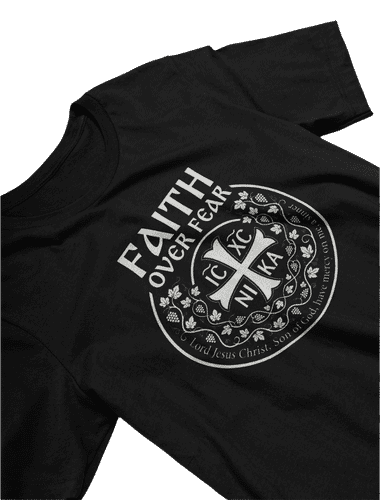
For brothers and sisters looking for a subtle way to carry the Jesus Prayer and the ancient symbol of Christ’s victory into everyday life, we are grateful to share our new community apparel piece featuring the traditional IC XC NIKA Christogram, embodying faith over fear in your daily routine.
New!
Carry the Symbol of Victory
From $29.45
In a world full of noise and worry, remind yourself, and everyone you meet, that Jesus Christ Conquers.
The traditional IC XC NIKA Christogram has stood for centuries.
Our 🎁 gift to the community: use code WELCOME-10 at checkout.
When our life is built upon Christ, the Head Cornerstone, we become citizens of an unshakeable Kingdom.
Let us cast off spiritual indifference, nurture a grateful heart, and faithfully tend the vineyard of our soul until the Lord returns in glory.
Frequently Asked Questions About Matthew 21:33–42
What is the core spiritual lesson of the Parable of the Wicked Tenants?
The core lesson is that all human life and spiritual gifts are entrusted to us by God as a sacred stewardship. We are called to offer back the fruits of repentance, humility, and good works, avoiding the trap of spiritual pride and self-ownership.
Why is Christ called the Cornerstone in Matthew 21:42?
Christ is the Cornerstone because He unites Heaven and earth, Jew and Gentile, in Himself. Though rejected and crucified by those seeking earthly power, His Resurrection made Him the ultimate foundation of the Church and human salvation.
How do we tend the vineyard of our soul in daily life?
We tend the vineyard through unceasing prayer, regular participation in Holy Confession and Holy Communion, fasting, guarding our thoughts, reading Holy Scripture, and fulfilling God’s commandments with active love and gratitude.
Dive Deeper:
