
The Gospel of Saint Matthew contains some of the most profound divine disclosures regarding the Kingdom of Heaven. Among these, the Parable of the Royal Wedding Feast in Matthew 22:1-14 stands as a towering summary of divine economy, human freedom, and the mystical destiny of mankind.
In Orthodox Christian theology, salvation is never viewed as an external legal acquittal or a mere passive inheritance. Salvation is deification, an ontological transformation wherein human beings are healed of death and corruption to become partakers of the divine nature by uncreated grace.
The royal marriage prepared by God the Father for His divine Son is the ultimate icon of this eternal communion.
Through the Incarnation, Jesus Christ united divine nature with human nature in His Person, betrothing Himself to the Church and inviting every human soul to sit at the table of His eternal joy.
Holy Gospel Reading: Matthew 22:1-14
[1] And Jesus answering, spoke again in parables to them, saying:
[2] The kingdom of heaven is likened to a king, who made a marriage for his son.
[3] And he sent his servants, to call them that were invited to the marriage; and they would not come.
[4] Again he sent other servants, saying: Tell them that were invited, Behold, I have prepared my dinner; my beeves and fatlings are killed, and all things are ready: come ye to the marriage.
[5] But they neglected, and went their own ways, one to his farm, and another to his merchandise.
[6] And the rest laid hands on his servants, and having treated them contumeliously, put them to death.
[7] But when the king had heard of it, he was angry, and sending his armies, he destroyed those murderers, and burnt their city.
[8] Then he saith to his servants: The marriage indeed is ready; but they that were invited were not worthy.
[9] Go ye therefore into the highways; and as many as you shall find, call to the marriage.
[10] And his servants going forth into the ways, gathered together all that they found, both bad and good: and the marriage was filled with guests.
[11] And the king went in to see the guests: and he saw there a man who had not on a wedding garment.
[12] And he saith to him: Friend, how camest thou in hither not having a wedding garment? But he was silent.
[13] Then the king said to the waiters: Bind his hands and feet, and cast him into the exterior darkness: there shall be weeping and gnashing of teeth.
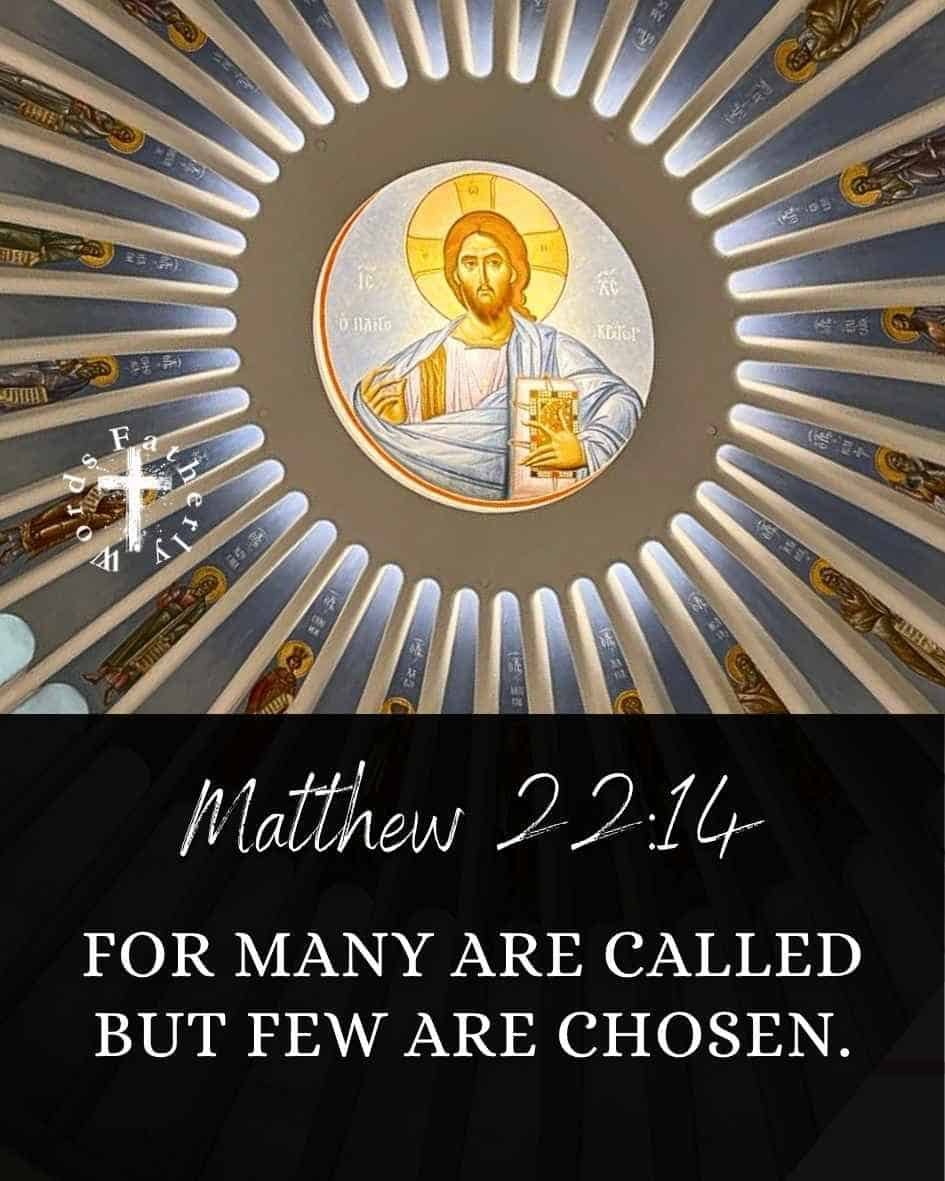
[14] For many are called, but few are chosen.
Why the Church Appoints Matthew 22:1-14 on the 14th Sunday of Matthew
The Orthodox liturgical calendar is a therapeutic journey directed by the Holy Spirit to guide the faithful into deeper spiritual health.
The reading of Matthew 22:1-14 is appointed for the 14th Sunday of Matthew, a crucial moment in the post-Pentecost spiritual season.
To grasp the full liturgical intention behind this placement, we must observe how Christ speaks this parable during His final public confrontation with the religious leaders in Jerusalem, mere days before His voluntary Passion on the Cross.
In the Sunday Gospel sequence, this passage directly follows the Parable of the Wicked Tenants.
Having demonstrated how the leaders of the Old Covenant rejected the prophets and would soon slay the heir, Christ immediately transitions to the Parable of the Royal Wedding Feast to reveal the future of salvation history.
The Holy Fathers appointed this reading for this specific Sunday for three distinct spiritual reasons:
1. The Transition from the Old Covenant to the Universal Church
The parable clearly marks the shifting of spiritual responsibility.
Those first invited, the leaders and populace of ancient Israel who had been prepared through the Law and the Prophets, refused the invitation when the fulfillment arrived.
The King then commands His servants to go out to the main roads and thoroughfares, symbolizing the apostolic mission to the Gentiles and the gathering of all nations into the Catholic Church.
2. The Living Reality of the Holy Eucharist
The royal wedding feast is not merely a metaphor for heaven after death.
It is an immediate description of the Divine Liturgy celebrated every Sunday in the Orthodox Church. Saint John Chrysostom notes that at every Liturgy, Christ offers His own sacrificed Body and Blood as the true heavenly food.
By placing this Gospel in the late summer liturgical cycle, the Church calls believers to evaluate their reverence, attendance, and preparation for Holy Communion.
3. A Call to Spiritual Sobriety and Synergia
While entry into the Church is an unmerited gift of divine grace extended to all humanity, remaining in the Kingdom requires active cooperation, known as synergia.
By introducing the tragic figure of the guest lacking a wedding garment, the Church warns her children against spiritual complacency. Belonging to the visible Church or attending services is insufficient if the heart remains unchanged and unrepentant.
Deep Exegesis of Matthew 22:1-14: Patristic and Dogmatic Commentary
To enter into the fullness of this parable, we must examine the deep spiritual symbolism behind every element of the text through the Orthodox Patristic tradition.
The Mystical Marriage: The Incarnation as the Bridechamber
Saint Gregory the Dialogist and Saint John Chrysostom teach that the King who made a marriage for His Son represents God the Father preparing the salvation of the world through His Incarnate Son.
Why is our salvation described as a marriage feast?
Marriage represents the most complete, intimate, and irrevocable union possible.
In the womb of the Holy Virgin, the divine nature of God the Word united Himself with human nature. Christ did not assume a human persona; He assumed complete human nature, purifying it, healing it of mortality, and raising it to sit at the right hand of the Father.
The Church is the Bride of Christ. In every Holy Mystery, especially the Eucharist, the soul experiences an intimate, real union with the Heavenly Bridegroom.
The feast is filled with divine joy because death has been swallowed up in victory.
The Divine Long-Suffering and Human Rejection
The parabolic narrative highlights the incredible patience of God.
The King does not issue a single call and instantly shut His doors upon meeting hesitation. He sends servants a first time, and when the guests refuse, He sends a second group of servants with an even more encouraging message: “Behold, I have prepared my dinner; my beeves and fatlings are killed, and all things are ready: come ye to the marriage.”
The slain oxen and fatlings point directly to the mystical Sacrifice of Christ.
Under the Old Law, animal sacrifices were offered continuously as shadows of what was to come. But in the New Covenant, the true Lamb of God has been slain once for all on Golgotha. The table is fully set; the grace of salvation is completely prepared.
Yet, despite this infinite generosity, those invited showed utter coldness.
In Patristic exegesis, the farm represents carnality and attachment to physical comfort, while the merchandise represents greed, economic anxiety, and the pursuit of earthly prestige.
These invitees were not necessarily committers of gross criminal acts; their downfall was spiritual indifference. They allowed legitimate temporal tasks to displace their relationship with God.
In our current culture, the overwhelming speed of modern life often leaves believers feeling mentally exhausted, anxious, and spiritually drained by everyday burdens.
If you are struggling under the heavy weight of daily anxiety and inner turmoil, praying through specific Davidic Psalms together with the intercessory prayers of Saint Arsenios the Cappadocian offers a powerful spiritual sanctuary that brings deep peace back to the soul.
The Mission to the Highways: Bad and Good Called Alike
When the original invitees proved themselves unworthy through their persistent refusal, the King commanded His servants to go into the highways and crossways of the world and gather as many as they could find, both bad and good.
This detail is foundational to Orthodox ecclesiology.
The Church is not an exclusive club reserved for the spiritually elite or morally immaculate. She is a spiritual hospital open to all.
Christ did not come to call the righteous, but sinners to repentance.
The servants gathered the outcast, the spiritually wounded, the Gentiles who knew nothing of the Law, and those buried in dark sins.
However, being called into the hospital is only the beginning. Being invited into the royal hall means we are expected to accept the treatment offered by the Divine Physician.
The Mystery of the Wedding Garment: Repentance, Baptism, and Love
The climax of the parable occurs when the King enters the banquet hall to inspect the guests. He sees a man who is not wearing a wedding garment.
In the ancient Near East, when a monarch hosted a celebration of this magnitude, standard protocol dictated that royal robes were provided in the outer vestry for all invited guests, particularly those brought in from the streets who lacked appropriate clothing.
Therefore, this guest was not missing a wedding garment due to poverty or sudden notice. He had passed through the outer vestry, received the offered robe, and deliberately cast it aside or refused to put it on.
He wished to enjoy the King’s rich foods while maintaining his own dirty, worldly garments.
What does the wedding garment represent in Orthodox Patristic theology?
- The White Robe of Holy Baptism: Saint Andrew of Crete and Saint John Damascene write that the wedding garment is the radiant tunic of grace received when a person is immersed in the holy waters of Baptism. When an Orthodox Christian is baptized, the priest clothes them in a white garment, chanting: “Grant unto me the robe of light, O Thou Who clothest Thyself with light as with a garment.”
- The Virtue of Active Love: Saint Gregory the Dialogist and Saint Augustine explicitly identify the wedding garment as the virtue of unfeigned love or charity. Saint Gregory explains that a person who enters the Church with faith but lacks selfless love for God and his neighbor is sitting at the feast without a wedding garment.
- The Transformation of the Mind: Saint Symeon the New Theologian teaches that the wedding garment is Christ Himself, consciously acquired through continuous repentance, holy virtues, and participation in the Holy Spirit.
To wear the wedding garment means that our baptismal grace remains alive and active within us.
It means that we do not merely hold orthodox doctrines in our intellect while living a pagan lifestyle, but that our faith is visibly manifested through humility, purity, forgiveness, and works of mercy.
The Speechlessness of the Soul and the Mystery of Eternal Judgment
When the King asks the guest: “Friend, how camest thou in hither not having a wedding garment?”, the Gospel records that the man was speechless.
In the original scriptural language, the word used for speechlessness implies being muzzled or bound by the weight of truth. He had no excuse to offer. He could not claim he was not offered a garment, nor could he claim he did not know a garment was required.
His silence is the absolute self-condemnation of a human being who treated divine grace with contempt.
The King commands the attendants to bind his hands and feet and cast him into the exterior darkness, where there will be weeping and gnashing of teeth.
In Orthodox dogmatic theology, God does not create a place of torture called hell to inflict external vengeance on sinners. God is uncreated light and divine love.
As Saint Isaac the Syrian famously writes, those who find themselves in hell are tormented by the scourge of divine love. He then explains that those who become conscious that they have sinned against love experience a suffering more grievous than any fear of external punishment, while the same love becomes joy for the blessed.
For a soul that has acquired the wedding garment of repentance, love, and purity, the uncreated presence of God is supreme joy, light, and heavenly rest.
But for a soul that has hardened its heart, rejected repentance, and clung to self-love, that same divine love feels like a burning flame and outer darkness.
The binding of the hands and feet represents the spiritual paralysis that takes place after death, when the earthly time for active struggle and repentance has come to an end.
Christ concludes the parable with the sobering words: “For many are called, but few are chosen.”
The call to salvation is universal and offered to every human soul without exception. But the chosen are those who freely respond to grace, put on the garment of Christ, and persevere in a life of repentance until their final breath.
Practical Applications for the Everyday Orthodox Christian
The Parable of the Royal Wedding Feast is a practical mirror for our daily spiritual life. Here is how we must translate this Patristic commentary into daily Orthodox living:
1. Approaching the Divine Liturgy with Holy Fear and Preparation
The Divine Liturgy is the actual presence of the Royal Wedding Feast on earth. We must never allow our participation in worship to become a mindless, social routine.
To prepare properly for the Eucharistic Banquet:
- Practice Pre-Communion Fasting: Observe strict Eucharistic fasting from midnight prior to receiving Holy Communion, keeping both body and senses disciplined.
- Read the Communion Prayers: Pray through the Office of Holy Communion the evening before or morning of Liturgy, cultivating deep awareness of our unworthiness and trust in God’s mercy.
- Seek Reconciliation: Never step forward to the Holy Chalice while holding active malice, hatred, or unrepentant anger against any human being. Reconcile with your brother or sister first.
2. Frequent Cleaning of the Garment Through Confession
Even after Baptism, we stain our spiritual garments through daily failures, uncharitable words, prideful thoughts, and bodily passions.
God in His mercy has provided the Sacrament of Holy Confession as a second baptism.
Through the tears of sincere repentance and the prayer of absession read by a canonical Orthodox priest, the stains on our baptismal garment are washed clean. We must establish a regular rhythm of Sacramental Confession with our spiritual father, treating it as necessary medicine for the soul rather than a rare obligation.
3. Weaving the Garment Through Active Almsgiving and Virtue
Saint John Chrysostom asserts that the spiritual garment is woven out of practical works of mercy done for the poor and suffering.
We weave our wedding garment daily when we:
- Offer secret financial or material aid to those in need.
- Visit the sick, lonely, or elderly, offering them genuine time and care.
- Control our tongue from slander, gossip, and harsh judgments against others.
- Forgive offenses immediately, remembering how much God continuously forgives us.
Bearing Witness to Christ’s Victory in the World
As we strive to preserve our baptismal garments clean amidst a secular, chaotic world, carrying physical reminders of our faith helps keep our mind oriented toward the Heavenly Kingdom throughout the workday.
For brothers and sisters looking for a subtle way to carry the Jesus Prayer and the ancient symbol of Christ’s victory into everyday life, we are grateful to share this new community apparel piece with you. Featuring the traditional IC XC NIKA Christogram alongside the enduring message “Faith over Fear,” this shirt serves as a quiet witness to the truth that in a world full of noise and worry, Jesus Christ Conquers.
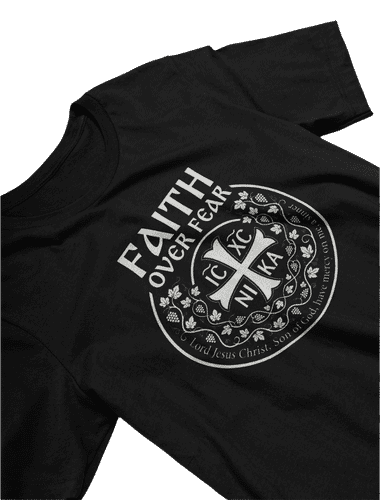
New!
Carry the Symbol of Victory
From $29.45
In a world full of noise and worry, remind yourself, and everyone you meet, that Jesus Christ Conquers.
The traditional IC XC NIKA Christogram has stood for centuries.
Our 🎁 gift to the community: use code WELCOME-10 at checkout.
Conclusion: Accepting the Invitation Today
The Parable of the Royal Wedding Feast in Matthew 22:1-14 presents every human soul with a choice between temporal distractions and eternal life.
God the Father has made a marriage for His Son. The divine sacrifice on Golgotha has been completed, the Holy Spirit fills the Church, and the banquet table of the Holy Eucharist is fully spread.
Let us not offer excuses.
Let us not allow farms, merchandise, or temporal anxieties to steal our eternal inheritance.
Through daily repentance, frequent participation in the Holy Sacraments, and active works of love, let us continuously wash and adorn our wedding garment, so that when the King comes to inspect the guests, we may be found worthy to sit at His table forever.
Summary for Personal Reflection
- The Call is Free: Salvation is an unmerited gift of divine grace open to all people without distinction.
- The Response is Required: We must actively respond through free will, entering the Church and receiving the Sacraments.
- The Garment is Essential: True faith must be clothed in baptismal purity, repentance, and selfless love.
- The Judgment is Real: Those who despise divine grace and remain unrepentant self-condemn themselves to outer darkness.
- The Time is Now: Today is the day of salvation; we must prepare our souls before the earthly journey closes.
Dive Depper:
