
Did the rich man and Lazarus really live, or did Christ invent them to make a point?
It is one of the most common questions about Luke 16:19-31, and the Orthodox answer is richer than a simple yes or no.
The short answer: the Church does not require one answer. St. Cyril of Alexandria saw a real event, because the Lord gives the poor man a name. Other readers have taken the story as a parable.
What the Church holds without doubt is the teaching itself: mercy withheld has eternal consequences, and the time to repent is now.
This short piece is a companion to our full commentary on the Gospel reading of the Fifth Sunday of Luke. It weighs both views, shows what the Church holds in common, and explains why the question matters less than the gate in the story.
Luke 16:19-31: The Two Verses That Frame the Story
On the Fifth Sunday of Luke, the Orthodox Church hears the whole reading at the Divine Liturgy. Two verses frame it: the beggar at the gate near the beginning, and Abraham’s last answer at the end.
[20] “A certain beggar, named Lazarus, was taken to his gate, full of sores…”
[31] “If they don’t listen to Moses and the prophets, neither will they be persuaded if one rises from the dead.”
Verse 20 gives us a man with a name, and that is where the debate begins. Verse 31 looks ahead to a Resurrection that many would still refuse, which is why the story points beyond itself.
Is It a True Story? The Case for a Real Event
Lazarus is the only character in any of Christ’s parables who is given a name. St. Cyril of Alexandria takes this seriously: a name suggests that the Lord is speaking of events that truly happened.
Euthymios Zigabenos and St. Theophylact add that there was a tradition of a poor man named Lazarus, well known in Jerusalem for his poverty.
His name means “God helps” in Hebrew, so even the name carries the message: this is the man everyone overlooked and God did not. A name also fits the point of the story. Real people have names and faces, and the rich man’s failure was to treat a real person as if he were nothing. By naming Lazarus, the Lord gives back to the forgotten man what the rich man withheld from him.
There is a further reason to listen with trust. Christ is the Lord of both the dead and the living (Romans 14:9), so when He speaks of Hades and Abraham’s bosom, He is not guessing. Whether He recalls one particular man or draws a picture, He speaks as the One who knows what lies on both sides of death.
Is It a Parable? The Case for a Story with a Purpose
Many preachers and readers call it a parable, and they have reasons. Luke opens it with the same words that begin the story of the unjust steward (Luke 16:1), so the opening alone does not settle the question.
The pictures of the afterlife also invite care. A flame, a thirsty tongue, a fingertip dipped in water, a conversation across a gulf: both men are still waiting for the resurrection of their bodies, so these bodily images are not a description of how souls are shaped.
The Fathers read such details as pictures that help us grasp realities beyond our senses, and they ask us to listen for the call to repentance instead of drawing a map.
Notice what the story does not need. Its teaching does not depend on identifying the rich man or on locating Hades on a map. Everything the Lord wants us to learn is already there: a gate, a table, a choice, a death, a judgment. That is why the Fathers could preach it to rich and poor alike without first settling a historical question.
Calling it a parable does not make it less true. A parable is not a lie. Death, judgment, mercy and the Kingdom are all real, and the Lord who tells the story is the Truth. The rich man may be a figure, but the hardness of heart, the Judgment and the mercy are not figures at all.
What the Orthodox Church Teaches: Two Readings, One Teaching
The Church has never forced the question, and the Fathers differ in emphasis. What she receives without hesitation is what both readings share.
Death is not the end, and every person meets the fruit of his life.
Hades is not the final state: both men wait for the Resurrection and the Last Judgment, and what they have now is a foretaste.
Mercy is central, because nothing in the Gospel is more closely tied to eternal life than how we treat the one at our door (Matthew 25:31-46). And the Church prays for the departed at every Liturgy, trusting in God’s mercy and leaving the verdict to Christ.
St. John Chrysostom preached a whole series of sermons on this passage, and his great concern in them is how his listeners live. The Orthodox way is not to settle such questions by private opinion. We read the Gospel in the Church, with the Fathers, and we are content to leave open what the Church leaves open. A believer can hold either reading safely, as long as the question never becomes a way to escape the teaching.
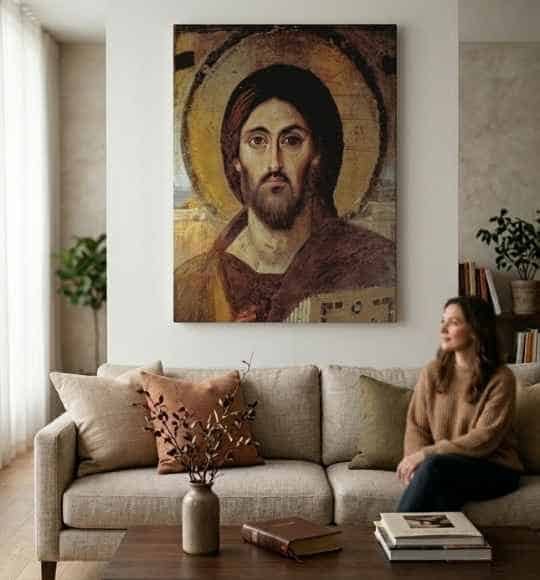
Both readings keep our eyes on the same Lord, who sees every Lazarus, and few images of Him are as moving as the Christ Pantokrator of Saint Catherine’s Monastery, one of the oldest Byzantine icons, painted in the 6th century and kept on Sinai for well over a thousand years, with a face stern on one side and tender on the other.
Our canvas of this icon is an authentic, original gift that makes a real difference in the home of any faithful Christian, and the code WELCOME-10 gives you 10% off.
Why the Gate Matters More Than the Question
There is a warning inside the debate.
In verses 27 to 31, the rich man’s brothers are offered a sign from the dead, and Abraham refuses: they already have Moses and the prophets. It is easy to spend our energy on questions about the story and none on its demand. Even a proof that Lazarus lived would change nothing for a heart that has decided not to listen.
So whichever way you read it, the question that remains is the one the story asks: who is lying at your gate?
It may be a neighbor who lives alone, a coworker who is quietly struggling, or someone asking for help near your church. Learn the name. Give something this week, however small, since the Lord promises a reward for a cup of cold water given in His name (Matthew 10:42). In the story the gulf is fixed only after death, and here the gate is still yours to open.
Three questions are worth carrying into your week:
- Where is my gate?
- What do I call mine that is really lent to me by God?
- What am I postponing that I already know I should do?
Write them down, and answer at least one before the week ends.
Arguing about a parable can be easier than facing the worry that quietly chokes our prayer: anxiety about money, health and the future. The Church has an old remedy for it, certain Psalms of David and the prayers of Saint Arsenios the Cappadocian, and which ones to pray, and when, is all in our free ebook, which will reach your inbox as soon as you enter your email in the form on this page.
Our full commentary on Luke 16:19-31 goes verse by verse. It explains why the rich man was never accused of a crime, why the Church reads this Gospel shortly before the Nativity Fast, what Abraham’s gentle word “son” reveals about the Kingdom, and six practical ways to open your own gate. Read it next, and you will hear this Gospel at the Liturgy with new ears.
