The rich man in Luke 16:19-31 is never accused of stealing, lying, cheating or hurting anyone. Christ does not list a single crime against him. Yet he lifts his eyes in Hades, in torment, begging for one drop of water.
So what did he do wrong?
He never saw Lazarus. A sick and hungry man lay at his gate every day, and the rich man feasted as if that man did not exist. That is the meaning of the parable of the rich man and Lazarus: the danger of wealth is not owning things, but a heart so full of itself that there is no room left for God, or for the neighbor He places at our door.
This short commentary on the Gospel reading of the Fifth Sunday of Luke goes through the passage step by step. You will see why the Orthodox Church reads it at this point in the year, why only one of the two men has a name, what Abraham’s gentle word “son” reveals, what the passage teaches about Hades and life after death, and how to live it today.
Luke 16:19-31: The Gospel Reading of the Rich Man and Lazarus
On the Fifth Sunday of Luke, the Orthodox Church hears this Gospel reading.
[19] Now there was a certain rich man, and he was clothed in purple and fine linen, living in luxury every day.
[20] A certain beggar, named Lazarus, was taken to his gate, full of sores,
[21] and desiring to be fed with the crumbs that fell from the rich man’s table. Yes, even the dogs came and licked his sores.
[22] It happened that the beggar died, and he was carried away by the angels to Abraham’s bosom. The rich man also died and was buried.
[23] In Hades, he lifted up his eyes, being in torment, and saw Abraham far off, and Lazarus at his bosom.
[24] He cried and said, ‘Father Abraham, have mercy on me, and send Lazarus, that he may dip the tip of his finger in water and cool my tongue! For I am in anguish in this flame.’
[25] But Abraham said, ‘Son, remember that you in your lifetime received your good things, and Lazarus bad things. But here he is now comforted, and you are in anguish.
[26] Besides all this, between us and you there is a great gulf fixed, that those who want to pass from here to you are not able, and that no one may cross over from there to us.’
[27] He said, ‘I ask you therefore, father, that you would send him to my father’s house;
[28] for I have five brothers, that he may testify to them, so they won’t also come into this place of torment.’
[29] But Abraham said to him, ‘They have Moses and the prophets. Let them listen to them.’
[30] He said, ‘No, father Abraham, but if one goes to them from the dead, they will repent.’
[31] He said to him, ‘If they don’t listen to Moses and the prophets, neither will they be persuaded if one rises from the dead.’
Why Did the Rich Man Go to Hades? It Was Not His Wealth
Start with what the story does not say. The Lord never calls the rich man a thief, a liar or an oppressor, and He does not say how the man got his money.
If wealth itself were the sin, Abraham would be in the wrong place. Abraham was very rich in livestock, silver and gold (Genesis 13:2), and he is the one who receives Lazarus.
The Church also honors the righteous Job, and Joseph of Arimathea, a rich man who gave Christ his own new tomb. Riches can serve God.
What the Lord does show us is a gate. Verse 19 says the feasting went on every day, and verse 20 says Lazarus was laid at the rich man’s gate. This was not a rare lapse of attention. Every time the rich man went out or came in, the suffering man was there.
St. John Chrysostom stresses that the poor man was always in front of him, so ignorance was no excuse. Notice also that verse 21 says Lazarus longed for the crumbs, not that he received them. The dogs showed more mercy than the man whose table he lay beside.
The Fathers do not soften what this means:
- St. John Chrysostom teaches that refusing to share with the poor is a kind of theft, because what we call ours is lent to us by God for the good of others.
- St. Basil the Great, speaking to the wealthy, says that the bread you store belongs to the hungry and the coat in your closet belongs to the one who has none.
The rich man treated everything as his own, so he gave nothing away, and his possessions became a wall.
Under the lack of mercy lies something deeper. St. John Climacus teaches that clinging to money is the child of unbelief. Abba Isaiah defines love of money as not trusting that God will take care of you.
A man who trusts God can open his hand. A man who does not will hold on to everything, even while a human being lies at his gate.
One last detail. The first time the rich man lifts his eyes is in Hades (verse 23). On earth he looked only at himself and his table. The Church spends her whole life teaching us to lift our eyes in time: in prayer before the icon of Christ, in the Liturgy, and in the faces of those who stand at our door.
Why the Church Reads the Rich Man and Lazarus on the Fifth Sunday of Luke
The Church does not choose her Gospel readings at random. After the Exaltation of the Holy Cross, she turns from Matthew to the Gospel of Luke and reads it Sunday by Sunday. The Rich Man and Lazarus is always the Fifth Sunday of Luke, and it always falls between October 30 and November 5.
- It begins at the Cross. On the Sunday after the Exaltation, the Lord says that whoever wishes to come after Him must deny himself, take up his cross, and follow Him (Mark 8:34-9:1).
- Then the Gospel of Luke opens with Peter, who has toiled all night and caught nothing. At the Lord’s word he lets down the nets, and then he falls at Jesus’ knees and says, “Depart from me, for I am a sinful man, O Lord.” Yet they bring the boats to land, leave everything, and follow Him (Luke 5:1-11).
- Next the Lord commands mercy. Love your enemies, do good, and be merciful, just as your Father also is merciful (Luke 6:31-36).
- Then He tells the parable of the Sower (Luke 8:5-15). The seed that falls among thorns, He explains, is choked by the cares, riches and pleasures of this life, and brings no fruit to maturity.
- On the feast of Saint Luke the Evangelist, which fell on a Sunday this year, the Lord tells the Seventy not to rejoice that the spirits are subject to them, but to rejoice that their names are written in heaven (Luke 10:16-21).
- On the Sixth Sunday of Luke, we meet the man of Gadara, who lived among the tombs and whom no one could bind. Christ sets him free, and the people find him sitting at the feet of Jesus, clothed and in his right mind. The whole region, seized with great fear, asks Christ to depart from them. The man who was healed begs to stay with Him (Luke 8:26-39).
And now comes the rich man. Mercy was commanded, mercy was shown by Christ, and the Word was sown. In the rich man we see a heart where the cares, riches and pleasures of this life left no room for the Word to grow, and no mercy for the poor man lying at his gate (Luke 16:19-31).
The chapter itself holds another key. A few verses earlier the Lord tells us to make friends for ourselves with unrighteous mammon, so that when it fails, they may receive us into everlasting dwellings (Luke 16:9). The rich man had the means to make a friend for eternity, and that friend was lying at his gate. The money failed, as all money does, and no one was waiting to receive him.
The calendar adds a second reason. The Church places the parable at the door of the fast to remind us what fasting is for. A fast that only changes our menu has missed its purpose.
The Fathers teach that fasting and almsgiving walk together: what we save by eating simply should reach the person who has nothing. Before we prepare to welcome Christ at His birth, the Church shows us where He waits for us now, in the poor man at the gate (Matthew 25:40).
Who Is Lazarus? Hidden Meanings in the Parable of the Rich Man and Lazarus
Lazarus is the only character in any of Christ’s parables who is given a name. His name means “God helps” in Hebrew, and that sums up the whole story: the man everyone overlooked is the man God helps. The beggar’s name is a quiet confession of faith, while the rich man, who had every human help, is left without one.
This reversal is deliberate. In the world, the names of the rich are carved on buildings and handed down in history, while the poor pass by like shadows. In the Gospel, the Lord turns this around. The Church keeps the same truth: every one of us is named at Baptism and named before God in the prayers of the Liturgy, and Christ tells His disciples to rejoice that their names are written in heaven (Luke 10:20).
Euthymios Zigabenos records an old tradition that called the rich man Nineveh, but the Gospel keeps him anonymous, and that silence teaches. A man who made no room for others ends up with no place in the story.
Now look at how Lazarus carries his suffering. He is poor, sick, hungry and ignored, yet the Gospel records no complaint from him, no curse against the rich man and no word against God.
St. John Chrysostom stresses that poverty alone saves no one. Lazarus is received for his patience and his thankfulness. Suffering does not make a person holy by itself. What matters is what the heart does with it, and the heart of Lazarus held on to God.
St. Nikolai Velimirović offers a striking picture: God set these two men side by side like mirrors. The wounds on the body of Lazarus showed the wounds hidden in the soul of the rich man, and the outward splendor of the rich man was a picture of the true splendor inside Lazarus. One looked healthy and was sick within. The other looked sick and was whole within.
One small word carries a lot. In verse 25 Abraham says the rich man “received” his good things. Euthymios Zigabenos notes that this word is used for what is owed, as in a repayment. Some Byzantine interpreters took this to mean that whatever small good the rich man had done was repaid to him in this life, and that the sufferings of Lazarus washed away whatever small faults he had. We do not need to press the point. It reminds us that God’s justice leaves nothing unnoticed, in a life that looks like pure luxury or in one that looks like pure misery.
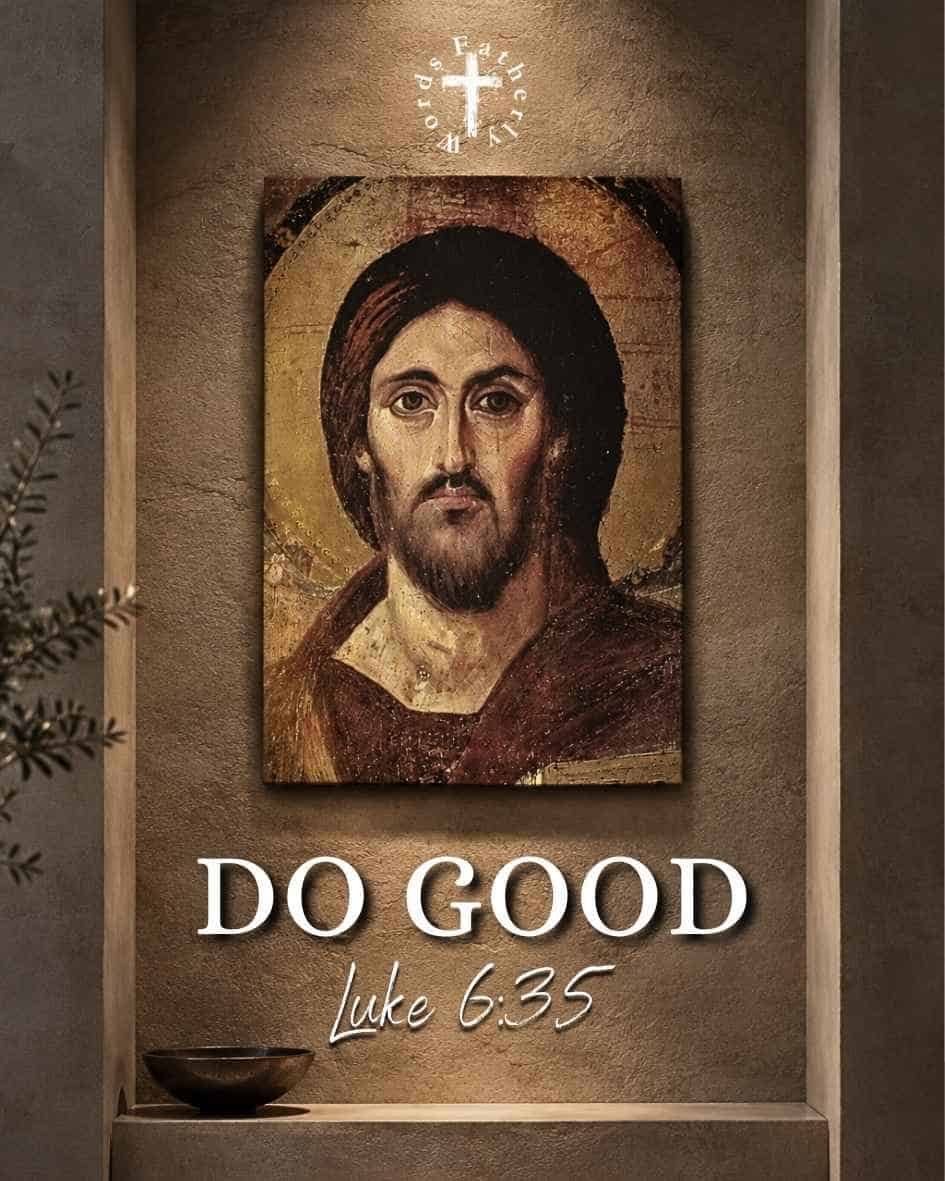
The One who notices every Lazarus has always been kept before the eyes of the faithful, and the Christ Pantokrator of Saint Catherine’s Monastery, one of the oldest Byzantine icons, painted in the 6th century and guarded on Sinai for over a thousand years, shows His face stern on one side and tender on the other, judgment and mercy in a single gaze.
Our canvas of this icon is an authentic, original gift that will make a real difference in the home of any faithful Christian, and the code WELCOME-10 gives you 10% off.

Hades, Abraham’s Bosom and the Great Gulf: Orthodox Teaching on Life After Death
The Fathers read this parable first as a call to repentance, not as a map of the afterlife. Still, it tells us several things the Church holds firmly.
First, notice the word Hades. It is not the final place of the lost. The Church teaches that every person will rise with a body at the Second Coming of Christ and stand before Him at the Last Judgment.
In the parable both men are still waiting: the rich man’s body has been buried (verse 22), and the judgment has not yet come. What they experience is a foretaste. Lazarus is comforted, the rich man is in anguish, and each already lives in what his heart chose.
Second, remember when Christ told this story: before the Cross. In those days all the departed went down to Hades, the righteous to rest in Abraham’s bosom and the sinners to torment. Then Christ Himself descended into Hades, broke its gates and led the righteous out, as the icon of the Resurrection shows when He lifts Adam and Eve by the hand.
The Church still uses the image of Abraham’s bosom for the rest of the righteous, and she believes that those who fall asleep in Christ are now with Him in a foretaste of Paradise, awaiting the final day. It is fitting that Lazarus is received by Abraham, who welcomed strangers at his tent door (Genesis 18:1-8).
The man who practiced hospitality receives the one who was refused it.
Third, the angels carried Lazarus. The world gave him nothing, but heaven sent an escort. In the Litany we ask for “an angel of peace, a faithful guide, a guardian of our souls and bodies,” because the Church believes no one is left alone at death.
Fourth, listen to how Abraham speaks. He calls the rich man “son” (verse 25). There is no hatred in the Kingdom and no revenge in the words of the righteous.
St. Isaac the Syrian teaches that those who suffer in Gehenna are scourged by love. God’s love is the same for everyone, but it is received as joy by hearts that have opened to it and as pain by hearts that have closed. The rich man does not need a new punishment. He needs only to see the truth about what he refused.
Notice also that the rich man still says “father Abraham.” The Lord’s listeners trusted in belonging to Abraham’s family (Luke 3:8), but here Abraham himself cannot carry a heart that refused mercy. Belonging to the right family, or to the right community, is not enough. The Lord looks for fruit.
Fifth, the great gulf. Many Orthodox preachers point out that the gulf in Hades only confirms the one the rich man dug in life, between his table and his gate. A distance of a few steps on earth became a distance no one can cross.
This does not mean the Church gives up on the departed. She prays for them at every Liturgy and at every memorial service, trusting in God’s mercy and leaving the verdict to Christ, who alone knows each heart.
If One Rises from the Dead: Why Moses and the Prophets Are Enough (Luke 16:27-31)
In verses 27 to 31 the rich man makes a second request, and it reveals even more than the first. He asks Abraham to send Lazarus to warn his five brothers. Even now he sees Lazarus as someone to be sent on errands, and he implies that God did not warn them enough.
St. Nikolai Velimirović adds a painful thought: the brothers were probably following the path their older brother himself had shown them.
Abraham answers in one sentence: they have Moses and the prophets. Remember who is listening. Luke 16:14 tells us that the Pharisees, who loved money, were mocking the Lord, and in verses 16 and 17 He has just spoken about the Law and the Prophets. He is telling them directly that they already have the warning, and the warning is the Scriptures.
The Law commands care for the poor and the stranger, and the prophets thunder against those who feast while others go hungry.
Then comes a line that reads like a prophecy: neither will they be persuaded if one rises from the dead. Later the Lord raises another Lazarus, His friend from Bethany (John 11), and the chief priests plan to kill Lazarus because his living presence led many to believe (John 12:10-11). Christ Himself rises, and the chief priests pay the guards to hide it (Matthew 28:11-15).
A sign cannot convert a heart that has decided not to change. Repentance means a change of mind and of life, and it begins with obeying what has already been said.
For us this means two things. The Church puts the Gospel in our ears at every Liturgy because the Word is enough, and St. John Chrysostom often urged lay people to keep the Scriptures at home and read them daily.
We do not need extraordinary experiences to know what to do. The Scriptures also forbid seeking messages from the dead (Deuteronomy 18:10-11).
A hunger for signs is often a way of postponing obedience, and we do not know how much time we have.
Rich Man and Lazarus Meaning: Common Questions
Is the rich man and Lazarus a parable or a true story?
The Church does not demand one answer. St. Cyril of Alexandria notes that the Lord gives the poor man a real name, which points to a real event, and Euthymios Zigabenos and St. Theophylact mention a tradition of a poor Lazarus well known in Jerusalem. Others read it as a parable. Either way, the teaching is certain: what we do with mercy now has eternal weight.
Is the rich man’s torment eternal, and is Hades the same as Gehenna?
Hades is the realm of the departed, while Gehenna is the final state after the Last Judgment. The Book of Revelation says that death and Hades themselves are cast into the lake of fire (Revelation 20:14), so Hades is not the last word. The parable shows the time before the Judgment. The final verdict belongs to Christ alone, and the Church does not claim to know it for any individual. What is certain is that the choices we make now shape what we are able to receive then, and the time to repent is now.
Does the parable mean we must give away everything we own?
Not necessarily. The Lord called some to leave everything, as He did the apostles, and the Church honors those who choose complete poverty in monastic life. For most of us the path is stewardship: giving generously, regularly and with joy, in proportion to what we have and with the blessing of our spiritual father. When Zacchaeus gave half of his goods to the poor, the Lord said that salvation had come to his house (Luke 19:8-9).
How to Live the Rich Man and Lazarus Parable in Daily Life
The parable does not ask you to feel guilty about what you own. It asks you to see, and then to act. Here is how to begin.
- Find your Lazarus. Ask who is lying at your gate right now. It may be a neighbor who lives alone, a coworker who is quietly struggling, a relative you have been avoiding, or someone asking for help near your church. Learn their name. The rich man’s sin was not seeing, so the cure begins with looking.
- Give on a schedule, not on a mood. Decide in advance how much you will give each month, and talk with your spiritual father about a sensible portion. A fixed commitment protects generosity from busyness and from changing feelings. Give with joy, because God loves a cheerful giver (2 Corinthians 9:7), and quietly, as the Lord teaches (Matthew 6:3). Mercy does not have to be large, since the Lord promises a reward for a cup of cold water given in His name (Matthew 10:42).
- Fast with mercy. On Wednesdays, on Fridays and through the Nativity Fast, set aside what you save by eating simply and give it away.
- Hold what you own as a steward. Before a purchase, ask whether it is a real need and who else might need what you are about to spend. Thank God for what you have first, then ask how to use it well.
- Visit the sick and remember the departed. Lazarus was sick and alone. Call, visit and bring a meal to someone who is ill. Give names to your priest to be remembered at the Liturgy, both the living and the departed.
- Listen to Moses and the prophets today. Read a few verses of the Gospel each day and be present at the Liturgy. The rich man’s brothers did not need a miracle. They needed to act on what they already had.
Anxiety about money, health and the future is one of the thorns that chokes the Word in us, and the Church has an old remedy for it: certain Psalms of David, and the prayers of Saint Arsenios the Cappadocian. Which ones to pray, and when, is all in our free ebook, and it will reach your inbox as soon as you enter your email in the form on this page.
In Hades the gulf is fixed, but here the gate is still yours to open. Find your Lazarus this week, learn his name, and begin with one small act of mercy.