
The Holy Prophet Samuel stands as one of the most pivotal, righteous, and majestic figures in the sacred history of the Old Testament.
Serving as the final Judge of Israel and the inaugurator of the prophetic tradition, his holy life bridged the chaotic era of the Judges with the establishment of the Israelite monarchy.
Commemorated annually by the Eastern Orthodox Church on August 20th, Prophet Samuel is venerated as a beacon of unyielding obedience to God, an exemplary intercessor, a righteous magistrate, and a divine visionary whose life manifested the uncreated grace of the Almighty over a thousand years before the Nativity of our Lord and Savior Jesus Christ.
The Miraculous Birth and Consecration of Prophet Samuel
The origin of the Holy Prophet Samuel is rooted in deep prayer, divine mercy, and ascetic dedication.
He was born in Ramathaim-Zophim, in the hill country of Ephraim. This place was also known as Ramah. His lineage traces back to the priestly tribe of Levi. Samuel was the son of Elkanah, a devout Levite, and Anna (Hannah), a woman of profound faith and patience.
For many long years, Anna suffered the painful burden of childlessness. In ancient Israel, barrenness was often viewed with social reproach, yet Anna did not fall into despair. Instead, she turned her sorrow into unceasing prayer before the Lord of Hosts.
Visiting the holy sanctuary at Shiloh, where the Ark of the Covenant was preserved under the care of High Priest Eli, Anna wept bitterly and made a solemn vow before God. She petitioned the Lord for a male child, promising that if her prayer were answered, she would dedicate the child entirely to the service of God for all the days of his life, with the vow of a Nazarite that no razor should ever touch his head.
The Almighty God, who hears the humble sighs of the contrite heart, accepted Anna’s faithful prayer. She conceived and gave birth to a son, whom she named Samuel, which signifies “Asked of God” or “Heard by God.”
As soon as the child was weaned, Anna fulfilled her promise with pious exactitude. She brought the young child to Shiloh and presented him to High Priest Eli, exclaiming that this was the child for whom she had prayed, and offering him up as a holy gift consecrated to the Lord forever.
Life in the Sanctuary of Shiloh and the Divine Calling
Reared within the holy environs of the Tabernacle at Shiloh under the mentorship of Eli, young Samuel ministered before the Lord, wearing a linen ephod.
He grew both in physical stature and in grace with God and men, standing as a stark contrast to the impiety and corruption of Eli’s biological sons, Hophni and Phinehas, who defiled the sanctuary through their sacrilegious behavior and greed.
During this era, direct revelations from the Lord were rare, and prophetic visions were not widespread (1 Samuel 3:1).
However, God chose young Samuel to reawaken the prophetic word in Israel. One night, while sleeping within the sanctuary near the Ark of the Covenant, Samuel heard a distinct voice calling his name: “Samuel, Samuel!”
Believing that the aging and visually impaired Eli was calling him, the obedient youth ran to his master three times, saying, “Here I am, for you called me.”
By the third time, Eli discerned that it was the Lord calling the youth. Eli instructed Samuel to return to his bed and answer if called again: “Speak, Lord, for Your servant hears.”
Samuel obeyed, and the Lord manifested Himself in a divine revelation, a genuine Theophany of the uncreated Divine Word. The Lord disclosed to Samuel the coming judgment upon the house of Eli due to the unpunished wickedness of his sons.
This nocturnal calling marked Samuel’s official divine consecration as a Prophet of the Most High God. From that night forward, all Israel from Dan to Beersheba recognized that Samuel was established as a true and trustworthy prophet of the Lord, whose words never fell to the ground unfulfilled.
In an era dominated by relentless pressure, noise, and spiritual exhaustion, modern men and women frequently suffer from overwhelming anxiety and inner agitation. Discover simple Orthodox Christian prayers that can bring peace and tranquility to your daily life.
Fill out our short form to receive your free guide to Orthodox prayers for peace of mind.
Samuel as the Righteous Judge and Spiritual Shepherd of Israel
Following the catastrophic defeat of the Israelites by the Philistines, the capture of the Ark of the Covenant, and the sudden deaths of Eli and his sons, Israel entered a period of deep spiritual mourning and political fragmentation.
It was Prophet Samuel who stepped forward as the supreme spiritual shepherd and righteous Judge of the nation.
Samuel’s judgeship was characterized by absolute fairness, incorruptible justice, and spiritual reformation.
Unlike prior judges whose leadership was largely military or localized, Samuel traveled annually in a circuit to Bethel, Gilgal, and Mizpah, judging Israel in all those places with wisdom, while maintaining his residence at Ramah, where he erected an altar to the Lord.
He called the entire nation to genuine repentance, exhorting them to cast away foreign idols, such as the Baals and Ashtoreths, and to direct their hearts solely to the one true God.
When the Philistines gathered to attack Israel at Mizpah, Samuel offered a burnt offering and cried out to the Lord on behalf of the people.
God answered his intercession with thunder, terrifying the enemy and granting Israel a miraculous victory.
Samuel then set up a stone of remembrance between Mizpah and Shen, naming it Ebenezer (“Stone of Help”), declaring: “Thus far the Lord has helped us.“
Throughout Samuel’s tenure as Judge, the hand of the Lord was against the Philistines, restoring peace and order to the land.
The Transition to the Monarchy: Anointing Saul and David
As Prophet Samuel grew old, he appointed his sons, Joel and Abijah, as judges in Beersheba. However, his sons did not walk in his righteous ways; they turned aside after dishonest gain, took bribes, and perverted justice.
Concerned about the future, the elders of Israel gathered at Ramah and demanded of Samuel: “Look, you are old, and your sons do not walk in your ways. Now make us a king to judge us like all the nations.”
This request deeply grieved Prophet Samuel, as it represented a rejection of the direct theocratic rule of God over Israel. The Almighty comforted His prophet, saying: “Listen to the voice of the people in all that they say to you; for they have not rejected you, but they have rejected Me, that I should not reign over them.”
Under God’s directive, Samuel warned the people sternly about the rights, taxes, and conscriptions that a king would impose upon them.
When the people insisted, God ordered Samuel to grant their request.
Anointing Saul as the First King
Led by divine revelation, Samuel secretly anointed Saul, the son of Kish from the tribe of Benjamin, pouring a flask of oil over his head to consecrate him as the first king over Israel (1 Samuel 10:1).
Samuel subsequently presented Saul publicly to the assembled tribes at Mizpah. When Saul proved disobedient to God’s explicit commands, first by presumptuously offering burnt sacrifices at Gilgal without waiting for the prophet, and later by failing to execute God’s command regarding Amalek, Samuel boldly confronted the king.
Samuel uttered the timeless principle of Orthodox theology: “To obey is better than sacrifice, and to heed than the fat of rams.“
Because Saul rejected the word of the Lord, God rejected him from being king.
Anointing Saint David the King and Prophet
Grieving over Saul’s spiritual downfall, Samuel was commanded by God to go to Bethlehem, to the house of Jesse. There, among Jesse’s young sons, God selected David, the shepherd boy.
Samuel took his horn of holy oil and anointed David in the midst of his brothers. From that day forward, the Spirit of the Lord came mightily upon David.
Thus, Prophet Samuel performed the extraordinary divine role of anointing both the first king (Saul) and the ultimate king of Israel’s golden age (David), from whose royal lineage our Lord Jesus Christ was born according to the flesh.
The Farewell Address: Patristic Wisdom and Eternal Lessons
When Saul was established on the throne, Prophet Samuel formally stepped down from his civil administrative duties, separating the prophetic office from political kingship. Before doing so, he delivered an immortal farewell address to the entire nation at Gilgal (1 Samuel 12:1-25), demonstrating his total transparency and immaculate moral integrity.
Samuel challenged the people to testify against him if he had ever defrauded anyone, taken a bribe, or oppressed a single soul. The entire assembly responded with one voice that he had lived with complete purity and honesty.
Samuel then uttered profound spiritual exhortations that remain fully applicable to all generations and believers today:
“If you fear the Lord and serve Him and obey His voice, and do not rebel against the commandment of the Lord, then both you and the king who reigns over you will continue following the Lord your God. However, if you do not obey the voice of the Lord, but rebel against the commandment of the Lord, then the hand of the Lord will be against you, as it was against your fathers.” — 1 Samuel 12:14-15
Samuel demonstrated his prophetic power by calling upon the Lord to send thunder and rain during the dry wheat harvest, proving to the people their sin in demanding an earthly king.
When the terrified people begged Samuel to pray for them so they would not die, the holy Prophet displayed the supreme pastor’s heart, proclaiming:
“Far be it from me that I should sin against the Lord in ceasing to pray for you; but I will teach you the good and the right way.”
Prophetic Vision, Ecstatic Prophecy, and the School of the Prophets
In Orthodox Patristic tradition, Prophet Samuel is recognized not merely as a temporal leader, but also as a key figure in the establishment of an organized prophetic ministry in Israel.
Although prophets had appeared throughout Israel’s earlier history, the prophetic ministry became more regularly organized in Samuel’s time. Samuel led communities of prophets, often described as the “Company of Prophets” or, in later terminology, the “Schools of the Prophets.”
These organized prophetic guilds were spiritual brotherhoods centered around holy centers like Ramah, Bethel, and Jericho. Under Samuel’s direct spiritual fatherhood, these disciples dedicated themselves to preserving the Mosaic Law, cultivating intense personal prayer, chanting spiritual hymns, and studying holy traditions.
The primary characteristics of these prophetic communities included spiritual guidance by a prominent holy elder and intense spiritual ecstasy under the influence of the Holy Spirit.
Patristic Understanding of True Prophetic Ecstasy
In contrast to pagan, Canaanite idolatrous diviners who induced self-mutilation and chaotic frenzy, the holy Old Testament prophets experienced true divine ecstasy when overshadowed by the Holy Spirit.
As taught by Holy Fathers like Saint Theodoret of Cyrrhus, the Holy Spirit cleansed their minds and granted them spiritual illumination.
When Saint John Chrysostom and other Church Fathers comment on the prophetic titles assigned to Samuel, they emphasize his spiritual elevation:
- The Seer / He Who Sees: Indicates that Samuel did not merely dream or imagine future events, but possessed spiritual eyes cleansed by divine grace, enabling him to behold the very word and will of Almighty God while fully awake.
- The Speaker: Refers to his divine authority to speak directly on behalf of God as an uncompromised messenger of Holy Truth.
- The Man of God: Demonstrates his intimate, holy, and unblemished communion with the Creator.
Why Prophet Samuel is Venerated as an Orthodox Saint
In Orthodox Christian theology, Old Testament righteous patriarchs and prophets are venerated as Saints because they achieved union with God through their living faith, purity of heart, and unwavering obedience to the Divine Will. Prophet Samuel embodies every virtue of holiness:
- Unblemished Purity & Obedience: From early childhood in the Tabernacle to his final breath in old age, Samuel served God without compromise or earthly corruption.
- Incorruptible Justice: As a judge, he never accepted bribes, perverted truth, or used his office for self-aggrandizement.
- Continuous Intercession: In Psalm 98:6 (LXX), the Psalmist David sings: “Moses and Aaron among His priests, and Samuel among those who call upon His name; they called upon the Lord, and He answered them.” Prophet Samuel is recognized alongside Moses as one of the greatest intercessors in human history.
- Prefiguring Jesus Christ: Prophet Samuel served as prophet, priest, and ruler/judge, foreshadowing the threefold office of our Lord and God Jesus Christ, who is the Eternal Prophet, High Priest, and King of Kings.
Holy Death, Repose, and Annual Liturgical Commemoration
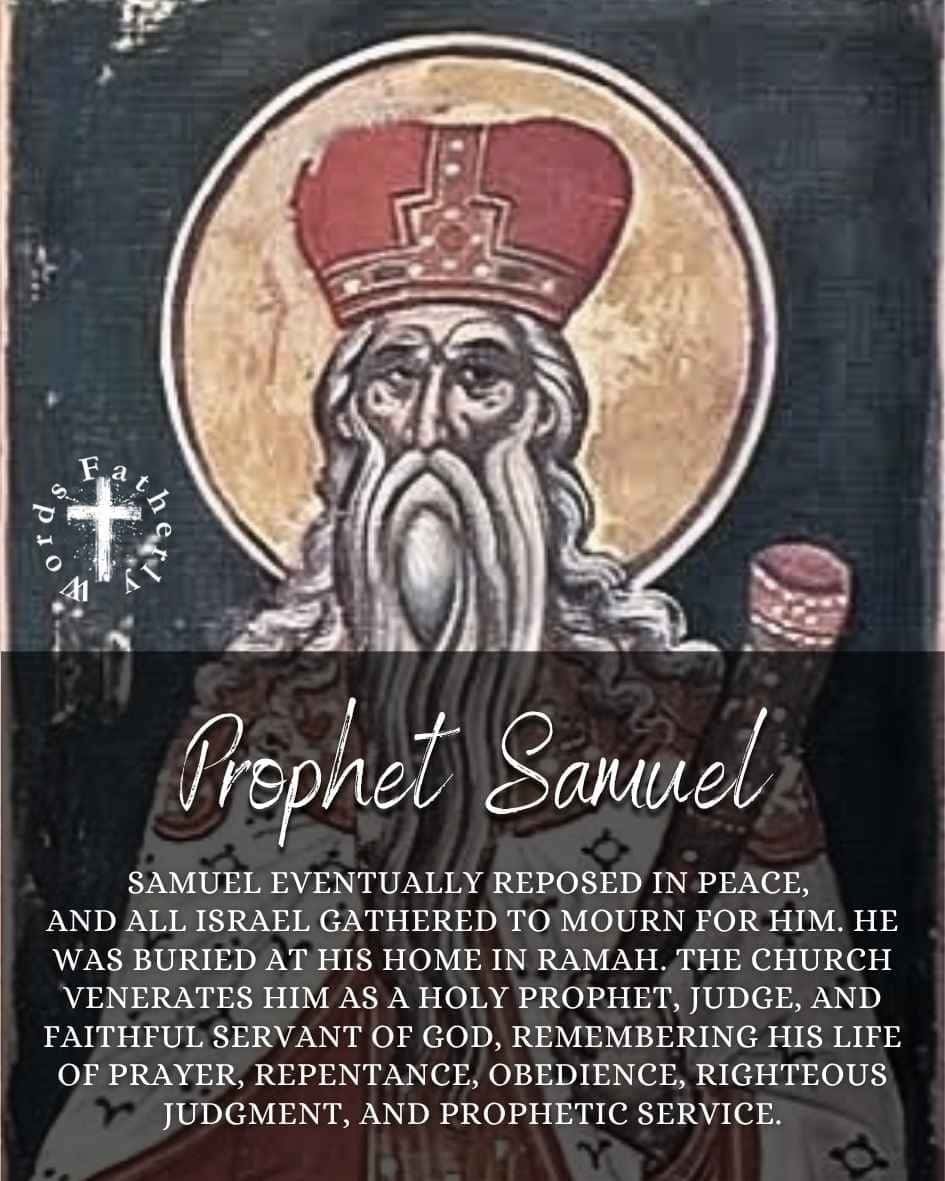
Having completed his divine mission, establishing the monarchy, anointing King David, and organizing the prophetic schools, Prophet Samuel reposed peacefully at a very advanced age.
His death was mourned by the entire nation of Israel. All the people assembled together, wept bitterly for him, and buried him with great honor at his home in Ramah (1 Samuel 25:1).
Prophet Samuel prophesied for forty years and completed his earthly journey approximately 1,035 years before the Holy Incarnation of our Lord Jesus Christ. His sacred memory is celebrated every year on August 20th in the Holy Orthodox Eastern Church.
For brothers and sisters looking for a subtle way to carry the Jesus Prayer and the ancient symbol of Christ’s victory into everyday life, we are grateful to share our new community apparel piece with you.
Featuring the traditional IC XC NIKA Christogram with the inscription “Faith over Fear,” this design reminds us that in a world full of noise and worry, Jesus Christ Conquers!

New!
Carry the Symbol of Victory
From $29.45
In a world full of noise and worry, remind yourself, and everyone you meet, that Jesus Christ Conquers.
The traditional IC XC NIKA Christogram has stood for centuries.
Our 🎁 gift to the community: use code WELCOME-10 at checkout.
Orthodox Patristic Reflection and Spiritual Application
The life of the Holy Prophet Samuel serves as a luminous beacon for Orthodox Christians striving to navigate the turbulence of the modern world.
In a culture characterized by confusion, moral laxity, and spiritual blindness, Prophet Samuel shows us the power of listening attentively to the voice of God.
Just as young Samuel responded in the quiet of the night, “Speak, Lord, for Your servant hears,” every Christian soul is called to cultivate inner silence, constant prayer, and sacred attentiveness to the holy commandments.
Furthermore, Samuel’s exemplary life reminds us that true victory over fear, distress, and worldly instability is found through wholehearted devotion to the Holy Trinity.
By honoring the Holy Prophet Samuel on August 20th and seeking his powerful heavenly intercessions, we ask the Lord to grant us the same incorruptible spirit, deep humility, and steadfast faith that shone so brightly in the last Judge and divine Prophet of ancient Israel. Amen.
Dive Deeper:
