
An Orthodox icon corner is a dedicated place in your home where the family stands in prayer before the holy icons of Christ, the Theotokos and the saints. It is usually a shelf or a section of wall with a vigil lamp, a cross and a few carefully chosen icons.
Some families call it a prayer corner or a home iconostasis. Whatever the name, it turns an ordinary room into a small church.
This guide explains what to put in your icon corner, where to place it, how to pray before it, and why the Holy Fathers never treated icons as decoration.
If you are new to Orthodoxy, you will find simple first steps. If you have prayed before icons all your life, you may find meanings you had not noticed before.
What Is an Orthodox Icon Corner? The Home as a Little Church
The word icon simply means image. The icon corner is the place in the house where the images of Christ and His saints gather the family’s attention for prayer. It is where the heart of the household’s faith beats: where we give thanks, ask for help, confess our failings and bring our tears to the Lord, to the Theotokos and to the saints.
This is not a modern habit. The first Christians prayed in homes long before they built churches. Saint Paul says, “Greet the church that is in their house” (Romans 16:5), speaking of Aquila and Priscilla, and he says the same of Nympha in Colossians 4:15.
Our Lord’s promise belongs to every praying family: “Where two or three are gathered together in My name, I am there in the midst of them” (Matthew 18:20).
Saint John Chrysostom urged Christian parents to make their house a church, and he called the family a little church. This is why the Fathers speak of the church in the house, and the icon corner is where that little church gathers.
One boundary matters. The icon corner never replaces the Divine Liturgy. It carries the Liturgy into daily life, and it lets someone who is sick, traveling or unable to reach church still stand with the Church in prayer.
Why Every Christian Home Needs an Icon Corner
Orthodox Christians have kept icons at home since the earliest centuries, and the reasons are practical as well as spiritual.
It is the Gospel you can see. The Scriptures give us the written word of God. Sermons and the writings of the Fathers give us the spoken word. The icon gives us the visible word. When you see the icon of the Crucifixion, the event itself stands before you. When you see the icon of Saint Demetrius, you remember his martyrdom. Saint Basil the Great taught that what a story tells the ear, a painting silently shows the eye. This is why iconographers say they write an icon rather than paint one: it preaches the Gospel in color.
It keeps the saints close. The Letter to the Hebrews speaks of “so great a cloud of witnesses” (Hebrews 12:1), those who finished the race and now encourage us to run. Before the icons you are never praying alone. You stand among the family of God.
It guards the character of your home. Icons guard the house and the character of every person in it. A visitor sees them, understands what this family believes, and adjusts his words and behavior. The same quiet influence works on us. It is harder to raise your voice in anger or to speak ill of someone in the presence of Christ and His saints.
It hands the faith to your children. A child who sees his parents light the lamp and make the sign of the cross learns what matters long before he can read. The icon of his own patron saint in his room lets you tell the saint’s story at bedtime. This is also why an icon is the traditional gift at a baptism, a wedding or a new home: it gives the family something to pray before, not something to display.
It gives you a refuge. Saint Peter tells us to cast “all your care upon Him, for He cares for you” (1 Peter 5:7). In a restless, anxious world, a fixed place where you can stop, pray and lay your worries before Christ makes that verse something you can actually do.
Are Icons Idols? What the Holy Fathers Teach About Venerating Icons
Almost every newcomer asks this, and the Church answered it clearly.
God Himself commanded sacred images. He told Moses to place two golden cherubim over the ark of the covenant (Exodus 25:18).
The deeper answer is the Incarnation. “The Word became flesh and dwelt among us” (John 1:14), and Christ is “the image of the invisible God” (Colossians 1:15).
The invisible God made Himself visible, and what can be seen can be depicted. Saint Theodore the Studite argued that if Christ cannot be depicted, then He did not truly become man. An icon of Christ is therefore a confession of the Incarnation.
Saint John of Damascus, who defended the icons, wrote, “I do not worship matter, but I worship the Creator of matter, who became matter for my sake” (On the Divine Images 1.16).
Saint Basil the Great gave the principle that explains the kiss we give an icon: the honor shown to the image passes to the one it represents (On the Holy Spirit 18).
The Seventh Ecumenical Council in 787 confirmed it. Icons receive veneration and honor, while worship belongs to God alone. When you kiss the icon of Christ, you are not kissing wood and paint. You are greeting Christ. That is why every true icon carries the name of the person it shows: the name binds the image to the person.
Church tradition traces holy images to the time of our Lord. The Holy Mandylion is the face of Christ imprinted on cloth by the Lord Himself.
Saint Luke the Evangelist wrote icons of the Theotokos while she was still alive, and she blessed them.
Saint Andrew of Crete testifies that an icon of the Theotokos not made by human hands was still venerated in a church in Lydda, west of Jerusalem, in his own day.
Then came the storm. In the eighth and ninth centuries iconoclast emperors ordered icons burned. Many faithful monks and families hid them and protected them, and some died for them. Some of the oldest icons survived only because they stood in remote monasteries, far from the emperors’ reach.
In 843, under Empress Theodora, the icons were restored for good. The Church celebrates this victory every year on the first Sunday of Great Lent, the Sunday of Orthodoxy.
Do the Saints Hear Us When We Pray Before Icons?
Some ask whether icons see, hear or answer. An icon is not wood and color. It is the image of a living person.
Christ says God “is not the God of the dead but of the living, for all live to Him” (Luke 20:38). The saints who gave their lives for the truth of Christ are alive in Him, and they hear, see and intercede for those who pray.
The Church’s history shows this in simple stories. Saint Gregory the Theologian tells of a young woman who was about to fall into sin. She saw the venerable icon of Saint Polemon and was so shaken with shame that she turned back and fled the temptation. The icon spoke to her without a word.
Saint Mary of Egypt, whom the Church honors twice a year, was held back by an invisible force when she tried to enter the church of the Resurrection to venerate the Cross. She looked at the icon of the Theotokos at the entrance, asked for permission to enter, and the Theotokos allowed her.
If anyone still asks what icons do, ask the mothers who keep vigil on their knees, and the fathers, brothers and sisters who pray at night before the icons. They will tell you these are not decorative pictures. Pray before them with faith and humility, and you will see for yourself.
What to Put in an Orthodox Icon Corner: The Essential Icons
You need only a few things, chosen with reverence.
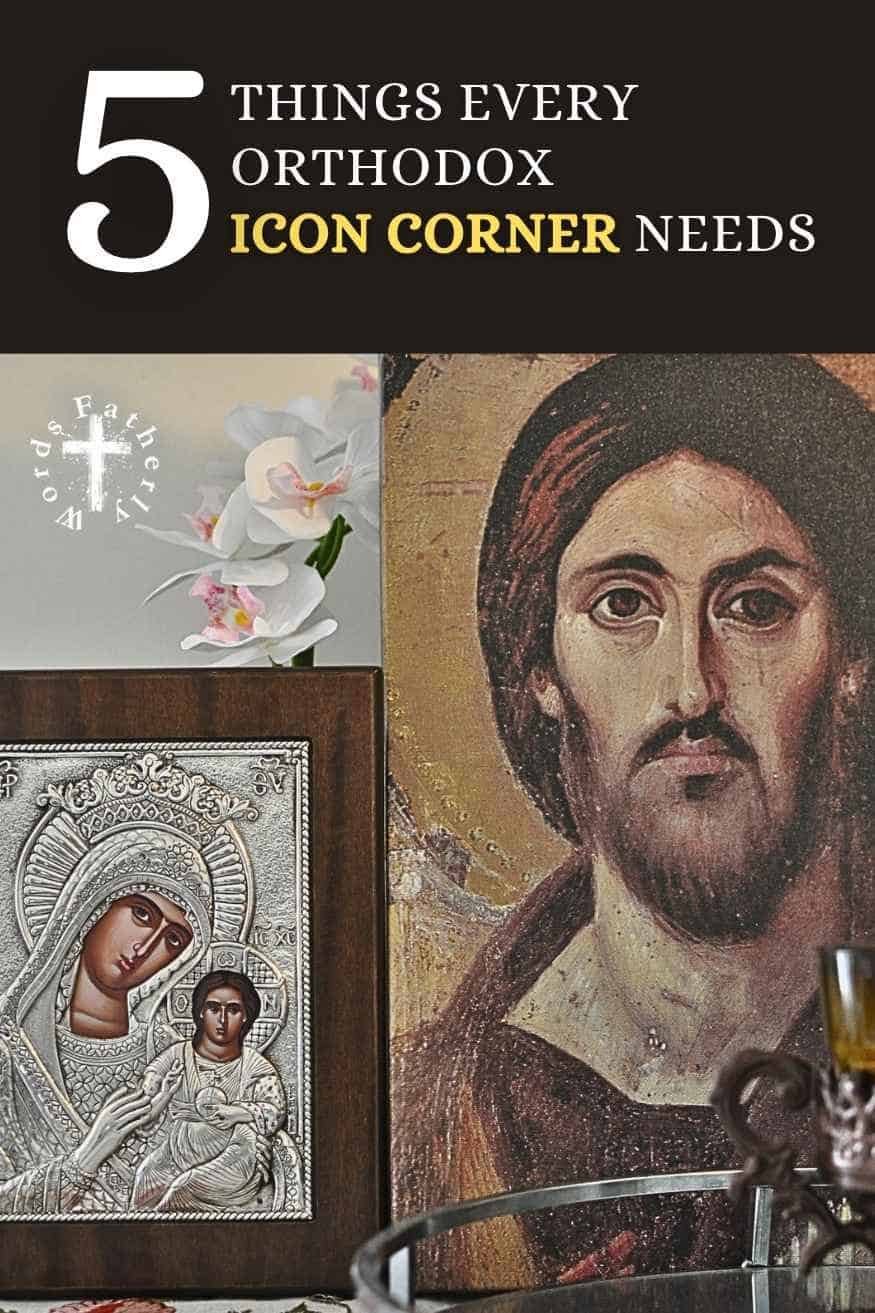
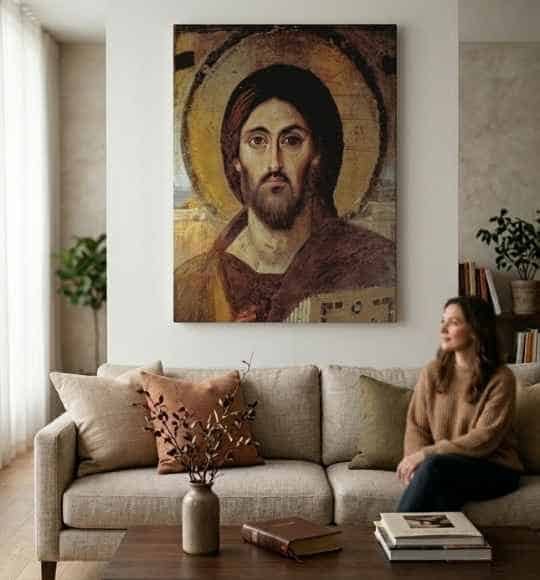
Christ. The icon of our Lord holds the center of the icon corner, and no other icon should be larger than His. Most families choose Christ Pantocrator, the Almighty, who blesses with His right hand and holds the Gospel in His left. The 6th century Pantocrator of Saint Catherine’s Monastery on Mount Sinai, one of the oldest Byzantine icons of Christ, survived the iconoclasts and has gazed on the faithful for over fourteen centuries.
Inspired by it, our Christ Pantocrator canvas is the perfect original gift for faithful Christians, one that makes a lasting difference in any home, and with code WELCOME-10 you receive 10% off.
The Theotokos. Place the icon of the Theotokos with the Child to the left of Christ as you face the icons, as in the iconostasis of a church. She is the Mother of us all, and she intercedes with her Son at every moment for our salvation.
Your patron saint. Choose the icon of the saint whose name the head of the household or a family member bears. At baptism we receive a saint’s name, and that saint becomes our friend and intercessor. An icon inherited from parents or grandparents belongs here too, not as a family keepsake but as a living piece of the faith passed on from generation to generation.
The Cross. Let a cross crown the whole arrangement. If you wish to place an icon above those of Christ and the Theotokos, let it be the Crucifixion.
A few companions. A Gospel book, a prayer book and a prayer rope fit naturally on the shelf below the icons, ready for prayer.
The Vigil Lamp, Beeswax Candles, Incense and Holy Water: What Each One Means
Each item beside the icons teaches something, and the Church’s worship explains what.
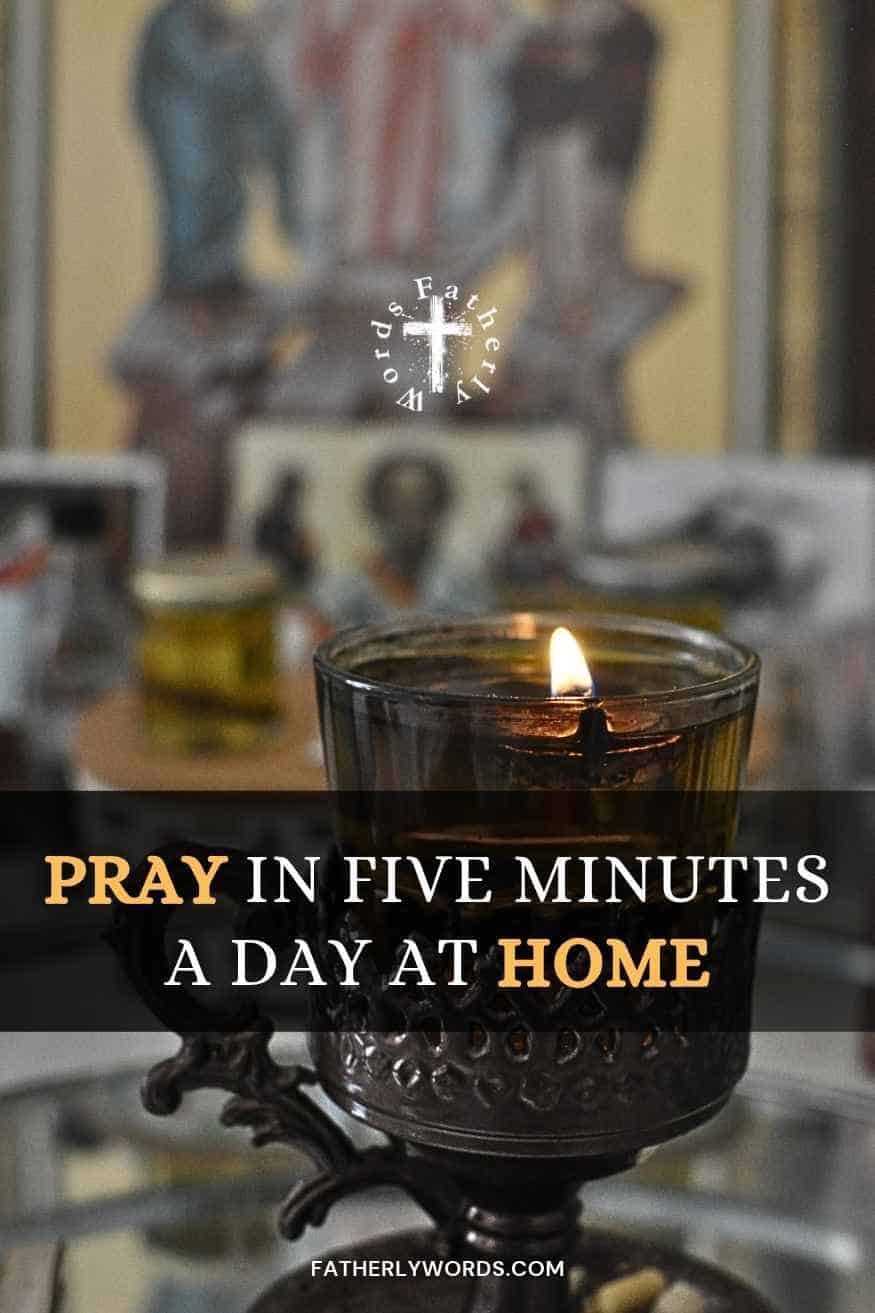
The vigil lamp is the light of Christ. The Lord says, “I am the light of the world” (John 8:12), and the psalmist says, “Your law is a lamp to my feet” (Psalm 118:105).
A small oil lamp with a floating wick, kept lit before the icons, also teaches watchfulness. When we sleep or are away, the lamp keeps burning, like the soul in the Song of Songs: “I sleep, but my heart is awake” (Song of Songs 5:2).
Saint John Chrysostom explains that the oil of the wise virgins in the Lord’s parable (Matthew 25) is mercy, so the oil in your lamp asks a question: have I been merciful today?
Use pure olive oil. Many families light the lamp from the Holy Light they carry home from the Resurrection service, so the same flame that proclaimed Christ’s victory burns all year.
Beeswax candles are offering and purity. A candle lit at prayer is a willing offering. Pure wax melts before the fire, as a heart softens and surrenders to the grace of God. Choose real beeswax: it is a pure gift of creation offered back to its Creator.
Incense is prayer rising. “Let my prayer be directed like incense before You” (Psalm 140:2). In the Book of Revelation, the golden bowls of incense are “the prayers of the saints” (Revelation 5:8). A pinch of incense on a hot coal before prayer fills the room with fragrance and reminds us that our prayer ascends to the throne of God. Place the censer on a stable, heat-safe surface, and ask your priest to show you how to use it.
Holy water sanctifies the home. Keep a small bottle of holy water from church near the icons. Take a sip with prayer in the morning, especially in sickness or trouble, and sprinkle the rooms of the house. It reminds us that our lives and our homes are sanctified through the Church. Saint John Chrysostom already speaks of the faithful carrying the water of Theophany to their homes.
Blessed objects from the Church year, such as the palm cross from Palm Sunday, also belong near the icons.
How to Set Up Your Orthodox Icon Corner at Home
Choose a place that faces the East. Praying toward the East is an ancient tradition. Saint Basil the Great lists it among the unwritten traditions of the Church, and Saint John of Damascus explains that Christ is the Sun of Righteousness and the Dayspring, and that Paradise was planted in the East, so that is where we direct our worship.
If you cannot use an east wall, choose any quiet place where you can stand undisturbed. God hears us everywhere.
Arrange the icons in order. Christ in the center, the Theotokos to His left as you face the icons, your patron saints around them, a cross above. A simple shelf in the corner of a room or a floating shelf on the wall is enough, even in a small apartment.
Keep the space sacred. An icon is not a work of art or a decoration. It is a holy object that joins the visible world to the unseen one and helps us gather our attention for prayer.
Do not set photographs, vases, figurines, souvenirs, posters or paintings beside the icons. They belong to the passing world and compete for your eyes. Fresh flowers are welcome. Keep the shelf clean and dust it with respect.
Choose true icons. Look for icons written in the tradition of the Church: the saint’s name inscribed, the calm, unsentimental style of Byzantine iconography. Avoid religious paintings in a realistic or sentimental style. They invite emotion rather than prayer.
Have them blessed. Bring new icons to your priest for a blessing, and ask him to bless your home with holy water, as the Church does every year at Theophany.
Think about safety. Use a glass lamp on a stable surface, away from curtains and paper.
Icons in Every Room: Bedrooms, Children’s Rooms and the Entrance
The family icon corner is the center, but the Orthodox home carries icons into every room.
- Above every bed: the Crucified Lord watches over each member of the family, at night and in the morning.
- In the couple’s bedroom: the wedding crowns rest in a small case with an icon of Christ and the Theotokos, a reminder that the marriage was blessed in the Church and is lived with Christ.
- In the children’s rooms: icons of the saints whose names they bear, for boys and girls alike. Retell the saint’s life at bedtime, and celebrate the saint’s feast day together.
- At the entrance: greet the icons with the sign of the cross when you come home, and thank God for everything. A cross or an icon of the Theotokos at the front door blesses all who enter and leave.
How to Pray at Your Orthodox Icon Corner Every Day
A simple daily rule is enough to begin. Ask your spiritual father to bless it, and keep it small enough that you can keep it.
In the morning. Light the lamp, stand before the icons and cross yourself slowly. Say “O Heavenly King,” the Trisagion prayers and the Lord’s Prayer, then ask God’s blessing on the day. Add the Jesus Prayer: “Lord Jesus Christ, Son of God, have mercy on me, a sinner.”
Saint John Climacus counsels, “Let the remembrance of Jesus be united with your breath” (The Ladder of Divine Ascent, Step 27).
Before meals. Stand together and pray: “Bless, O Lord, the food and drink of Your servants, for You are holy.”
In the evening. Bring the day before the icons. Thank God, ask forgiveness, and forgive those who hurt you. Pray for the living and the departed, keeping a short list of their names on the shelf. Kiss the icons, make the sign of the cross and go to rest.
Modern life fills every day with anxiety, yet the faithful have long found peace in certain Psalms of David and in the prayers of Saint Arsenios the Cappadocian. Enter your email in the form here to discover which ones and how to pray them, and we will send you a free ebook.
With children. Let the youngest light the lamp, kiss the icon of their saint and say one short prayer. Short and joyful is better than long and forced.
Five faithful minutes each day are enough to begin, and they grow into a life of prayer. “Pray without ceasing” (1 Thessalonians 5:17), and the icon corner is where that begins.
Common Mistakes to Avoid with Your Icon Corner
- Treating icons as decor. Matching icons to the furniture, or moving them for style, misses the point. They are sacred objects, not design pieces.
- Crowding the shelf. Twenty icons you never pray before are worth less than three you pray before daily. Start small.
- Mixing the sacred with the ordinary. Photographs, souvenirs and everyday clutter do not belong on the icon shelf.
- Using icons like lucky charms. An icon is not magic. It is a meeting with a person, and grace works through faith, humility and repentance.
- Forgetting to pray. An icon corner no one prays at is only a shelf. The lamp, the cleaning and the daily rule all need your care.
Orthodox Icon Corner FAQ
Is an Orthodox icon corner the same as a home altar?
No. The Holy Altar exists only in the church, where the Divine Liturgy is celebrated. The icon corner is a place of prayer in the home, the little church of the family, but it is not an altar.
Which direction should an icon corner face?
Face East if you can, following the ancient custom of praying toward the East. If you cannot, choose a quiet place where you can stand without being disturbed. The Lord hears prayer everywhere.
How many icons should an Orthodox home have?
Begin with two: Christ and the Theotokos. Then add the icon of your patron saint. Quality matters more than quantity, because you should be able to pray before each icon.
Can I make an icon corner in a small apartment or a shared room?
Yes. A small shelf, the top of a bookcase or a section of wall is enough. If you live with people who are not Orthodox, keep the space modest and respectful and let your prayer do the teaching.
Who should bless my icons?
A priest. Bring new icons to church, or ask him to bless them when he blesses your home with holy water.
What should I do with old or damaged icons?
Never throw them in the trash. Bring them to your priest. The Church’s custom is to burn them with reverence or bury them in clean ground.
Are printed or canvas icons acceptable?
Yes, if they are faithful to the Byzantine iconographic tradition, carry the saint’s name and are blessed by a priest.
Start Your Orthodox Icon Corner Today
You do not need a perfect shelf. You need an icon of Christ, an icon of the Theotokos, a lamp and five minutes. Place them toward the East, light the lamp tonight, make the sign of the cross and say the Jesus Prayer. The home that prays becomes a little church, and the icons will begin to teach you what they have taught the faithful for centuries.
