
The Parable of the Rich Fool in Luke 12:16–21 teaches that wealth gathered only for ourselves leaves the soul empty. God calls the rich man a fool not because he was rich, but because he forgot God, ignored his neighbor, and planned for years he would never see.
Orthodox Christians hear this Gospel reading on the Ninth Sunday of Luke. The parable is short, yet it asks the questions every household faces:
- How much is enough?
- Who is my money really for?
- What will remain when my last night comes?
This short commentary on the Gospel reading covers the full text, the reason Jesus told it, why the Church places it before us in late November, the hidden details in each verse, and practical ways to live it out. It is only six verses long, and almost every phrase carries a lesson.
Luke 12:16–21 Gospel Text: The Parable of the Rich Fool in Full
This is the Gospel reading as the Church proclaims it on the Ninth Sunday of Luke:
[16] And he spoke a similitude to them, saying: The land of a certain rich man brought forth plenty of fruits.
[17] And he thought within himself, saying: What shall I do, because I have no room where to bestow my fruits?
[18] And he said: This will I do: I will pull down my barns, and will build greater; and into them will I gather all things that are grown to me, and my goods.
[19] And I will say to my soul: Soul, thou hast much goods laid up for many years take thy rest; eat, drink, make good cheer.
[20] But God said to him: Thou fool, this night do they require thy soul of thee: and whose shall those things be which thou hast provided?
[21] So is he that layeth up treasure for himself, and is not rich towards God.
What Is the Meaning of the Parable of the Rich Fool?
The Church begins the reading at verse 16, but the parable has a setting. While Jesus teaches about God and eternal life, a man in the crowd interrupts Him: “Teacher, tell my brother to divide the inheritance with me.” (Luke 12:13) Jesus declines to act as a judge in a family dispute: “Man, who made Me a judge or an arbitrator over you?” (Luke 12:14)
The Lord came to redeem human hearts, not to settle earthly estates. Yet He sees the passion hiding behind the request, and He turns to the whole crowd: “Take heed and beware of covetousness, for one’s life does not consist in the abundance of the things he possesses.” (Luke 12:15) The Parable of the Rich Fool is His answer.
The story is simple. A rich landowner has an extraordinary harvest. Nothing in the account says he cheated anyone. Instead of thanking God, he is swallowed by worry about where to store the crop. He decides to tear down his barns and build bigger ones, and he promises his soul years of rest, food, drink and fun. That same night God calls him a fool and asks a question no one can answer: whose will all this be?
Three lessons stand out:
- True life does not come from possessions.
- Death is certain and gives no warning, so everything we gather is left behind.
- Real riches are thanksgiving to God and love for our neighbor, shown in deeds.
Why the Church Reads the Parable of the Rich Fool on the Ninth Sunday of Luke
After the feast of the Holy Cross in September, the Church turns to the Gospel of Luke for its Sunday readings. By the Ninth Sunday, in the second half of November, one theme has taken over: how we treat our neighbor and what we do with what God gives us. The Rich Man and Lazarus is read earlier in the season, the Good Samaritan is read the Sunday before this parable, and the Rich Fool completes the group.
Three things come together on this Sunday.
- First, the harvest is in. The fields have been gathered and the storehouses are full, so the Church asks what we will do with our abundance.
- Second, winter is coming, and with it the needs of the poor and the weak grow heavier.
- Third, the Nativity Fast begins on November 15, calling us to prayer, fasting and almsgiving before the birth of Christ, who “though He was rich, yet for your sakes He became poor, that you through His poverty might become rich.” (2 Corinthians 8:9)
It is fitting to hear about barns and full bellies just as we begin to fast.
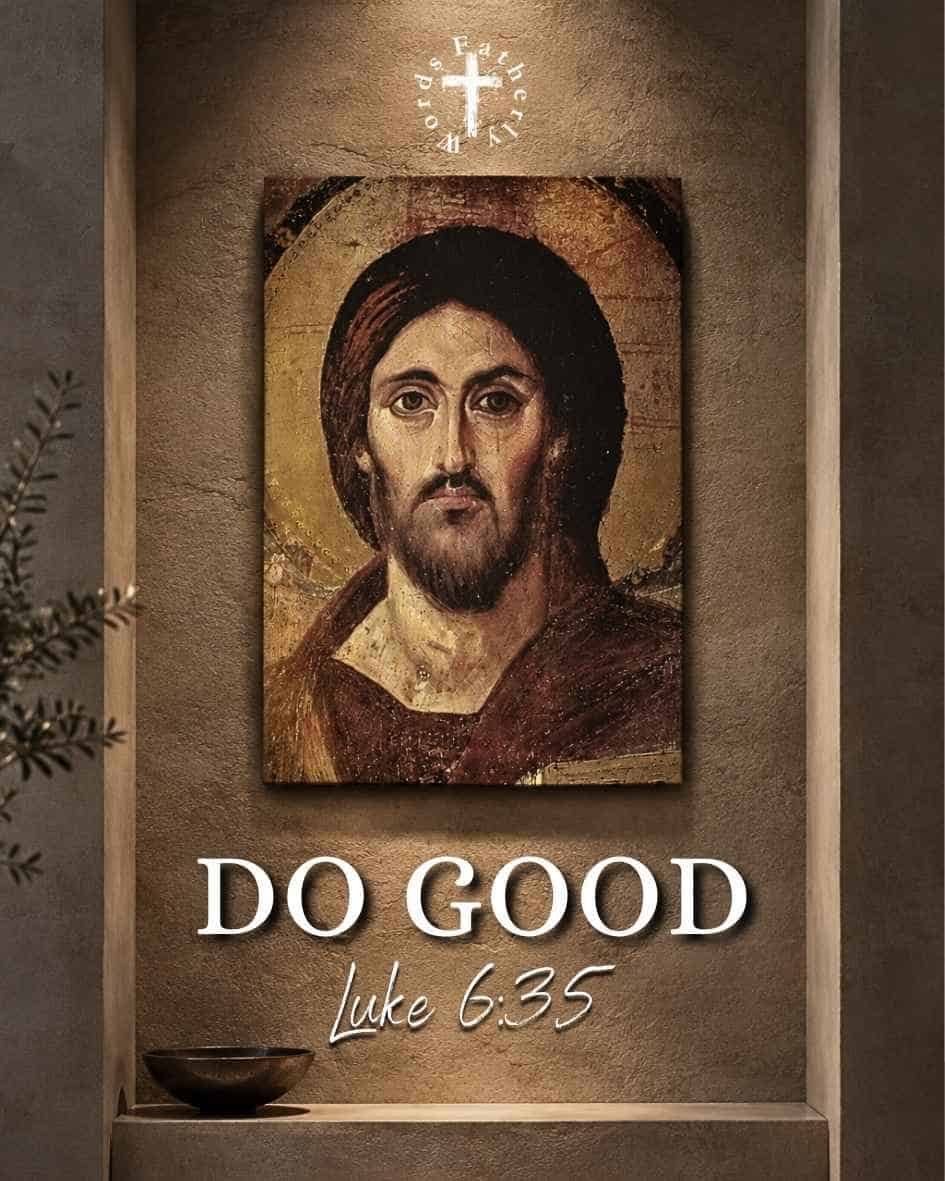
While this Gospel is read, the eyes of the faithful rest on the icon of Christ, the Ruler of All, who sees every barn we plan and every neighbor we pass by.
Why Did God Call the Rich Man a Fool?
Not because he was rich. He is a fool because he failed in three ways.
- He did not see his goods as gifts from God.
- He did not give thanks to God, which should mark a Christian’s whole life.
- And he did not share with the brothers and sisters who needed help.
“What do you have that you did not receive?” (1 Corinthians 4:7)
The Psalms have a name for such a person: “The fool has said in his heart, ‘There is no God.’” (Psalm 13:1 in the Orthodox Psalter).
The rich man never says it aloud. He says it with his plans. He speaks only to himself and lives as if God did not exist, as if life were his to manage and not a gift from the One who makes it and gives it.
He also believed that happiness lives in money, comfort and a full table.
He did not suspect that true life is found in eternal values and in God Himself, the source of every blessing.
Whoever makes the stomach his god drifts away from the road to union with God, a road made of prayer, humility, the Mysteries of the Church and love shown in deeds.
Hidden Meanings in Luke 12:16–21 That Most Readers Miss
The whole land produced plenty, not one field. Saint Cyril of Alexandria points out that the Gospel says the entire land of this man bore fruit, to show how great his wealth was. Notice what the Lord does not say: that he stole or cheated. Wealth can ruin the soul even when it is gathered honestly.
“What shall I do?” is a beggar’s cry. A man surrounded by countless goods speaks like a poor man, anxious and cornered. Saint Cyril observes that this is how someone lacking the necessities of life talks. The rich man has everything and has lost his peace and his sleep. “The abundance of the rich will not permit him to sleep.” (Ecclesiastes 5:12)
He speaks only about himself. In the text above he says “I” six times and “my” four times. God is absent from his speech, and so is every neighbor. Saint Cyril adds that he did not see his harvest as a gift from God, as righteous Job did: “The Lord gave, and the Lord has taken away.” (Job 1:21). He wanted to keep every bit for himself, and that is why he could not enjoy any of it. A simple answer sat right in front of him: give the surplus to the hungry and thank God for the harvest.
The barns he builds will not last. Saint Cyril says he builds barns that perish, not barns that remain. Tearing down and rebuilding also means heavy labor, more worry and more stress. How could he enjoy his wealth while trapped in greed and self-love?
He feeds the soul with food for the body. The soul is spiritual. It cannot live on grain and wine, only on heavenly, spiritual goods, yet the rich man tells it, “take thy rest; eat, drink, make good cheer.” Saint Cyril adds that we should eat to live, not live to eat. Those who live for the table say, “Let us eat and drink, for tomorrow we die!” (1 Corinthians 15:32). Saint Cyril answers that the wise draw the opposite conclusion: since death is near, let us live soberly today.
He sets his own lifespan. “Many years,” he says, as if he had harvested them from the ground. Saint Cyril asks him: you can store the grain, but where will you get the years? “For what is your life? It is even a vapor that appears for a little time and then vanishes away.” (James 4:14)
The enemy works through laziness and forgetfulness. Saint Cyril teaches that Satan, who hates what is good, tries to make those who could do good lazy about it. He urges us to close our hands, pile up wealth on earth and forget death. Against this, the Law tells us what to do for a brother in need: “you shall open your hand wide to him and willingly lend him sufficient for his need.” (Deuteronomy 15:8)
This Night Your Soul Is Required: Luke 12:20 and the Hour of Death
Things do not go as the rich man expected. Before he can speak to his soul, God speaks to him first. The night he pictured as a night of happy feasting becomes a night of fear.
Saint Cyril notes that while the man was planning tomorrow’s meal at dusk, he never lived to see the first light of dawn, because he had not noticed death, his nearest neighbor.
The Lord says that “they” require the soul. According to the Church’s teaching, fearful demons come for the soul of someone bound to material things. Such a person leaves behind everything he worked for and departs poor, empty of good works and of the grace of God, into a night without end.
For the righteous, the merciful and the lovers of mankind, the same hour is the most beautiful sunrise of a day that never ends and never sets. It is the entrance into the Kingdom of God. Good angels, not frightening powers, receive the soul and lead it into God’s embrace.
Then comes the question no one can answer: “whose shall those things be?” Saint Cyril says the enjoyment lasts only a moment, then it vanishes like dust and passes to others, often to people we do not know, or even to enemies. David saw it clearly: “He heaps up riches, and does not know who will gather them.” (Psalm 39:6)
The same Lord who warns the rich man is the One who receives the merciful into the day without end. We meet Him as Judge and as the Lover of mankind, and the two cannot be separated.
Few images hold both truths in one face like the Christ Pantocrator of Saint Catherine’s Monastery, one of the oldest Byzantine religious icons, painted in the 6th century AD with one half of His face gentle and the other stern.
Our canvas brings that ancient face into your home as a meaningful, original gift that makes a lasting difference for faithful Christians, and the code WELCOME-10 gives you 10% off.

Covetousness, Wealth and Stewardship in Orthodox Teaching
Covetousness is the passion the Lord names first. Saint Paul goes further and calls it “covetousness, which is idolatry.” (Colossians 3:5)
The covetous man bows to a false god, and Saint Cyril says he is as defiled as those who worship wood and stone. “The love of money is a root of all kinds of evil.” (1 Timothy 6:10)
Saint John Chrysostom put the difference between a thief and a covetous man in one line: the thief steals by night, the covetous man by day.[1]
The remedy is stewardship. “The earth is the Lord’s, and all its fullness.” (Psalm 24:1)
God Himself gives the sun and the rain to everyone without exception, “on the evil and on the good.” (Matthew 5:45)
A steward calls nothing his own. He receives from God and passes it on.
The rich fool acted like an absolute owner, treating others as strangers to his enjoyment and imagining he had total power over his life. The saints call “mine” and “yours” cold words.
A rich person can be saved, if he gains or inherits wealth honestly and treats himself as a manager of it for the needs of the world. He gives what he has in surplus to cover what others lack. The saints also warn that it is very hard to heap up great wealth without someone else going without, even when every step is legal.
What matters most is the attitude toward property: whether it becomes the center of our existence and the meaning of our life.
Christ so identifies Himself with the hungry, the sick, the stranger and the prisoner that He says, “inasmuch as you did it to one of the least of these My brethren, you did it to Me.” (Matthew 25:40)
Saint Anastasios of Sinai condemns not only the rich man who gathers by injustice, but also the one who could save a person from famine, debt or captivity and does not. “I have never harmed anyone” is not enough. We must come close and bend down to the problem of the other.
Today the same illness appears as the foolish investor, for whom profit has become the goal and meaning of life. The beginning of the disease is the same, and so is the end. One day the show of this life finishes, and a man discovers that nothing he used on the stage was his own. “For we brought nothing into this world, and it is certain we can carry nothing out.” (1 Timothy 6:7)
The rich fool has no name in the Gospel, only barns.
What Does It Mean to Be Rich Toward God?
The Lord closes the parable with a warning and a hope: the man who lays up treasure for himself “is not rich toward God.” To be rich toward God is to be wealthy in what we can carry with us.
Saint Paul tells the rich to be “rich in good works, ready to give, willing to share.” (1 Timothy 6:18)
The Lord says the same to His hearers: “Sell what you have and give alms; provide yourselves money bags which do not grow old, a treasure in the heavens that does not fail.” (Luke 12:33)
Then comes the reason: “For where your treasure is, there your heart will be also.” (Luke 12:34)
The only safe investment is almsgiving. Money kept for ourselves is not secure anywhere, not in chests, banks or the stock market. The one who gives freely receives three rewards: the joy of giving, the gratitude of a poor brother, and above all the heavenly treasures promised by the Lord, who is generous beyond measure.
“He who has pity on the poor lends to the Lord, and He will pay back what he has given.” (Proverbs 19:17)
Wealth also cannot buy what the soul needs most. It cannot heal illness or grief, remove temptations, or mend a divided family. Look closely at the lives of many of the world’s richest people and you often find sadness behind the curtain: broken families, lawsuits, inheritance quarrels and endless scheming. Who would choose such a life?
Having what we need to live in peace is better than chasing more and never finding rest.
Saint Cyril sums it up: whoever is worn out by earthly cares departs poor to God, but whoever cares for what the Lord wants becomes rich in good works and has a treasure in heaven that cannot be robbed.
How to Apply the Parable of the Rich Fool in Daily Life
The parable asks for small, steady changes at home, at work and at church. Here are seven.
- Thank God before you plan. Thank Him for the paycheck, the meal and the roof, and do this before deciding what to do with extra money. Thanksgiving is what the rich man skipped, and it should mark a Christian’s whole life.
- Live on what you need. Aim for simple food, clothing and shelter: “having food and clothing, with these we shall be content.” (1 Timothy 6:8) The fasts of the Church train this habit, and the bee is the model, taking from the flowers only what it needs.
- Give the surplus. What remains because of your self-control should not pile up but go to those in need. The Old Testament set a tenth as the minimum, and the Gospel asks for a heart that gives far more freely. Decide your giving first, then plan the rest of your budget.
- Give more than money. A neighbor often needs a kind word, sincere interest or gentle manners more than cash. Your talents are for others too: money and gifts are meant to be shared, not owned.
- Do the good, not only avoid the harm. The golden rule does not say only what not to do. It says, “whatever you want men to do to you, do also to them.” (Matthew 7:12) Look around your parish, your family and your street for the person you can help this week.
- Keep your last night in mind. “So teach us to number our days, that we may gain a heart of wisdom.” (Psalm 90:12) In every Divine Liturgy we ask for a Christian ending to our life, painless, blameless and peaceful, and a good defense before the awesome judgment seat of Christ. Think about what will happen to your goods when you are gone, and let your will reflect your faith.
- Hand your worries to God. The rich man lost his sleep over his barns. “Be anxious for nothing, but in everything by prayer and supplication, with thanksgiving, let your requests be made known to God.” (Philippians 4:6)
Anxiety is the rich man’s sleepless night in modern dress, and the Church has long answered it with specific Psalms of David and the prayers of Saint Arsenios the Cappadocian. Which ones bring peace is a story for our free ebook: fill in the form on this page and it will arrive in your inbox.
Frequently Asked Questions About the Parable of the Rich Fool
What is the main lesson of the Parable of the Rich Fool?
Life does not consist in the abundance of possessions. What we have is a gift from God, meant to be thanked for and shared, and death can come tonight. The only treasure we take with us is love shown in good works.
Is it a sin to be rich according to the Orthodox Church?
Wealth itself is not condemned. The rich fool is faulted for his heart: he forgot God, gave nothing and thought he owned his life. A rich person who treats his wealth as a trust from God and uses the surplus to help others can be saved.
Is saving for the future wrong?
Planning is not the problem. The sin is storing up everything for ourselves, with no thanks to God and no thought for those in need, while assuming we control how long we live.
What does the word “fool” mean in Luke 12:20?
It means senseless, without understanding. The rich man calculates everything except God, His law and the certainty of death, which can arrive at any moment without warning.
Who are “they” that require the rich man’s soul in Luke 12:20?
The Gospel says “they require thy soul of thee.” The Church’s teaching points to the fearful powers that come for the soul of a man bound to material things, while for the merciful, good angels lead the soul into the embrace of God.
What is the difference between the Rich Fool and the Rich Man and Lazarus?
Both warn about wealth, but they show different failures. The rich man in Luke 16:19–31 ignores a poor man lying at his gate, while the rich fool in Luke 12:16–21 hoards his harvest and forgets death. Together they show that selfishness can look like neglect or like saving.
When is Luke 12:16–21 read in the Orthodox Church?
On the Ninth Sunday of Luke, in the second half of November, according to the Greek (Byzantine) lectionary. It falls just after the Nativity Fast begins.
Becoming Rich Toward God Starts Tonight
The rich man’s story ends at night. Ours has not ended yet. Tonight, ask three questions:
- What has God given me that I have not thanked Him for?
- What do I hold that someone near me needs?
- If my soul were required tonight, what would I have stored in heaven?
Answer honestly, then act this week: give something, thank someone, forgive someone, and pray before you sleep.
