
What does the parable of the Good Samaritan mean? In Luke 10:25-37, Jesus answers a lawyer who asks how to inherit eternal life and who his neighbor is. The Orthodox Church hears far more than a lesson in kindness. The wounded man is fallen humanity, and the Good Samaritan is Christ Himself, who came down to us, healed our wounds, and placed us in the care of His Church until He returns.
This passage is the Gospel reading for the 8th Sunday of Luke. Below you will find the full text, a short commentary on the Gospel reading, the hidden meanings the Holy Fathers saw in every detail, and practical ways to live the parable this week.
If you have ever wondered why the priest and the Levite passed by, why Jesus chose a Samaritan, or what the oil, the wine, and the two pence stand for, the answers are here.
Luke 10:25-37 Gospel Reading: The Parable of the Good Samaritan
Here is the Gospel reading for the 8th Sunday of Luke, with the verse numbers in brackets:
[25] And behold a certain lawyer stood up, tempting him, and saying, Master, what must I do to possess eternal life?
[26] But he said to him: What is written in the law? how readest thou?
[27] He answering, said: Thou shalt love the Lord thy God with thy whole heart, and with thy whole soul, and with all thy strength, and with all thy mind: and thy neighbour as thyself.
[28] And he said to him: Thou hast answered right: this do, and thou shalt live.
[29] But he willing to justify himself, said to Jesus: And who is my neighbour?
[30] And Jesus answering, said: A certain man went down from Jerusalem to Jericho, and fell among robbers, who also stripped him, and having wounded him went away, leaving him half dead.
[31] And it chanced, that a certain priest went down the same way: and seeing him, passed by.
[32] In like manner also a Levite, when he was near the place and saw him, passed by.
[33] But a certain Samaritan being on his journey, came near him; and seeing him, was moved with compassion.
[34] And going up to him, bound up his wounds, pouring in oil and wine: and setting him upon his own beast, brought him to an inn, and took care of him.
[35] And the next day he took out two pence, and gave to the host, and said: Take care of him; and whatsoever thou shalt spend over and above, I, at my return, will repay thee.
[36] Which of these three, in thy opinion, was neighbour to him that fell among the robbers?
[37] But he said: He that shewed mercy to him. And Jesus said to him: Go, and do thou in like manner.
The reading moves in four steps:
- In verses [25] to [29], a lawyer asks two questions.
- In verse [30], a man falls among robbers.
- In verses [31] to [33], three travelers see him, and only one stops.
- In verses [34] to [37], the Samaritan heals him, and Jesus ends with a command: “Go, and do thou in like manner.”
Why the Church Reads the Good Samaritan on the 8th Sunday of Luke
On the Sundays that follow the Elevation of the Holy Cross, the Church reads the Gospel of Luke, and the eighth Sunday brings us to the parable of the Good Samaritan. It arrives in mid-November, just as the Nativity Fast begins.
The timing matters. Fasting without mercy is empty, and the Church places this parable at the door of the fast to remind us.
The prophet Isaiah asks, “Is it not to deal thy bread to the hungry, and that thou bring the poor that are cast out to thy house?” (Isaiah 58:7).
The priest and the Levite were men of worship, and they still walked past a dying man. Before we enter forty days of prayer and fasting, we are warned that devotion without compassion misses its purpose.
The readings around this Sunday point the same way. Earlier in the season, the Church reads about https://fatherlywords.com/luke-16-19-31-rich-man/ (Luke 16:19-31).
The next Sunday brings the rich fool, who stored up treasure for himself and was “not rich toward God” (Luke 12:16-21).
Together they ask a plain question: what are we doing with what God has given us, and who is lying at our gate?
The parable also prepares us for the Nativity. The Samaritan “came near him,” and at the Nativity the Son of God came near to us. “And the Word was made flesh, and dwelt among us” (John 1:14). Because God took a human face, the Church paints that face in holy icons and venerates it.
Who Is My Neighbor? The Lawyer’s Questions in Luke 10:25-29
A lawyer stands up to test Jesus and asks what he must do to possess eternal life. Jesus does not argue. He sends the man back to the Scriptures he knows: “What is written in the law? how readest thou?” (v. 26).
The lawyer answers well. He joins the love of God and the love of neighbor, the same two commandments Christ names as the summit of the whole Law (Matthew 22:37-40). Jesus replies, “Thou hast answered right: this do, and thou shalt live.”
The conversation could end there. It continues because of one detail in verse 29. The lawyer was “willing to justify himself.” He already knew the answer, and he did not want to be held to it, so he asks, “And who is my neighbour?”
People still do this. We draw a line around the word neighbor, and everyone outside the line becomes someone else’s responsibility.
Jesus tells a story, and then He turns the question around. He does not end with “Here is your neighbor.” He asks, “Which of these three, in thy opinion, was neighbour to him that fell among the robbers?” (v. 36).
A neighbor is not someone we sort into a category. A neighbor is someone we become by showing mercy. The lawyer’s question about eternal life and his question about the neighbor turn out to be one question.

Love of God and love of neighbor cannot be separated. The Apostle John writes, “If a man say, I love God, and hateth his brother, he is a liar: for he that loveth not his brother whom he hath seen, how can he love God whom he hath not seen?” (1 John 4:20) [1].
Both loves ask us to make room in the heart. When a person puts himself at the center of everything, there is no room for God and no room for the man on the road.
The parable also answers one of the oldest questions in Scripture. After Cain killed Abel, he said to God, “Am I my brother’s keeper?” (Genesis 4:9). Christ’s parable gives a plain answer: yes. We are keepers of one another, and we are asked to care for our neighbor with the whole strength of the heart.
The Road From Jerusalem to Jericho: Who Is the Wounded Man?
Jesus begins with a place His listeners knew well. The road from Jerusalem to Jericho runs about seventeen miles through steep desert and drops more than three thousand feet. It was a lonely, rocky road, and travelers feared bandits there. Luke says the man “went down,” and every step of that road did go down.
The man has no name. We are not told his nation, his religion, or his work. He is a human being who has been robbed, stripped, wounded, and left “half dead.” That is the point of the story. His identity does not matter, because his need is what makes him our neighbor.
The Fathers of the Church see in this man the whole human race. Jerusalem stands for paradise and life with God. Jericho stands for the fallen world.
To “go down” is the fall of Adam, who left the place of peace and fell into the hands of the devil and his demons. These robbers strip us of grace and leave us wounded by sin and passion. The man is “half dead” because the image of God in him is not destroyed. It is wounded and darkened, and without help it cannot heal itself.
The prophet Isaiah describes the same condition: “wounds, and bruises, and putrifying sores: they have not been closed, neither bound up, neither mollified with ointment” (Isaiah 1:6). Nobody on that road has bound them yet.
There is a quiet lesson here. Before we are anyone’s Samaritan, we are the wounded man. A Christian who forgets this becomes hard on people who suffer from the same wounds. A Christian who remembers finds compassion easier, because he knows what it is to lie on the road and wait for someone to stop.
Why the Priest and the Levite Passed By (Luke 10:31-32)
Two men with sacred duties come down the same road.
The priest, “seeing him, passed by.”
The Levite, who served in the Temple, came even closer, “when he was near the place and saw him,” and still “passed by.” Both saw. Neither helped.
One reading of the two men is that the priest left out of instinctive concern for himself, and the Levite left after calculation. He came near, took in the whole sight, weighed the cost, and walked away. Both are failures of love, and the second may be the colder one.
They also had excuses, and the excuses sound reasonable. Robbers might still be near. They might be hurrying to their duties. A man who looked dead could make a priest ritually unclean if he touched him. Christ answers all of this ahead of time: “go ye and learn what that meaneth, I will have mercy, and not sacrifice” (Matthew 9:13). Worship that steps over a suffering person is not worship that God receives.
The Fathers also see in the priest and the Levite the Law and the Prophets, the old order of priesthood and sacrifice. They could show a man his sickness, but they could not cure it: “it is not possible that the blood of bulls and of goats should take away sins” (Hebrews 10:4).
Yet the Law was not an enemy. It was “our schoolmaster to bring us unto Christ” (Galatians 3:24).
There is a hard question for us here. The priest and the Levite were men of the Temple, people of God. It is painful when those who should lead by love show indifference, and it has happened many times in history. It can happen to anyone who carries the name of Christian.
If we who stand in church do not show love, who will?
Christ says it plainly: “Inasmuch as ye did it not to one of the least of these, ye did it not to me” (Matthew 25:45).
Why Jesus Chose a Samaritan (Luke 10:33)
The third traveler is a Samaritan, and Jesus’ listeners would have felt the shock. The Jews and the Samaritans were bitter neighbors. The Samaritans lived in the region of the old northern kingdom and kept their own place of worship on Mount Gerizim, while the Jews worshiped in Jerusalem. John sums up the relationship in one line: “the Jews have no dealings with the Samaritans” (John 4:9).
Jewish listeners may well have expected a priest, a Levite, and then an ordinary Israelite. Instead, the hero is the one they were taught to avoid. The outsider is the one who has mercy, and the men of the Temple are the ones who fail.
Helping a relative, a friend, or someone who might repay us is good, and it is also easy.
Helping someone we are used to disliking is rare, and it makes mercy far more precious.
The Lord draws two principles from this. First, every person is our neighbor: friend or enemy, relative or stranger, rich or poor, countryman or foreigner. No border of nation, religion, or class cancels the commandment.
Second, the need of the other person comes first. The Samaritan gives up his plans, his schedule, and his money to serve a man he has never met.
His love has no condition and no hidden motive.
This is the same teaching Christ gives on the mountain: “Love your enemies, bless them that curse you, do good to them that hate you” (Matthew 5:44). The parable shows what that looks like on a dangerous road.
How the Good Samaritan Showed Mercy: Luke 10:33-35 Verse by Verse
Luke needs only three verses to show what mercy looks like, and every step costs something.
The Samaritan “came near him; and seeing him, was moved with compassion.”
Compassion comes first, but he does not stop at feeling. He goes up to the man, which means he leaves the safety of the road. He binds the wounds, pours in oil and wine, lifts the man onto his own beast, and brings him to an inn, which means he gives up his own comfortable ride. He takes care of him, and since he leaves “the next day,” he stays through the night. Then he pays two pence, about two days’ wages (Matthew 20:2), and promises, “whatsoever thou shalt spend over and above, I, at my return, will repay thee.”
The reading mentions no questions about the man’s name, nation, or religion. The Samaritan asks for no thanks, and he does not leave the work half finished. He uses what he has: oil, wine, his animal, and his money. Wine cleanses a wound and stings, while oil soothes and softens.
Mercy and truth work together. A wound that is only soothed can fester, and a wound that is only cleaned can hurt more than a person can bear. Christ treats us with both.
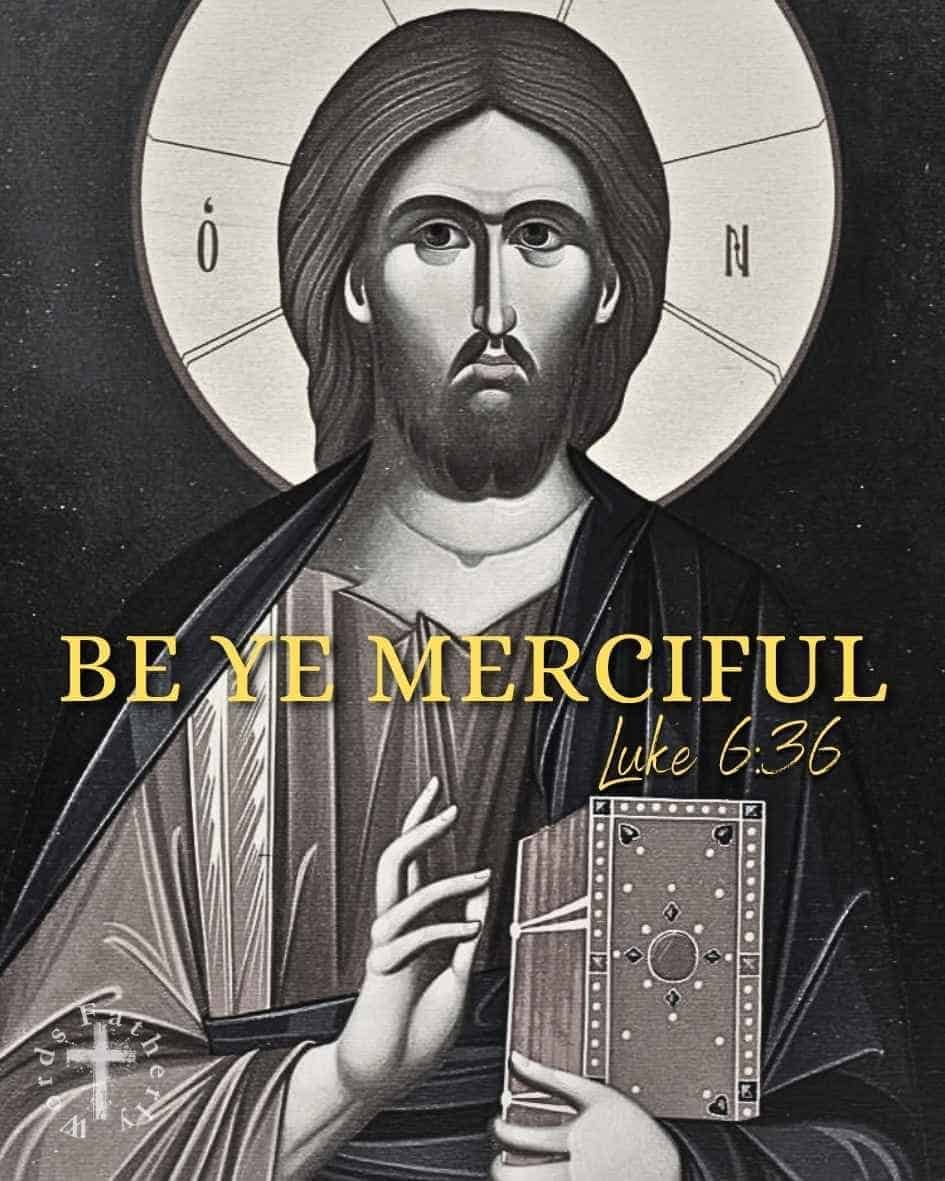
Many pilgrims who stand before the Christ Pantocrator of Saint Catherine’s Monastery, one of the oldest Byzantine religious icons, painted in the 6th century and preserved at the foot of Mount Sinai, notice that His face looks gentle on one side and stern on the other, mercy and truth together in one face.
Our canvas is a faithful reproduction of this icon, an original and deeply meaningful gift for faithful Christians that makes a lasting difference in a home, and the code WELCOME-10 gives you 10% off.

The Good Samaritan Is Christ: What the Holy Fathers Saw in the Parable
The Church has never read this parable only as a moral lesson. It is also the story of our salvation, and the Holy Fathers read it on both levels at once.
The command to love is real. But we cannot love like the Samaritan unless the Samaritan has first loved us.
Christ is that Samaritan. He came down from heaven to the place where humanity lay wounded. When His opponents said, “Say we not well that thou art a Samaritan, and hast a devil?” (John 8:48), He answered, “I have not a devil” (John 8:49), and He did not reject the other name.
An old Christian tradition adds that the name Samaritan is linked with the idea of keeping or guarding. If so, the parable answers Cain’s question in the fullest way: the true Keeper of mankind is Christ.
He did not fear the danger of the road. He came near, healed our wounds, and loved us to the end. His love shone fully on the Cross, where He prayed, “Father, forgive them; for they know not what they do” (Luke 23:34).
He became the good Samaritan for us, and He asks us to learn to love the way He loved: “This is my commandment, That ye love one another, as I have loved you” (John 15:12).
Good Samaritan Symbolism in the Orthodox Church: What Each Detail Means
Here is how the Holy Fathers read each detail of the parable. Every one points to our salvation.
- The wounded man: Adam, and all of us in him.
- Jerusalem: paradise, the place of peace and life with God.
- Jericho: the fallen world, where we suffer and die.
- The robbers: the devil and his demons, who strip us of grace and leave wounds of sin.
- Half dead: alive as a person made in the image of God, yet dead to the life of grace.
- The priest and the Levite: the Law and the Prophets, which revealed the sickness but could not heal it.
- The Samaritan: Christ, who “came unto his own, and his own received him not” (John 1:11).
- The bound wounds: our sins and passions, which Christ heals when we repent.
- The oil and wine: the healing Mysteries of the Church, the oil of anointing and the wine of Holy Communion, and also the mercy that soothes and the truth that cleanses.
- His own beast: His own body. Christ “his own self bare our sins in his own body on the tree” (1 Peter 2:24), and He carries the wounded man.
- The inn: the Church, which receives every wounded traveler.
- The host: the Apostles and the pastors of the Church, entrusted with the care of the sick.
- The two pence: the two Testaments, the treasure of Scripture given for our healing.
- “At my return”: the Second Coming, when Christ repays what was done for the wounded, and more.
None of these meanings cancels the literal one. The Fathers do not use the symbols as a reason to walk past a real person on a real road. The deeper reading gives the command its strength, because we are asked to love as we were loved.
The Lord promises to repay every act of mercy, and He counts it as done to Him: “Inasmuch as ye have done it unto one of the least of these my brethren, ye have done it unto me” (Matthew 25:40).
The Church Is the Inn: How Christ Heals the Wounded Today
In the parable, the Samaritan does not leave the man by the road, and he does not heal him alone. He brings him to an inn. The Orthodox Church understands herself in this way: a place where wounded people are received, treated, and kept until the Lord returns.
Christ says, “They that be whole need not a physician, but they that are sick” (Matthew 9:12). The Church is not a gathering of the perfect. She is a hospital for the sick.
The medicine is concrete.
- In Confession, we uncover our wounds and hear that God forgives.
- In Holy Communion, we receive the Body and Blood of Christ.
- In Holy Unction, we are anointed with oil for the healing of soul and body.
Prayer, fasting, and almsgiving are the daily treatment. All of it is Christ’s own healing, given through those He entrusted with the care of His people.
This matters because “Jesus Christ the same yesterday, and to day, and for ever” (Hebrews 13:8). Times change, but human hearts and human wounds do not. The Samaritan who met the traveler on the road to Jericho is the same Lord who meets us now. If you are wounded by sin, grief, or fear, the Church is the inn He prepared for you.
If you are new to Orthodoxy, a simple first step is to visit a parish on Sunday and ask the priest about Confession and Holy Communion. The doors are open to the wounded.
How to Live the Parable of the Good Samaritan Today: 7 Practical Steps
Christ ends the parable with a command: “Go, and do thou in like manner” (v. 37). Here is what that can look like this week.
- Look at who is on your road. The priest saw and looked away. The Samaritan saw and came near. Each morning, ask who around you is hurting: a neighbor, a coworker, a relative, a classmate.
- Begin at home. Love is hardest with the people closest to us. Notice how you speak to them and how you treat them, and offer a gentle word, a patient silence, or practical help.
- Give time, not only money. The Samaritan interrupted his journey. A phone call, a hospital visit, a ride, or an hour of listening can cost more than a donation, and it often heals more.
- Help wisely. He used what he had, and he also brought the man to the innkeeper instead of carrying everything alone. Connect people with the right help, such as a doctor, a food pantry, or your parish, and be sensible about your own safety.
- Serve someone you find hard to love. The Samaritan helped a man from the people who despised his own. Pray for the person who hurt you, and then do one concrete good for him (Matthew 5:44).
- Join fasting with almsgiving. During the Nativity Fast and every fast, set aside what you save and give it to someone in need. “He that hath pity upon the poor lendeth unto the LORD; and that which he hath given will he pay him again” (Proverbs 19:17).
- Let Christ heal you first. Go to Confession, receive Holy Communion as your priest guides you, and pray the Jesus Prayer: “Lord Jesus Christ, Son of God, have mercy on me, a sinner.” A heart healed by Christ has more mercy to give.
Not every wound can be seen, and the restless anxiety of modern life is one of them, which is why many Orthodox Christians turn to certain Psalms of David and to the prayers of Saint Arsenios the Cappadocian when worry will not let go.
Enter your email in the form below, and the free ebook with those Psalms and prayers will arrive in your inbox.
Frequently Asked Questions About the Good Samaritan (Luke 10:25-37)
Who is the Good Samaritan in the Bible?
The Good Samaritan is the traveler in Jesus’ parable in Luke 10:25-37 who stops to heal a wounded stranger when a priest and a Levite pass by. On the literal level, he is a model of mercy. In Orthodox understanding, he is Christ Himself, who comes down to heal fallen humanity.
What is the meaning of the parable of the Good Samaritan?
Jesus teaches that our neighbor is anyone in need, and that we become a neighbor by showing mercy at a cost to ourselves. The Fathers add that the parable tells the story of salvation: Christ finds mankind wounded by the devil, heals us, and entrusts us to the Church.
Why did the priest and the Levite not help the wounded man?
The reading does not give their reasons. Possible reasons include fear of the robbers, hurry, or concern about ritual uncleanness from touching a body that seemed dead. Whatever the reason, Christ shows that religious duty without mercy fails the test of love: “I will have mercy, and not sacrifice” (Matthew 9:13).
What do the oil and wine symbolize in the Good Samaritan?
Oil soothes and wine cleanses, and together they were a familiar treatment for wounds. The Church sees in them the healing Mysteries, the oil of anointing and the wine of Holy Communion, and also the mercy and truth with which Christ heals us.
Why were the Jews and Samaritans enemies?
They differed over where and how to worship God. The Jews worshiped in Jerusalem, the Samaritans on Mount Gerizim, and the two peoples avoided each other. John says it in one line: “the Jews have no dealings with the Samaritans” (John 4:9).
What does “Go, and do thou in like manner” mean?
It is Christ’s command to every Christian to show active, costly mercy to anyone in need, without asking whether the person is a friend, a stranger, or an enemy. It begins with one concrete act this week, not with a general feeling of goodwill.
What is the Gospel reading for the 8th Sunday of Luke?
In the Orthodox Church, the Gospel reading for the 8th Sunday of Luke is Luke 10:25-37, the parable of the Good Samaritan. It is read in mid-November, near the beginning of the Nativity Fast.
Final Thoughts on Luke 10:25-37: Go and Do in Like Manner
Luke 10:25-37 asks the lawyer, and each of us, to stop defining who deserves our love and to become a neighbor. It also shows us the One who first became our neighbor: the Good Samaritan who found us wounded, healed us with His mercy and truth, and placed us in the inn of His Church until He returns. “We love him, because he first loved us” (1 John 4:19). “Go, and do thou in like manner.” Amen.
